Alkenes (AQA A-Level Chemistry): Revision Notes
📚Revision Notes
3.4.5 Addition Polymers
Note
Addition polymers involve the formation of long chains of repeating units from monomers, particularly alkenes or substituted alkenes. This note will cover the formation, properties, and uses of addition polymers.
Formation of Addition Polymers
What are Addition Polymers?
Addition polymers are created through addition polymerisation, where small unsaturated molecules called monomers (often alkenes) join together to form a larger molecule called a polymer. In this reaction, the double bonds in the monomers break, allowing them to link together without producing any by-products.
Note
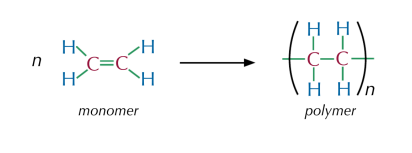
Example: Ethene to Poly(ethene)
Ethene () is a simple alkene with a double bond.
When ethene undergoes addition polymerisation, the double bonds break, and many ethene molecules join to form poly(ethene), commonly known as polyethylene.
Equation for Polymerisation:
Here, represents a large number of repeating units.
Making Poly(phenylethene) from Phenylethene
Polymerisation of phenylethene involves breaking the bond, resulting in the formation of poly(phenylethene). The presence of a bulky benzene ring makes it less tightly packed, leading to weaker intermolecular forces and greater flexibility compared to poly(ethene).
Structure of Addition Polymers
Repeating Units
The repeating unit of a polymer is the smallest section that repeats throughout the polymer chain. It is derived from the original monomer but without the double bond.
Drawing Repeating Units from a Monomer

- Identify the structure of the monomer.
- Remove the double bond and ensure the molecule is single-bonded.
- Enclose the repeating unit in brackets and add subscript 'n' to denote repetition.
Note
Example: Poly(chloroethene) from Chloroethene Monomer:
Repeating Unit:
Drawing the Monomer from a Repeating Unit
To identify the monomer:
- Locate the repeating unit.
- Remove the terminal bonds and add a double bond between the carbon atoms.
Naming Addition Polymers
IUPAC nomenclature dictates that polymers are named by prefixing the monomer's name with 'poly'. For instance:
- Ethene becomes poly(ethene).
- Propene becomes poly(propene).
- Chloroethene becomes poly(chloroethene) (commonly PVC).
Properties of Addition Polymers
Why are Addition Polymers Unreactive?
Addition polymers are generally unreactive due to:
- Saturation: The carbon chain consists entirely of single bonds (), which are stable.
- Non-polar Nature: Most polymers have non-polar carbon chains, reducing their chemical reactivity.
Intermolecular Forces in Polyalkenes
- Van der Waals Forces: These are the primary intermolecular forces between non-polar polymer chains. The longer and less branched a polymer, the stronger these forces.
- Permanent Dipole-Dipole Interactions: In polymers like PVC, where there are polar groups, additional dipole-dipole forces contribute to rigidity.
Impact on Physical Properties:
- High melting and boiling points due to strong intermolecular forces.
- Flexibility and rigidity depend on the chain length and branching.
Common Addition Polymers and Their Uses
Poly(ethene) (PE)
- Monomer: Ethene ()
- Properties: Lightweight, flexible.
- Uses: Plastic bags, film wrapping (Low-Density Polyethene - LDPE), and kitchenware (High-Density Polyethene - HDPE).
Poly(phenylethene) (Polystyrene)
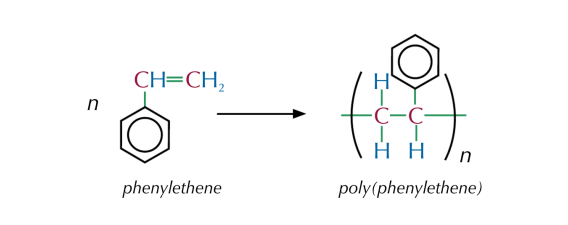
- Monomer: Phenylethene (styrene).
- Properties: Lightweight, good insulator, brittle when solid.
- Uses: Packaging materials, insulation, disposable containers.
Poly(chloroethene) (PVC)
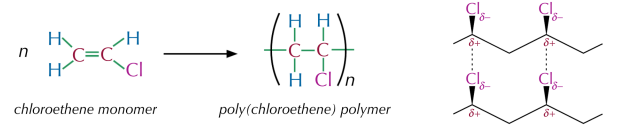
- Monomer: Chloroethene ()
- Properties: Durable, resistant to water, electrical insulator.
- Modification: Adding plasticisers makes PVC flexible.
- Uses:
- Without plasticiser: Drain pipes, window frames.
- With plasticiser: Electrical cable insulation, raincoats, flexible flooring.
Historical and Industrial Context
The understanding and production of polymers have advanced significantly over time:
- Initially, natural polymers like rubber and cellulose were used.
- The development of synthetic polymers (like PVC and poly(ethene)) has transformed industries from packaging to construction.
- Research continues into making polymers more sustainable, including biodegradable options and recycling processes.
Drawing Skills for Exams
Drawing a Repeating Unit from a Monomer
- Step 1: Identify the monomer structure.
- Step 2: Remove the double bond and connect the carbons.
- Step 3: Enclose the repeating unit in square brackets and add 'n'.
Drawing a Polymer Section from a Monomer
- Extend the repeating unit into a chain.
- Show multiple repeats clearly.
Converting Polymer Sections Back to Monomers
- Remove terminal bonds.
- Reintroduce a double bond to create the original monomer structure.