Alcohols (AQA A-Level Chemistry): Revision Notes
📚Revision Notes
3.5.4 Elimination Reactions of Alcohols
Note
Elimination reactions are a fundamental aspect of organic chemistry: the elimination of water (dehydration) from alcohols to form alkenes. This process is essential for producing alkenes that can be used in the synthesis of polymers without relying on crude oil derivatives.
What is an Elimination Reaction?
Note
An elimination reaction involves the removal of a small molecule from a larger one, resulting in the formation of a double bond. When alcohols are dehydrated, the small molecule removed is water (H₂O).
Dehydration of Alcohols
Dehydration is a type of elimination reaction where water is eliminated from an alcohol to form an alkene. This reaction is typically catalysed by an acid.
General Reaction
Conditions for Dehydration of Alcohols
Typical Conditions
- Temperature: 170°C for ethanol.
- Catalyst: Concentrated sulfuric acid () or phosphoric acid (). These conditions provide enough energy to remove water from the alcohol, forming a double bond between carbon atoms.
Note
Example: Dehydration of Ethanol
Ethanol can be dehydrated to form ethene, a basic alkene.
Equation:
This is the reverse of the acid-catalysed hydration reaction where ethene is hydrated to form ethanol.
Mechanism for the Elimination of Water
The mechanism for the dehydration of alcohols follows these general steps:
- Protonation: The group of the alcohol is protonated by the acid catalyst, converting it into a better leaving group ().
- Loss of Water: The protonated group leaves, forming a carbocation intermediate.
- Formation of Double Bond: A hydrogen atom from a neighbouring carbon is removed, and a double bond forms between the carbon atoms, creating the alkene.
Mechanism Steps for Ethanol to Ethene:
- Protonation: Ethanol is protonated by , forming
- Loss of Water: Water () is removed, forming a carbocation:
- Formation of Ethene: A hydrogen is removed from the adjacent carbon, and a double bond forms, resulting in ethene.
Products of Dehydration Reactions
Symmetrical vs. Unsymmetrical Alcohols
- Symmetrical Alcohols (like ethanol): Produce a single product since there is only one possible position for the double bond.
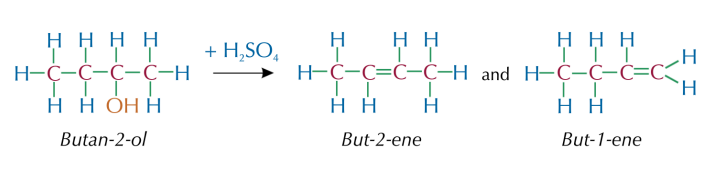
- Unsymmetrical Alcohols (like butan-2-ol): Can produce multiple products because the double bond can form in different positions.
Note
Example: Dehydration of Butan-2-ol
When butan-2-ol is dehydrated, the following products are possible:
- But-1-ene: Double bond at the first carbon.
- But-2-ene: Double bond at the second carbon. But-2-ene has cis and trans isomers due to restricted rotation around the double bond.
Applications of Dehydration of Alcohols
Producing Alkenes for Polymers
Alkenes produced through the dehydration of alcohols can be used to create addition polymers. This provides a sustainable alternative to using alkenes derived from crude oil, supporting a more environmentally friendly chemical industry.
Note
Practical Example: Preparation of Cyclohexene from Cyclohexanol
Procedure
- Dehydration: Cyclohexanol is mixed with concentrated phosphoric or sulfuric acid and heated under reflux to eliminate water and form cyclohexene.
- Separation: The crude cyclohexene is separated from the mixture using a separating funnel.
- Purification: Cyclohexene is purified by distillation, which separates it from any remaining impurities based on boiling points.
Key Points for Laboratory Practice
- Always use appropriate safety measures when handling acids and heating alcohols.
- Reflux and distillation help manage reaction conditions and ensure pure product isolation.
Note
Summary
- Elimination reactions remove a small molecule (usually water) to form a double bond.
- Acid-catalysed dehydration of alcohols produces alkenes, a useful method for generating sustainable resources for polymer production.
- Reaction Mechanism involves protonation, loss of water, and formation of a double bond.
- Unsymmetrical alcohols can lead to multiple products, including isomers.