Mass Number & Isotopes (AQA A-Level Chemistry): Revision Notes
📚Revision Notes
1.1.2 Mass Number & Isotopes
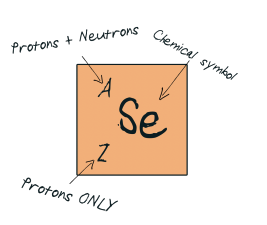
The mass number and atomic number are fundamental to understanding atomic structure, allowing us to calculate the number of protons, neutrons, and electrons in atoms and ions, while isotopes are variants of the same element that differ in their number of neutrons.
Key Concepts
Atomic Number ()
Note
The atomic number is the number of protons in the nucleus of an atom. It defines the identity of an element.
For example, selenium (Se) has an atomic number of 34, meaning it has 34 protons.
Mass Number ()
Note
The mass number is the total number of protons and neutrons in the nucleus. This determines the isotope of an element.
For example, an isotope of selenium could have 34 protons and 45 neutrons, giving it a mass number of 79.
Isotopes
Note
Atoms of the same element that have the same number of protons but different numbers of neutrons. Isotopes behave similarly in chemical reactions but have different physical properties, such as mass.
For example, selenium has several isotopes, such as Se-79 and Se-80. Both have 34 protons but a different number of neutrons.
Relative Atomic Mass
Note
The average mass of an atom of an element, taking into account all its isotopes and their relative abundances, compared to 1/12 of the mass of a carbon-12 atom.
Relative Isotopic Mass
The mass of a specific isotope of an element relative to 1/12 of the mass of carbon-12.
How to Calculate Protons, Neutrons and Electrons in Atoms and Ions
Atoms and ions consist of three types of subatomic particles: protons, neutrons, and electrons. You can work out how many of each are present using atomic and mass numbers.
Protons
Note
The number of protons is the atomic number (). For every element, the number of protons is fixed. For example, in selenium (Se), , meaning selenium always has protons.
Neutrons
You can find the number of neutrons by subtracting the atomic number from the mass number ().
For example, if selenium has a mass number of 79 (Se-79), it would have:
Electrons
Note
In a neutral atom, the number of electrons is equal to the number of protons. So, selenium in its neutral state has 34 electrons.
For ions, the number of electrons changes depending on the charge.
Positive ions (cations)
Note
If the atom loses electrons, the ion has fewer electrons than protons. For example, means selenium has 2 fewer electrons, so it would have electrons.
Negative ions (anions)
Note
If the atom gains electrons, the ion has more electrons than protons. For example, would have electrons.
Note
Example: Let's calculate the number of fundamental particles in (chloride ion).
Chlorine (Cl) has an atomic number of 17, meaning it has 17 protons.
The mass number of -35 is 35.
-
Neutrons: 35 - 17 = 18 neutrons.
-
Electrons: Since is a negative ion, it has gained 1 extra electron. So, 17+1=18 electrons. So, for :
-
Protons: 17
-
Neutrons: 18
-
Electrons: 18
The Existence of Isotopes
Note
Isotopes are atoms of the same element that have the same number of protons (since they are the same element) but different numbers of neutrons, leading to different mass numbers.
For instance:
- Se-79 has 34 protons and 45 neutrons.
- Se-80 has 34 protons but 46 neutrons.
Key Points About Isotopes
- Isotopes have the same chemical properties because chemical behaviour is determined by the number of protons and electrons (which remain the same).
- Isotopes have different physical properties, like mass, which can affect things like melting points or density.
Note
Summary Tips:
- Protons = Atomic number ()
- Neutrons = Mass number () - Atomic number ()
- Electrons: Same as protons unless the atom is an ion, then adjust for charge.