Government Failure (AQA A-Level Economics): Revision Notes
📚Revision Notes
Government Failure
What is government failure?
When markets fail, governments often step in to try to fix the problem through various interventions like taxes, regulations, or subsidies. However, government intervention doesn't always improve the situation. Sometimes, when the government tries to correct a market failure, it can actually make things worse.
Note
Government failure happens when government intervention reduces economic welfare, resulting in an allocation of resources that is worse than the free-market outcome. In other words, the government's attempt to help ends up creating new problems or making existing ones worse.
Understanding the problem
Earlier in your studies, you learned about market failures like externalities and merit goods. The assumption was that appropriate government intervention could reduce or eliminate these market failures. However, there's another possibility to consider: when the government intervenes in the economy to reduce or correct market failure, its intervention may lead to the appearance of other forms of resource misallocation.
Let's look at an example with education. Governments often provide free state education because they view it as a merit good and want to increase consumption. The socially optimal level of education provision () is higher than what markets would probably provide on their own (). However, government intervention doesn't automatically ensure that is actually achieved.
Note
Several issues can arise:
- The government may lack perfect information about what the socially optimal level actually is
- Some argue that free state education leads to over-provision because people consume more when the price is zero
- Others believe that state education quality is poorer than private education, creating another form of government failure
Reasons for government failure
There are several key reasons why government intervention might fail to improve economic welfare. Understanding these will help you analyse real-world policy decisions critically.
The pursuit of conflicting policy objectives
Governments must balance many different objectives, and these don't always align with each other. This can lead to poor decision-making and resource misallocation.
A good example involves government investment decisions. When governments want to expand the economy, they might approve long-term investment projects such as building new roads. However, they might later cancel these projects because they feel the need to contract the economy in response to changing economic conditions. This short-term thinking comes at the expense of long-term benefits.
Important
Government decisions are often criticised for favouring short-termism over long-term planning. Examples from the UK include debates over:
- Whether to permit construction of a third runway at Heathrow airport
- Whether to expand Gatwick or Stansted airports
- Whether to proceed with the High Speed 2 (HS2) railway line
Free-market economists tend to view such government expenditure as unnecessary, while interventionist economists argue that it's fully justified because it leads to better eventual outcomes. The conflict between these different policy goals can result in inefficient resource allocation.
Administrative costs
Government intervention in the economy comes with significant costs that taxpayers must bear. When governments try to correct market failures, they often create unnecessary layers of bureaucracy.
These administrative costs include:
- Setting up new government departments and agencies
- Employing civil servants to manage and enforce policies
- Creating and maintaining regulatory systems
- Monitoring and compliance activities
Important
If these costs are high relative to the benefits achieved, then this represents government failure. The money spent on administration could have been used more productively elsewhere in the economy. The UK government has faced criticism for the high costs it incurs when making major infrastructure and policy decisions.
The 'law of unintended consequences'
This concept, which has become very fashionable in recent years, suggests that whenever the government intervenes in the market economy, effects will be unleashed that policy-makers had not foreseen or intended.
Sometimes these unintended effects may be advantageous to the economy, while in other instances they may be harmful but relatively innocuous. However, problems arise when government intervention triggers harmful consequences that are greater than the benefits the government intervention was supposed to promote.
Note
The key principle: Government activity can be justified when the social benefits of intervention exceed the social costs, contributing to a net gain in economic welfare. However, if well-intentioned government intervention triggers harmful consequences greater than the intended benefits, then government failure results.
Important
Exam tip: It's important to avoid confusing government failure with market failure in your exam. Government failure can be the result of government intervention to correct cases of market failure, but the two concepts are distinct.
Examples of possible government failure
Let's examine some specific cases where government intervention has led to unintended negative consequences.
Government price controls create black markets
Price controls are a common form of government intervention, but they can create significant problems. In Section 8.9, you learned how a price ceiling or maximum price law can create excess demand in a market. This excess demand is then relieved through trading in an informal or shadow market - in other words, a black market.
Price ceilings are normally implemented to protect consumers from high prices. However, several issues can arise:
Note
The market forces argument: The rising price of a product may simply reflect natural market forces and changing supply or demand conditions. A higher price might be needed to:
- Create incentives for consumers to economise on consumption
- Encourage firms to divert more scarce resources into producing the good
The price ceiling may prevent these necessary market adjustments from happening.
Wrong signals and incentives: The controlled price can send out incorrect signals and create the wrong incentives, thus contributing to resource misallocation. Because it may be a criminal activity to break the price law, black markets are sometimes characterised by corruption and the threat of illegal force.
The free-market perspective: Economists who favour free markets often defend black markets by arguing they do the job that the primary market should do. They claim that black markets equate demand with supply. A price ceiling prevents the primary market from working properly, they argue. The touts and dealers who operate as middlemen in the black market or underground economy contribute to better resource allocation, although their contribution wouldn't be needed if there were no price controls in the first place. A black market or secondary market only comes into existence because price controls distort the primary market.
Case study: the landfill tax and government failure
Government policies designed to reduce negative externalities can sometimes have serious unintended consequences. The landfill tax in the UK provides an excellent example of this problem.
Example
Case Study: The UK Landfill Tax
Background: Almost every economic activity produces waste, including household rubbish and waste from building and construction. A large proportion of UK waste is either incinerated (which discharges pollutants into the atmosphere) or collected by local government and placed in landfill sites. Landfills cause pollution by releasing gases such as carbon dioxide and methane, and further problems arise as available landfill sites fill up.
The policy: In 1996, the UK government imposed a landfill tax, hoping it would create jobs and reduce waste. The tax was meant to discourage people from using landfill sites by making it more expensive to dispose of waste.
The unintended consequence: Instead of achieving its goals, the tax led to a significant increase in illegal fly-tipping. Building contractors and some households began to dump rubbish in public places and on other people's land. This was an adverse consequence of a tax that was intended to improve the environment.

Many people blame the controversial landfill tax for the rise in organised unauthorised dumping. The tax increased the costs of taking waste to licensed sites significantly. The cost of getting rid of one truckload of rubble could be as high as $400. Finding alternative dumping grounds, where off-loading costs little or nothing, allows unscrupulous people to make a fortune - but the cost to the environment is immense.
Important
The scale of the problem: Research published in 2022 by the Countryside Alliance uncovered the enormous scale of illegal fly-tipping in England and Wales:
- Illegal fly-tipping costs taxpayers over $392 million per year
- At least 1.13 million incidents of unlawful rubbish dumping were recorded between April 2020 and March 2021
- This works out at almost 130 incidents of fly-tipping every hour - more than two every minute
Low prosecution rates: Typically, only one in 50 cases leads to a prosecution. In cash-strapped rural local authorities, the rate of prosecutions has dropped to just three in every 1,000 cases. When waste is dumped on private land, the owners - despite having no part in the fly-tip - have a duty of care and are bound by law to clear it up on their own time and at their own expense.
The chief executive of the Countryside Alliance noted: "With the government raising the landfill tax and with more cuts coming to council budgets, this problem is only going to get worse."
Example
Worked Example: Calculating Price Elasticity of Demand
Let's examine how changes in waste disposal costs affected demand for landfill space. This helps us understand the economic impact of the landfill tax policy.
The data: Between 2018 and 2022, the government increased its tax on waste disposal. The table below shows how the price of waste disposal at landfill sites changed:
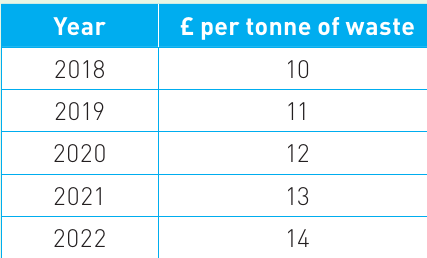
The question: If the quantity of landfill space demanded fell by 10% between 2018 and 2022, what was the price elasticity of demand for landfill space?
The calculation:
Interpretation: Since the elasticity statistic (ignoring the minus sign) was less than 1 or unity, the demand for landfill space was inelastic with respect to the change in price. This means that even with a significant price increase, people didn't reduce their demand for landfill space by much. This inelastic demand helps explain why the landfill tax led to unintended consequences like increased fly-tipping - people still needed to dispose of waste, but the higher legal costs encouraged some to find illegal alternatives.
Remember!
Summary
Key Points to Remember:
-
Government failure occurs when intervention makes resource allocation worse than the free-market outcome, not better.
-
Three main causes of government failure: conflicting policy objectives (like favouring short-term gains over long-term benefits), administrative costs (the expense of running government programmes), and the law of unintended consequences (when policies create unforeseen harmful effects).
-
Price controls can create black markets because they prevent the primary market from functioning properly, leading to informal trading that may involve corruption and illegal activity.
-
The landfill tax case study shows how good intentions can backfire - a tax meant to reduce waste and protect the environment instead led to a massive increase in illegal fly-tipping, costing taxpayers hundreds of millions and harming the environment.
-
Government failure is distinct from market failure - don't confuse them in your exam! Government failure is specifically about when government intervention to fix market problems ends up making things worse.