Government Intervention in Markets (AQA A-Level Economics): Revision Notes
📚Revision Notes
Government Intervention in Markets
Introduction: Why governments intervene in markets
Economists and politicians hold different views about whether governments should intervene in markets. Understanding these perspectives helps explain why different approaches to market problems exist.
Pro-free market economists believe that market forces naturally produce the best outcomes. They argue that the market mechanism, working through price signals in competitive markets, achieves better results than government intervention can deliver. In their view, business owners who risk their own money make better production decisions than civil servants who are protected by job security. They believe competitive markets ultimately serve consumer interests, as consumers know what they want better than governments do. According to this philosophy, government should act as a 'nightwatchman', maintaining law and order, providing public goods when markets fail, and creating a suitable environment for businesses to operate with minimal interference.
Interventionist economists take a contrasting position. They argue that markets are often uncompetitive, dominated by monopoly power, and prone to various market failures. They believe uncertainty about the future and lack of accurate market information destabilize markets. By intervening to correct market failures, governments can achieve better outcomes than unregulated market forces alone. Interventionists argue that government action can anticipate and counter destabilizing forces in markets, producing results superior to those achieved by market forces operating independently.
Note
Key Philosophical Divide:
The debate between pro-free market and interventionist economists represents a fundamental divide in economic thinking. Pro-free market economists trust that competitive forces and price signals will naturally guide markets toward optimal outcomes. Interventionist economists, however, believe markets systematically fail in predictable ways, requiring government action to achieve socially desirable outcomes.
Methods for correcting market failures
Governments have several options for correcting or reducing market failures. At one extreme, government can abolish the market entirely, using command or planning mechanisms financed through general taxation to provide goods and services. At the other extreme, government can try to influence market behavior by providing information and encouraging firms and consumers to act in certain ways, such as avoiding plastic bags.
Between these extremes, governments can impose regulations that limit people's freedom of action in markets. They can also use taxes, subsidies, price ceilings, and price floors to change prices and incentives, thereby altering economic behavior.
Government provision of public goods and merit goods
The free-rider problem means that markets may fail to provide pure public goods such as national defence and police services. When free-riding occurs, the incentive function of prices breaks down. If goods are provided through a market, people can free-ride rather than pay a price. Firms trying to sell these goods cannot make a profit, creating a situation where market provision is impossible.
Given the need for public goods, governments step into this gap and provide them, financing the provision through general taxation.
Similarly, governments discourage production and consumption of negative externalities and demerit goods, while encouraging production and consumption of positive externalities and merit goods. Government may choose to regulate or attempt to change the prices of merit goods and other goods that yield external benefits. Subsidies are frequently used to encourage production and consumption of merit goods.
Regulation can also force consumers to consume merit goods. The government may require people to be vaccinated against disease and to wear seatbelts in cars and crash helmets on motorbikes.
Note
UK Education as a Merit Good:
In the UK, education is both compulsory and completely subsidized for children aged 5 to 18. Low-income families would face impossible situations if they had to pay for education while also sending their children to school. Subsidies can be paid to private providers of education and healthcare, such as private schools and private hospitals. However, in the UK, education and healthcare are primarily provided by the state, forming an important part of public spending. Nevertheless, private-sector provision of merit goods is growing, though this does not necessarily mean good-quality provision.
Forcing firms and consumers to generate positive externalities
The state can impose regulations that force firms and consumers to generate positive externalities. Local authority bylaws can require households to maintain the appearance of properties. The state may order landowners to plant trees, making it illegal not to provide external benefits for others.
Government intervention for negative externalities and demerit goods
There are two main ways governments intervene to correct market failures caused by negative externalities and demerit goods. As with positive externalities and merit goods, government can use regulation and quantity controls. Alternatively, or additionally, government can use taxation.
Regulation and the correction of market failures
Governments use regulations, including compulsory consumption and subsidies, to enforce or encourage production of positive externalities and consumption of merit goods.
Regulation can directly influence the quantity of externality that a firm or household generates, and the level of consumption of a demerit good such as tobacco. In its most extreme form, regulation can completely ban or criminalise the generation of negative externalities such as pollution, or the sale and consumption of demerit goods such as heroin.
However, it may be impossible to produce a good or service, such as electricity in a coal-burning power station, without generating at least some negative externality. Banning the externality completely has the perverse effect of preventing production of the good, such as electricity, as well as the bad effect of pollution.
Important
Limitations of Complete Bans:
Complete bans on negative externalities can have unintended consequences. For example, completely banning pollution from coal-burning power stations would also prevent electricity production. This highlights why quantity controls that fall short of complete bans are often more appropriate than outright prohibition.
Because of this, quantity controls that fall short of a complete ban may be more appropriate. These include:
- Maximum emission limits
- Restrictions on the time of day or year during which negative externalities can legally be produced
- Age restrictions for milder demerit goods
For milder demerit goods, smoking can be banned in public places, while shops would break the law by selling alcohol to younger teenagers.
Taxation and the correction of market failures
Until recently, governments were more likely to use regulation rather than taxation to reduce negative externalities such as pollution and congestion. Indeed, in the past, it was difficult to find examples of pollution taxes outside economics textbooks, possibly because politicians feared pollution taxes would be too unpopular.
However, in recent years, governments have become more prepared to use congestion and pollution taxes. This reflects growing concern among governments and the public about environmental issues such as global warming and problems posed by fossil fuel emissions and other pollutants. It may also reflect both the growing influence of environmental pressure groups, such as Friends of the Earth, and a growing preference to tackle environmental problems with market solutions rather than through regulation.
Completely banning negative externalities and demerit goods represents market replacement rather than market adjustment. By contrast, taxes placed on goods affect incentives which consumers and firms face, providing a market-orientated solution to problems posed by negative externalities and demerit goods.
Note
The Polluter Must Pay Principle:
Taxation compensates for the fact that there is a missing market in the externality. In the case of pollution, the government calculates the money value of the negative externality and imposes this on the firm as a pollution tax. This is known as the polluter must pay principle.
The pollution tax creates an incentive, which was previously lacking, for less pollution to be dumped on others. By setting the tax so that the price consumers pay equals the social cost of producing another unit of the good generating the negative externality, resource allocation in the economy is improved.
However, a pollution tax, like any tax, introduces new inefficiencies and distortions into the market. These are associated with costs of collecting the tax and creating incentives to evade the tax illegally, for example by dumping pollution at night to escape detection. This is an example of government failure.
Important
The Critical Role of Price Elasticity:
The effectiveness of taxation depends significantly on price elasticity of demand. When imposing a tax on a good with fairly elastic demand, the tax is effective in reducing demand for the product. However, due to their addictive properties, demand for demerit goods such as alcohol, tobacco, and hard drugs can be inelastic. In that case, taxing demerit goods can raise substantial revenue for government, but may not significantly reduce consumption. If the tax is set at a very high rate, it may lead to smuggling and black market activity.
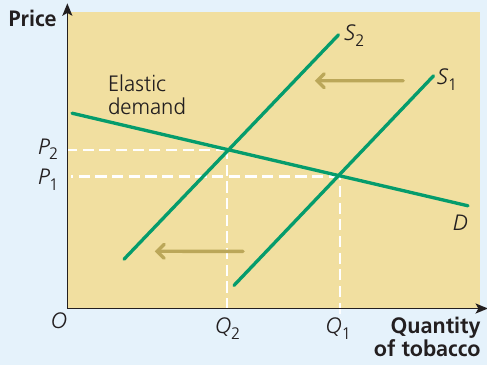
The diagram above illustrates how a tax on tobacco affects the market when demand is elastic. The supply curve shifts leftward from to , representing the tax burden. This causes price to increase from to and quantity to decrease from to . When demand is elastic, the quantity reduction is proportionally larger than the price increase, making the tax effective at reducing consumption.
Note
Exam tip:
Make sure you can analyse the effects of taxes imposed on goods and of subsidies by applying the concept of price elasticity of demand. This will help you understand the effectiveness of taxes and subsidies in moving equilibrium quantity consumed and produced towards the optimum level.
Pollution permits
Until quite recently, the main policy choice for dealing with pollution was between regulation and taxation. The former is an interventionist solution, whereas taxation, based on the polluter must pay principle, has been seen as a more market-orientated solution, but one which nevertheless required government to levy and collect the pollution tax.
In the 1990s, another market-orientated solution emerged in the USA, based on a trading market in permits or licences to pollute. More recently in the UK, the EU Emissions Trading Scheme has become the centrepiece of European efforts to cut emissions.
A 'permits to pollute' scheme for electricity still involves regulation. The government imposes maximum limits on the amount of pollution that coal-burning power stations can emit, followed by a steady reduction in these ceilings each subsequent year, say by 5%. But once this regulatory framework is established, a market in traded pollution permits takes over, creating market-orientated incentives for power station companies to reduce pollution because they can make money from it.
Note
How Tradable Pollution Permits Work:
A tradable market in permits to pollute works by allowing price to be set in the market through interaction of demand for and supply of permits. Energy companies able to reduce pollution by more than the law requires can sell their spare permits to other power stations that, for technical or other reasons, decide not to or cannot reduce pollution below the maximum limit. The latter still comply with the law, even when exceeding the maximum emission limit, because they buy the spare permits sold by the first group of power stations.
In the long run, even power stations finding it difficult to comply with the law have an incentive to reduce pollution, so as to avoid the extra cost of production created by the need to buy pollution permits.
Price controls
Price controls are another method governments use to intervene in markets. There are two main types: price ceilings (maximum prices) and price floors (minimum prices).
Price ceilings or maximum price laws
Perhaps the simplest way a government can impose a price control is through use of a price ceiling or price floor.
Note
Definition: Price Ceiling
A price ceiling is a price above which it is illegal to trade. Price ceilings, or maximum legal prices, can distort markets by creating excess demand.
Suppose, for example, that in a particular market (say, the market for bread), the government imposes a price ceiling or maximum legal price. In a free market, market forces would raise the price and eliminate excess demand. However, because the price ceiling prevents this from happening, there is no mechanism in the market for eliminating excess demand.
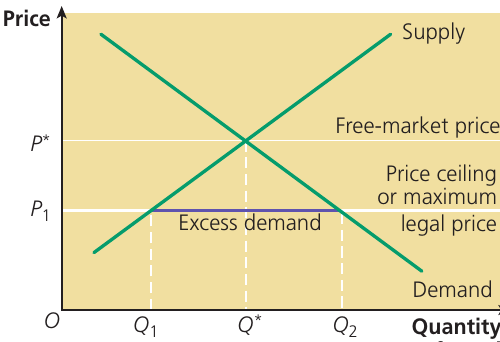
The diagram above shows how a price ceiling creates excess demand in a market. When the maximum legal price () is set below the free-market equilibrium price (), quantity demanded () exceeds quantity supplied (), creating excess demand shown by the distance between these points.
Rather than being rationed by price, households are rationed by quantity. Queues and waiting lists occur, and possibly bribery and corruption through which favored customers buy the good but others do not. Price ceilings also interfere with the incentive function of prices, preventing prices from rising to attract new firms into the market.
Important
Consequences of Price Ceilings:
The emergence of an informal or shadow market, sometimes called a black market, is also likely. Secondary markets emerge when primary markets (free markets) are prevented from working properly. A secondary market is a meeting place for lucky and unlucky customers. In the secondary market, some lucky customers who bought the good at the controlled price resell at a higher price to unlucky customers unable to purchase the good in the primary market.
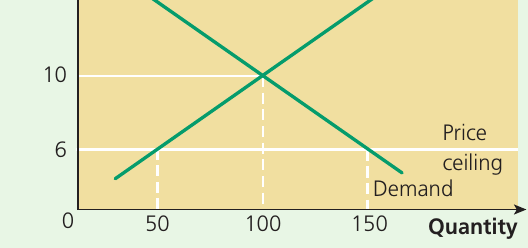
This diagram provides another illustration of how price ceilings work. The price ceiling is set at 6, well below the market equilibrium price of 10, creating a shortage as consumers demand more than suppliers are willing to provide at that price.
Example
Worked Example: Calculating Effects of a Price Ceiling
At any price charged for a good, the money value of the good bought and sold is calculated by multiplying price by quantity: .
Step 1: Calculate spending at equilibrium
- At a good's equilibrium price of $10, 100 units are bought and sold
- Amount spent = \10 \times 100 = $1{,}000$
Step 2: Calculate spending with price ceiling
- When a price ceiling of $6 is imposed, only 50 units are bought and sold
- Amount spent = \6 \times 50 = $300$
Step 3: Interpret the result
- The money spent on the good falls to $300, even though consumers would like to buy 150 units at this price
- This demonstrates how price ceilings reduce both the quantity traded and total market value
Price floors or minimum legal prices
Note
Definition: Price Floor
A price floor is a price below which it is illegal to trade. Price floors, or minimum legal prices, can distort markets by creating excess supply.
Sometimes governments impose minimum price laws or price floors. For a minimum price law to affect a market, the price floor must be set above the free-market price.
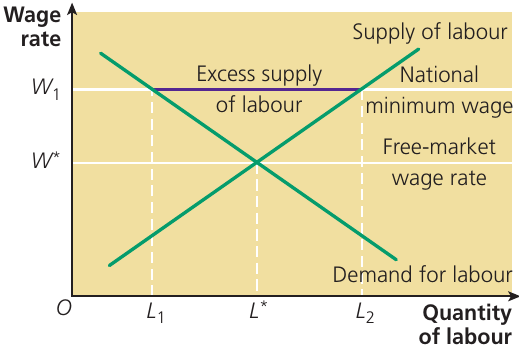
The diagram above illustrates the possible effect of a national minimum wage imposed in UK labour markets. A national minimum wage rate set at (which is above the free-market wage rate ) creates an excess supply of labour, causing unemployment equal to the distance between and . It may also cause rogue employers to break the law, for example by paying 'poverty wages' to vulnerable workers such as illegal immigrants.
Important
When Price Floors Have No Effect:
Note that whereas a price ceiling imposed above the free-market price would have no effect on the price at which bread is traded in the market, a national minimum wage set below the free-market wage rate would have no effect on unemployment. This is the situation in many UK labour markets.
As with price ceilings, price floors interfere with the incentive function of prices. Falling prices cause inefficient or high-cost firms to leave the market. A price floor prevents this from happening.
Note
Exam tip:
Make sure you can describe and explain at least three ways in which government intervention can affect the price of a good or service. This will help you produce an extended response to questions on methods of intervention to tackle market failure.
Summary
Key Points to Remember:
-
Two economic perspectives exist: Pro-free market economists believe markets work best with minimal government interference, while interventionist economists argue that government can correct market failures and improve outcomes.
-
Multiple intervention methods are available: Governments can provide goods directly, use regulation to control behavior, impose taxes to change incentives, offer subsidies to encourage production, or set price controls to influence market prices.
-
Taxation effectiveness depends on elasticity: Taxes on goods with elastic demand effectively reduce consumption, but taxes on goods with inelastic demand (like demerit goods) may raise revenue without significantly reducing consumption.
-
Price controls create market distortions: Price ceilings set below equilibrium create excess demand, leading to queues and black markets. Price floors set above equilibrium create excess supply, potentially causing unemployment in labour markets.
-
Market-based solutions can complement regulation: Pollution permits create market incentives to reduce negative externalities while maintaining regulatory frameworks, offering a hybrid approach between pure regulation and pure market forces.