Monopoly and Its Power (AQA A-Level Economics): Revision Notes
📚Revision Notes
Monopoly and Its Power
What is a monopoly?
A monopoly occurs when there is only one firm operating in a market. This is known as pure monopoly. In the UK, regional water companies provide a good example of pure monopolies, as each company is the sole supplier of water services in its geographical area.
However, economists often use the term 'monopoly' in a broader sense. It can describe any market where one firm is dominant, even if there are some smaller firms present as well. Throughout this topic, we focus on pure monopoly – where there is genuinely only one firm in the market.
Note
The economic theory of monopoly has been developed by many economists over time. One particularly significant contributor was Joan Robinson, whose 1933 book The Economics of Imperfect Competition was among the first to provide a detailed technical explanation of how firms with monopoly power compete with each other.
Profit maximisation in monopoly
Like all firms, a monopolist aims to maximise profit. The profit-maximising level of output occurs where marginal revenue equals marginal cost (). This is the same fundamental rule that applies to firms in all market structures, including perfect competition.
Important
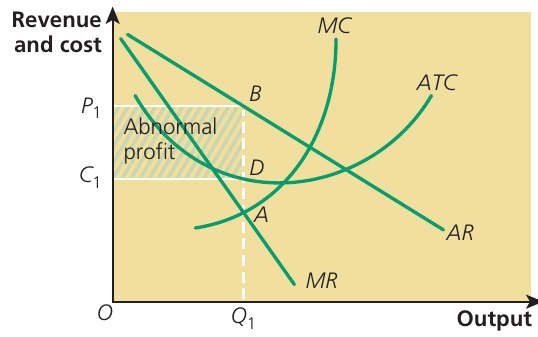
However, there is an important difference in monopoly. While the profit-maximising output is determined where , this does not determine the price. In monopoly, point A (where ) shows the profit-maximising quantity, but the price is found on the demand curve (average revenue curve) above this point.
Example
Understanding the Monopoly Profit Maximisation Diagram
The diagram above illustrates profit maximisation in monopoly. Let's examine each element:
- Output : This is where the MR curve intersects the MC curve (point A). This is the profit-maximising quantity that the monopolist will produce.
- Price : The monopolist charges the maximum price consumers are willing to pay for quantity . This is found on the AR (demand) curve at point B, directly above point A.
- Cost : The average total cost of producing units is shown at point D on the ATC curve.
- Abnormal profit: The shaded rectangular area between price and cost represents the abnormal profit (also called supernormal profit) earned by the monopolist.
Notice that the price the monopolist charges () is above the point where . This is the maximum price the monopolist can charge while still selling output . It is the monopolist's ability to set prices above costs that leads to abnormal profits.
Short-run versus long-run equilibrium
The diagram showing profit maximisation in monopoly does not distinguish between short-run and long-run equilibrium. This is significant because it reveals a fundamental difference between monopoly and perfect competition.
In perfect competition, abnormal profits are temporary. They exist only in the short run because new firms are attracted to enter the market, increasing supply and driving down prices until only normal profits remain in the long run.
Important
In monopoly, however, barriers to entry prevent new firms from entering the market. These barriers protect the monopolist's position and allow abnormal profits to persist in both the short run and the long run. Entry barriers enable the monopolist to preserve abnormal profits by keeping competitors out.
Because of this persistence of abnormal profits, the profit earned by a monopolist is often specifically called monopoly profit. The monopolist has the monopoly power to maintain these profits over time by preventing competition.
Monopoly power
Monopoly power (also known as market power) refers to the ability of a monopoly to raise and maintain prices above the level that would exist under perfect competition. This power to control prices is the defining characteristic of monopoly.
Note
Through monopoly power, the firm can:
- Set prices higher than would be possible in competitive markets
- Maintain these elevated prices over time
- Earn sustained abnormal profits
- Restrict output below the competitive level
It's important to note that monopoly power is not limited solely to pure monopolies. Firms in oligopoly and monopolistic competition can also exercise market power, although usually to a lesser degree than pure monopolies. Any firm that faces a downward-sloping demand curve and can influence the market price has some degree of market power.
The extent of a firm's monopoly power depends on the strength of barriers to entry in its market. The higher and more insurmountable these barriers, the greater the monopoly power and the more sustainable the abnormal profits.
Real-world example: Patents and intellectual property
Patents provide an excellent real-world example of how monopoly power operates in modern economies. Drug companies rely heavily on patent protection to maintain their monopoly positions.
Example
Patents and Drug Companies: Monopoly Power in Practice
Why patents matter for drug companies:
Without patent protection, pharmaceutical companies would struggle to survive. Developing new medicines requires enormous investment in research and development (R&D). If rival companies could immediately copy successful drugs, the original innovator would be unable to recover their development costs. Patents create temporary monopoly power that allows drug companies to charge prices high enough to fund continued innovation.
How drug companies protect their patents:
Multinational pharmaceutical companies take patent protection very seriously. When rivals attempt to breach their patents, they respond aggressively through legal action. They employ teams of specialist lawyers to defend their patents in court.
Companies also use private detectives to protect their intellectual property. As one major drug company chairman explained, these investigators "know the loops in the law" and conduct various operations including:
- Raiding rubbish bins to find evidence
- Tracking down former employees who may have breached confidentiality
- Preparing "sting operations" to catch firms operating with fake or copied products
International challenges:
Patent protection varies significantly across countries. In developed economies, multinational drug companies benefit from strong patent laws that rigorously enforce their intellectual property rights.
However, in developing economies such as India, China, and South America, the infrastructure to enforce property rights is often weaker. This makes protecting patents much more difficult. Drug companies face the challenge that their monopoly power is harder to maintain in these markets, even though the populations there may desperately need access to medicines.
Note
This creates an ethical dilemma: strong patent protection encourages innovation but can make medicines unaffordable in poorer countries.
Summary
Key Points to Remember:
- A pure monopoly exists when there is only one firm in a market, though the term is often used more broadly to describe markets with a dominant firm.
- Monopolists maximise profit where , but price is set from the demand curve above this point, allowing them to charge more than their marginal cost.
- Barriers to entry enable monopolists to maintain abnormal profits in both the short run and long run, unlike in perfect competition where such profits are competed away.
- Monopoly power is the ability to raise and maintain prices above competitive levels, and this power can also be exercised to a lesser degree by oligopolies and monopolistically competitive firms.
- Patents create temporary monopoly power that protects innovation in industries like pharmaceuticals, but enforcement varies internationally, creating challenges in developing economies.