Price, Income, and Cross Elasticities (AQA A-Level Economics): Revision Notes
📚Revision Notes
Price, Income, and Cross Elasticities
The meaning of elasticity
When economists study markets, they need to understand how responsive one variable is to changes in another. This is where the concept of elasticity becomes essential.
Elasticity measures how much one variable changes in proportion to a change in another variable. Think of it as measuring the sensitivity or responsiveness between two economic factors.
For example, imagine a product's price increases by 5%. If consumers reduce their purchases by more than 5%, we say demand is elastic — it responds strongly to price changes. However, if consumers only reduce their purchases by less than 5%, demand is inelastic — it responds weakly to price changes. When the percentage change in quantity exactly matches the percentage change in price, we have unit elasticity of demand.
Note
One useful feature of elasticity is that it's independent of the units we're measuring. Whether we measure price in pounds or dollars, or quantity in kilograms or tonnes, the elasticity value remains the same. This makes elasticity a powerful tool for comparing responsiveness across different markets and contexts.
Types of elasticity
Economists focus on three main types of demand elasticity:
- Price elasticity of demand — measures how quantity demanded responds to price changes
- Income elasticity of demand — measures how quantity demanded responds to income changes
- Cross elasticity of demand — measures how demand for one good responds to price changes in another good
Formulae for calculating elasticities
Each type of elasticity has its own formula:
Price elasticity of demand (PED):
Income elasticity of demand (YED):
Cross elasticity of demand (XED):
Note
Study tip: Remember that elasticities are calculated by dividing the percentage change in quantity demanded (or supplied) by the percentage change in the variable that caused the change. Always use percentage changes, not absolute changes.
Price elasticity of demand
Price elasticity of demand measures how responsive consumers are to price changes for a particular good. It tells us the extent to which quantity demanded changes when price changes.
Sometimes this is called 'own price' elasticity to distinguish it from cross elasticity, which measures responsiveness to changes in the price of a different good.
Important
Exam tip: When analysing the effects of demand or supply curve shifts, always consider elasticity. The impact on price and equilibrium output depends heavily on the price elasticity of the curve that hasn't shifted. For instance, when supply shifts leftwards, the resulting price and quantity changes are determined by the demand curve's price elasticity.
Example
Worked Example: Calculating Price Elasticity
When a small car's price is $15,000, there are 100,000 people in the UK who want to buy it. When the price falls to $10,000, the number wanting to buy rises to 200,000.
Step 1: Calculate percentage change in quantity
Step 2: Calculate percentage change in price
Step 3: Apply the PED formula
Interpretation: The negative value tells us that demand has an inverse relationship with price (as price falls, quantity demanded rises). The value of 3 (ignoring the minus sign) shows demand is elastic.
Infinite and zero price elasticity of demand
At the two extremes of price elasticity, we find demand curves with constant elasticity values at all points.
A perfectly elastic demand curve is horizontal. This shows infinite price elasticity (PED = ∞). Even the tiniest price increase causes quantity demanded to fall to zero. Conversely, any price decrease would cause quantity demanded to rise to infinity.
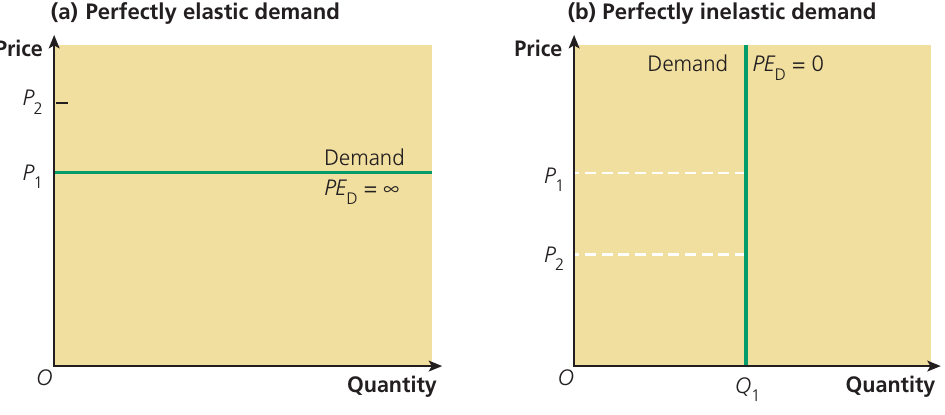
A perfectly inelastic demand curve is vertical. This shows zero price elasticity (PED = 0). When price falls (for example, from P₁ to P₂), the quantity demanded remains completely unchanged. Price changes have no effect whatsoever on quantity demanded.
The five demand curves you need to know
There are five key types of demand curve based on their elasticity:
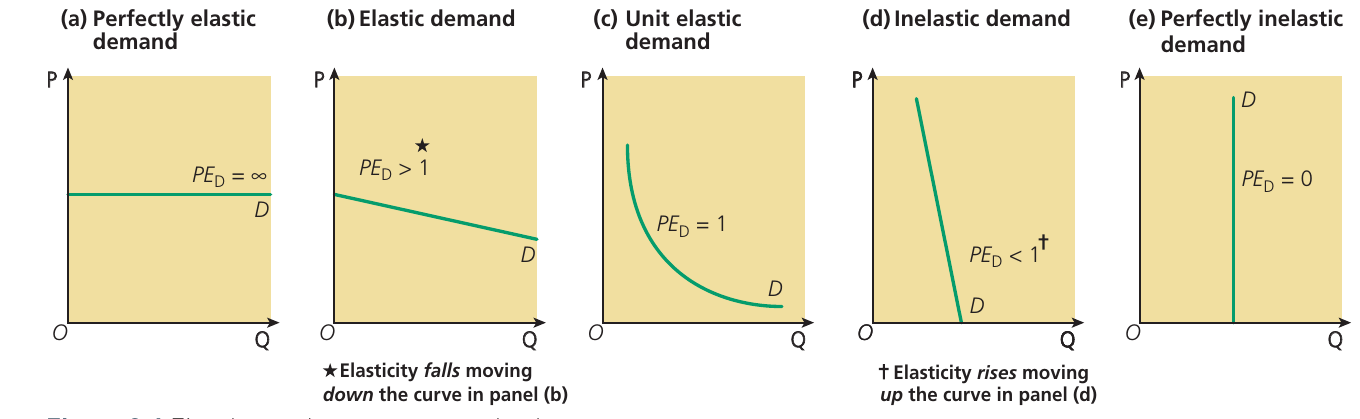
- Perfectly elastic demand (PED = ∞) — horizontal line
- Elastic demand (PED > 1) — relatively flat, downward-sloping curve
- Unit elastic demand (PED = 1) — curved line (rectangular hyperbola)
- Inelastic demand (PED < 1) — relatively steep, downward-sloping curve
- Perfectly inelastic demand (PED = 0) — vertical line
Important
Key distinction: Remember that elastic demand means consumers are highly responsive to price changes, while inelastic demand means they're relatively unresponsive. The steepness of the demand curve provides a visual clue to elasticity.
Factors determining price elasticity of demand
Several key factors influence how elastic or inelastic demand will be for a particular product.
Substitutability
This is the most important determinant of price elasticity. When close substitutes are readily available for a product, consumers can easily switch to alternatives if the price rises. This makes demand highly elastic.
Conversely, when no substitutes or only poor substitutes exist, demand tends to be inelastic. Consumers have limited alternatives, so they continue buying even when prices increase.
Note
For example, if the price of a particular brand of breakfast cereal rises, consumers can easily switch to numerous similar alternatives, making demand for that brand elastic. However, if the price of petrol rises and there are no readily available alternatives for motorists, demand tends to be more inelastic.
Percentage of income
Goods and services that take up a large proportion of household income tend to have more elastic demand than those representing only a small fraction of income.
When items account for only a tiny portion of income, consumers barely notice price changes, especially for goods they rarely purchase. People are less sensitive to price movements for these items.
However, for 'big-ticket' purchases like new cars or overseas holidays that consume a significant portion of income, consumers are much more responsive to price changes. They pay close attention to prices and adjust their purchasing decisions accordingly.
Necessities or luxuries
There's a common belief that demand for necessities is price inelastic, while demand for luxuries is elastic. However, this statement requires careful consideration.
When no obvious substitute exists, demand for a luxury good may actually be inelastic. At the other extreme, demand for particular types of basic foodstuff can be elastic if other staple foods are available as substitutes.
Important
The key point is that the existence of substitutes really determines price elasticity, not whether the good is classified as a luxury or necessity.
The 'width' of the market definition
The broader the market definition under consideration, the lower the price elasticity of demand.
For example, demand for bread from a particular bakery is likely more elastic than demand for bread from all bakeries. This is because bread from other bakeries provides close substitutes for bread from just one bakery.
If we widen the market definition further, demand for bread produced by all bakeries will be more elastic than demand for food as a whole. Different foods can substitute for each other, but at the level of all food, there are fewer alternatives available.
Time
The time period in question significantly affects price elasticity of demand.
Short run refers to the time period when at least one factor of production is fixed and cannot be varied. Long run refers to the time period when no factors are fixed and all factors of production can be varied.
For many goods and services, demand is more elastic in the long run than in the short run. This is because it takes time for consumers to respond to price changes.
Note
For example, if electric cars become relatively cheaper compared to petrol cars, it takes time for motorists to respond. They're 'locked in' to their existing petrol car investments in the short run. However, over the long run, they can switch to electric vehicles as they replace their cars.
In other circumstances, the response might be greater in the short run than the long run. A sudden rise in petrol prices might cause motorists to economise on petrol use for a few weeks before getting used to the higher price and drifting back to their old motoring habits.
Case study: elasticity and tobacco taxation
Various studies have calculated the price elasticity of demand for cigarettes across different groups in society, including young and old smokers, and men and women.
Note
Research findings: A World Bank review found that a 10% price increase would on average reduce tobacco consumption by about 4% in richer countries. Smokers in poorer nations tend to be more sensitive to price changes.
One comprehensive review analysed 86 studies and found a mean price elasticity of -0.48. This means that, on average, a 10% increase in cigarette prices leads to a 4.8% decrease in consumption.
The research also found greater price responsiveness among younger people, with an average price elasticity of -1.43 for teenagers, -0.76 for young adults, and -0.32 for adults.
These studies reveal that adult smokers have an average price sensitivity between -0.50 (men) and -0.34 (women), with lower-income groups showing greater price sensitivity.
Follow-up considerations:
- The formula PED = percentage change in quantity demanded / percentage change in price is used for these calculations.
- Income elasticity and cross elasticity of demand are the other two types besides price elasticity.
- Adult smokers may be less responsive than teenagers because of stronger addiction and higher disposable incomes. Teenagers are more price-conscious and haven't developed such strong habits.
- These elasticity statistics between zero and -1 indicate inelastic demand, which is significant for governments. Tax increases on cigarettes will raise substantial revenue because consumption doesn't fall proportionately. This helps fund public health initiatives.
Price elasticity of demand, total consumer expenditure and firms' total revenue
There's a useful rule for determining the general nature of elasticity between two points on a demand curve without using the formula.
- If total consumer expenditure increases in response to a price fall, demand is elastic
- If total consumer expenditure decreases in response to a price fall, demand is inelastic
- If total consumer expenditure remains constant in response to a price fall, demand is neither elastic nor inelastic (i.e. elasticity = unity, or since the demand curve slopes downwards, elasticity = minus unity or -1)
Consider the elastic demand curve shown below:
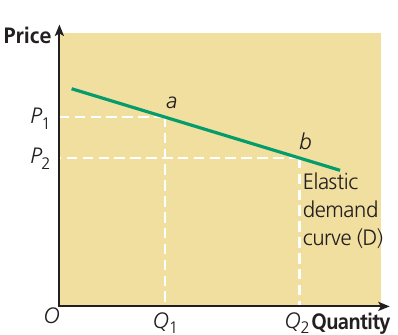
At price P₁, total consumer expenditure is shown by the rectangle bounded by P₁, point a, Q₁ and the origin O. When price falls to P₂, the consumer expenditure rectangle changes to the area bounded by P₂, point b, Q₂ and O. The second rectangle is clearly larger than the first, so total consumer expenditure increases following a price fall. This confirms the demand curve is elastic.
Note
Study tip: Total consumer expenditure is exactly the same as firms' total sales revenue. We can therefore state this rule in terms of revenue rather than consumer expenditure. When demand is elastic, a price decrease leads to an increase in total revenue. When demand is inelastic, a price decrease leads to a decrease in total revenue.
Unit elastic demand and expenditure
When demand has unit elasticity, total expenditure remains unchanged following a price change. This special case occurs when the demand curve is a rectangular hyperbola — a specific curved line where the proportionate change in quantity demanded exactly equals the proportionate change in price.
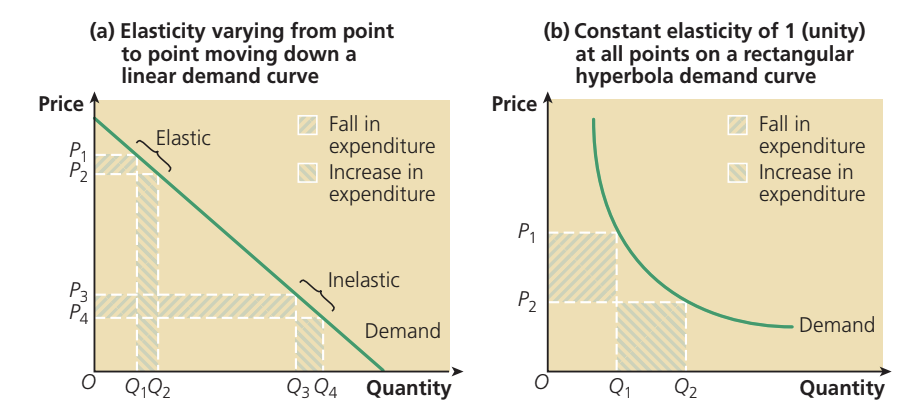
For a rectangular hyperbola demand curve, consumer expenditure remains constant whether price rises or falls. The elasticity equals unity (or -1 considering the negative relationship) at all points on this curve. Mathematicians call this special curve shape a rectangular hyperbola because whenever price falls, the proportionate change in quantity demanded exactly matches the proportionate change in price, keeping total expenditure constant.
Income elasticity of demand
Income elasticity of demand measures how responsive demand is to changes in income. It shows the extent to which quantity demanded for a good changes when consumer income changes.
The nature of income elasticity depends on whether the good is classified as a normal good or an inferior good.
When disposable income increases, a demand curve shifts rightwards, but only if the good is a normal good (where demand increases as income rises). However, some goods are inferior goods, for which demand decreases as income increases. An increase in income actually shifts the demand curve for an inferior good leftwards.
Important
Income elasticity of demand is always negative for an inferior good and positive for a normal good. This reflects the fundamental relationship: as income rises, quantity demanded of an inferior good falls, while quantity demanded of a normal good rises.
Example
Worked Example: Calculating Income Elasticity
People's average incomes fall from $1,000 a week to $600 a week. As a result, demand for potatoes increases from 1 million tonnes to 1.2 million tonnes a week. Calculate the income elasticity of demand for potatoes.
Step 1: Identify the formula
Step 2: Calculate the percentage changes
- Percentage change in quantity demanded = +20%
- Percentage change in income = -40%
Step 3: Apply the formula
Interpretation: The minus sign indicates that the good is an inferior good. The number 0.5 indicates that demand is inelastic (the percentage change in quantity demanded is less than the percentage change in income).
Categories of normal goods
Normal goods can be further divided into superior goods (or luxuries) and necessities.
Superior goods have an income elasticity of demand greater than +1. Although the quantity demanded of a normal good always rises with income, it rises by a greater percentage for superior goods like luxury cars.
Necessities have an income elasticity lying between zero and +1. Demand for basic goods or necessities like shoe polish rises by a smaller percentage than the increase in income.
Note
Interpretation tip: The size and sign (positive or negative) of income elasticity affects how a good's demand curve shifts following a change in income. A highly positive income elasticity means the demand curve shifts significantly rightwards when incomes rise, while a negative income elasticity means it shifts leftwards.
Application example
The UK's income elasticity for overseas holidays is +1.6. This tells us that overseas holidays are a superior good (luxury) for UK consumers. When UK incomes rise by 10%, demand for overseas holidays rises by 16%. This makes sense because holidays abroad are a discretionary purchase that people spend more on proportionately as they become wealthier.
Cross elasticity of demand
Cross elasticity of demand (or cross-price elasticity of demand) measures how the demand for one good responds to changes in the price of another good.
The cross elasticity between two goods or services indicates the nature of the demand relationship between them. There are three possibilities:
- Complementary goods (or goods in joint demand)
- Substitutes (or competing goods)
- An absence of any discernible demand relationship
Complementary goods
Cars and petrol (or diesel fuel) are complementary goods — they're in joint demand. A significant increase in fuel prices, such as the 30.7% increase in petrol prices in the year to March 2022, affects the demand for cars, though the effect may not be large.
By contrast, private car travel and bus travel are substitute goods. A significant increase in the cost of running a car causes some motorists to switch to public transport, provided bus fares don't rise by a similar amount.
Note
The size and sign (positive or negative) of cross elasticity affect how a good's demand curve shifts following a change in the price of another good.
For example, a cross elasticity of demand of +0.3 for bus travel with respect to the price of running a car indicates that a 10% increase in the cost of private motoring would cause the demand for bus travel to increase by just 3%.
For most demand relationships between two goods, cross elasticities are inelastic rather than elastic, both when the goods are in joint demand and when they are substitutes.
Negative cross elasticity: complementary goods
Complementary goods (or goods demanded together) have negative cross elasticities of demand. A rise in the price of one good leads to a fall in demand for the other good.
Example
Example: Bicycles and Bike Lamps
Consider bicycles and bike lamps. Suppose the cross elasticity of demand for bike lamps with respect to the price of new bicycles is -0.5.
This tells us that a 10% increase in the price of new bicycles leads to a 5% fall in the demand for bike lamps. The negative sign confirms these goods are complements.
Positive cross elasticity: substitute goods
By contrast, the cross elasticity of demand between two goods which are substitutes for each other is positive. A rise in the price of one good causes demand to switch to the substitute good whose price hasn't risen, so demand for the substitute increases.
For example, a new bicycle and a new motor scooter are substitutes for each other. If the cross elasticity of demand for a new bicycle with respect to the price of a motor scooter is +0.4, this tells us that a 10% increase in the price of new motor scooters will lead to a 4% increase in demand for new bicycles as consumers switch between these two types of private transport.
Zero cross elasticity: no relationship
If we select two goods at random — for example, pencils and suitcases — the cross elasticity of demand between them will be zero. When there's no discernible demand relationship between two goods, a rise in the price of one good has no measurable effect upon the demand for the other. The cross elasticity of demand is zero, unless both items make up an important part of household expenditure.
Note
Application example: The price of a gaming console for a particular games provider rises by 30%. In subsequent years, demand for games cartridges for this system falls by 10%. This information tells us the cross elasticity of demand between the two products is negative (approximately -0.33), indicating that consoles and games cartridges are complementary goods. When console prices rise, fewer people buy consoles, which reduces demand for the associated games.
Summary
Remember!
Elasticity measures responsiveness — it shows how much one variable changes proportionately in response to a change in another variable. It's independent of the units of measurement.
Three key elasticities to master:
- Price elasticity of demand (PED) — responsiveness to price changes
- Income elasticity of demand (YED) — responsiveness to income changes
- Cross elasticity of demand (XED) — responsiveness to changes in other goods' prices
Each has its own formula, and you must avoid confusing them or writing formulae 'upside down'.
Price elasticity ranges from zero to infinity:
- Perfectly inelastic demand (PED = 0) is vertical
- Perfectly elastic demand (PED = ∞) is horizontal
- Between these extremes lie inelastic (PED < 1), unit elastic (PED = 1), and elastic (PED > 1) demand
Substitutability is the key determinant of PED — when close substitutes are available, demand is elastic. Other factors include the percentage of income spent on the good, time period considered, and the width of the market definition.
Income elasticity distinguishes normal from inferior goods:
- Normal goods have positive YED (demand rises with income)
- Inferior goods have negative YED (demand falls as income rises)
- Superior goods (luxuries) have YED > 1
- Necessities have YED between 0 and 1
Cross elasticity reveals relationships between goods:
- Negative XED indicates complementary goods (consumed together)
- Positive XED indicates substitute goods (competing products)
- Zero XED means no relationship
This helps businesses understand how changes in related markets affect their products.
Elasticity and revenue are linked:
- When demand is elastic, price decreases increase total revenue
- When demand is inelastic, price decreases reduce total revenue
This is crucial for firms' pricing strategies and for governments setting indirect taxes.