Equilibrium (AQA A-Level Further Maths): Revision Notes
📚Revision Notes
Equilibrium
What is equilibrium?
An object is in equilibrium when it experiences a system of forces and couples that result in no net motion. For equilibrium to occur, all forces and couples must act in the same plane (coplanar forces).
Note
Coplanar means 'in the same plane' - all forces and couples must lie within a single flat surface for the equilibrium conditions to apply.
Conditions for equilibrium
For an object to be in equilibrium under a system of coplanar forces, two essential conditions must be satisfied:
Important
Two Essential Conditions for Equilibrium:
-
The resultant of all forces must be zero - This means the sum of force components in any two different directions must equal zero, ensuring no linear movement occurs.
-
The total moment of all forces and couples must be zero - This ensures no rotational movement occurs.
These conditions can be expressed mathematically using three equations that you solve simultaneously. Typically, you resolve forces in two perpendicular directions (often horizontal and vertical) and take moments about a suitable point.
Setting up equilibrium equations
When solving equilibrium problems, you need to:
- Resolve forces in two perpendicular directions (usually horizontal and vertical)
- Take moments about a strategically chosen point
- Write three equations and solve them simultaneously
Note
Exam tip: Choose your moment point carefully to eliminate unknown forces from the equation. Taking moments about a point where an unknown force acts means that force doesn't appear in your moment equation, significantly simplifying your algebra.
Solving equilibrium problems systematically
Follow these steps when approaching equilibrium problems:
- Draw a clear diagram showing all forces, distances, and angles
- Identify all forces acting on the system (weights, reactions, tensions, friction)
- Choose two perpendicular directions for resolution (e.g. horizontal and vertical)
- Choose a point to take moments about (ideally where unknowns intersect)
- Write your three equations:
- Resolving horizontally:
- Resolving vertically:
- Taking moments:
- Solve simultaneously to find unknown quantities
Important
Common exam trap: Always check whether surfaces are smooth or rough. Smooth surfaces have reactions perpendicular to the surface only (no friction). Rough surfaces can have both normal reactions and friction forces.
Worked example 1: Ladder against a wall
Example
Worked Example: Ladder Against a Wall
Problem: A uniform ladder weighing 120 N rests on a smooth floor with its upper end on a smooth wall. End is held by a string fixed to the base of the wall at . A weight of 80 N is attached three-quarters of the way up the ladder at . If m and m, find the tension in the string and the reaction at the ground.
Solution:
Since both surfaces are smooth, the reactions and are normal to the wall and ground respectively.
Step 1: Resolve vertically
For vertical equilibrium:
or equivalently (upward force balances downward force):
Therefore: N
Step 2: Take moments about point
Taking moments about eliminates both and from appearing in certain forms, simplifying the calculation.
The moment equation gives us information about the reaction at the wall.
Step 3: Resolve horizontally
For horizontal equilibrium:
Using the geometry of the problem and solving gives:
Key insight: Choosing to take moments about point was strategic because it eliminated forces and from that equation, making the algebra simpler.
Worked example 3: Cylindrical roller with plank
Example
Worked Example: Cylindrical Roller with Plank
Problem: A cylindrical roller with centre and radius 63 cm is fixed to smooth, horizontal ground. A uniform plank rests against it at point . One end, , lies on the ground and the other end, , projects beyond the roller. The plank is perpendicular to the horizontal axis of the roller. A light string of length 1.05 m keeps the plank from slipping. If the plank has weight and length 90 cm, find the tension in the string in terms of .
Solution:
Step 1: Draw a diagram showing all forces
is the midpoint of the uniform plank (where the weight acts). There are smooth contacts at and , so reactions and are perpendicular to and respectively.
Step 2: Use geometry to find angles
Let using the symmetry of the circle.
In :
Using Pythagoras' theorem:
Step 3: Take moments about
This eliminates and from the equation:
Step 4: Resolve horizontally
Avoid using in this equation:
Therefore:
Note
Exam tip: A third equation (resolving vertically) wasn't needed because the question only asked for tension . Always identify what you need to find before writing all possible equations - this saves time and reduces errors.
Worked example 4: Hinged rod
Example
Worked Example: Hinged Rod
Problem: A uniform rod of weight 10 N and length is hinged at . Its end is held by a string so that the rod and string are both inclined at 30° to the horizontal. Find the tension in the string and the total reaction at the hinge.
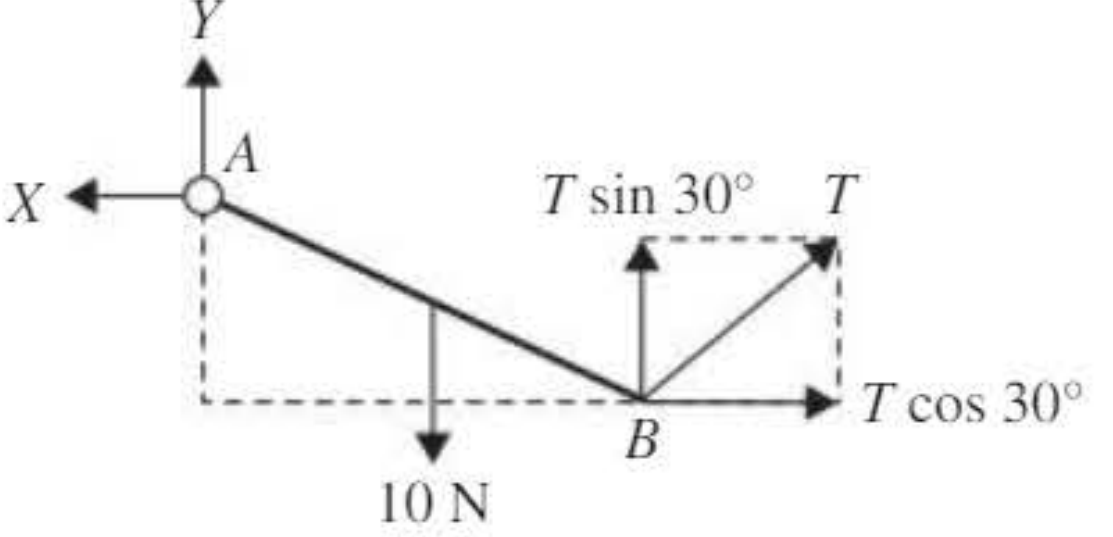
Solution:
Step 1: Resolve horizontally
Let the tension in the string be and components of reaction at hinge be and .
Step 2: Resolve vertically
Step 3: Take moments about
Taking moments about means does not appear in this equation:
Step 4: Solve simultaneously
Substitute equations [1] and [2] into [3]:
From equations [1] and [2]:
Step 5: Find total reaction at hinge
Alternative method: The algebra can be simplified by taking moments about instead, with resolved into two components. This means and do not appear in the equation:
Using the vector product in mechanics
The vector product (or cross product) provides an alternative method for calculating moments, particularly useful in three-dimensional problems.
Definition of vector product
For two vectors a and b, the vector product is:
where is the acute angle between the directions of a and b, and n is a unit vector perpendicular to both a and b (using the right-hand rule).
Moment calculation using vectors
A force F acting at point with position vector r from origin produces a moment about :
where r is the position vector from to the point of application.
The magnitude of this moment is:
Let be the shortest (perpendicular) distance from to the line of action of F. Then:
Important
Key principle: In general, a force F acting at point P has a moment M about point Q given by: where (position vector from Q to P).
Important note: The moment about is actually the moment about an axis through perpendicular to the plane containing , , and F.
Worked example 5: Couple using vector product
Example
Worked Example: Couple Using Vector Product
Problem: Two forces N and N act at points and respectively. Their resultant forms a couple with a third force which acts at the origin .
Find: a) The force and its magnitude b) The moment M of the couple and its magnitude
Solution:
Part a: Find
Since the overall resultant is a couple (not a single force):
Magnitude:
Part b: Find moment M of couple
The moment M of the couple equals the total moment of all three forces about any point. Taking moments about :
where and
Using the determinant method for cross products:
Magnitude of the moment:
Note
Exam tip: When dealing with couples, remember that the resultant force is zero, but the total moment is non-zero. This is the defining characteristic of a couple.
Remember!
Summary
Key Points to Remember:
-
An object is in equilibrium when both the resultant force is zero AND the total moment is zero - both conditions must be satisfied simultaneously.
-
Resolve forces in two perpendicular directions (typically horizontal and vertical) to create two equations, then take moments about a strategic point for the third equation.
-
Choose your moment point wisely - select a point where unknown forces act to eliminate them from your moment equation and simplify the algebra.
-
Smooth surfaces have reactions perpendicular to the surface only (no friction), while rough surfaces can have both normal reactions and friction forces.
-
The vector product gives the moment about a point, where r is the position vector from that point to where the force acts. This is particularly useful for three-dimensional problems.