Kinematics of Circular Motion (AQA A-Level Further Maths): Revision Notes
📚Revision Notes
Kinematics of Circular Motion
Introduction to circular motion
When an object moves in a circular path at constant speed, it experiences circular motion. Although the speed remains constant, the velocity continuously changes because the direction of motion changes. This results in acceleration towards the centre of the circle, even though the object's speed doesn't increase.
Understanding circular motion requires knowledge of both angular quantities (measured in radians) and linear quantities (measured in metres). These two sets of quantities are related through the radius of the circular path.
Note
The key to mastering circular motion is understanding the relationship between angular and linear quantities. Angular measurements use radians, while linear measurements use standard SI units like metres and seconds.
Angular displacement and arc length
Angular displacement () is the angle through which the radius rotates, measured in radians. One complete revolution equals radians.
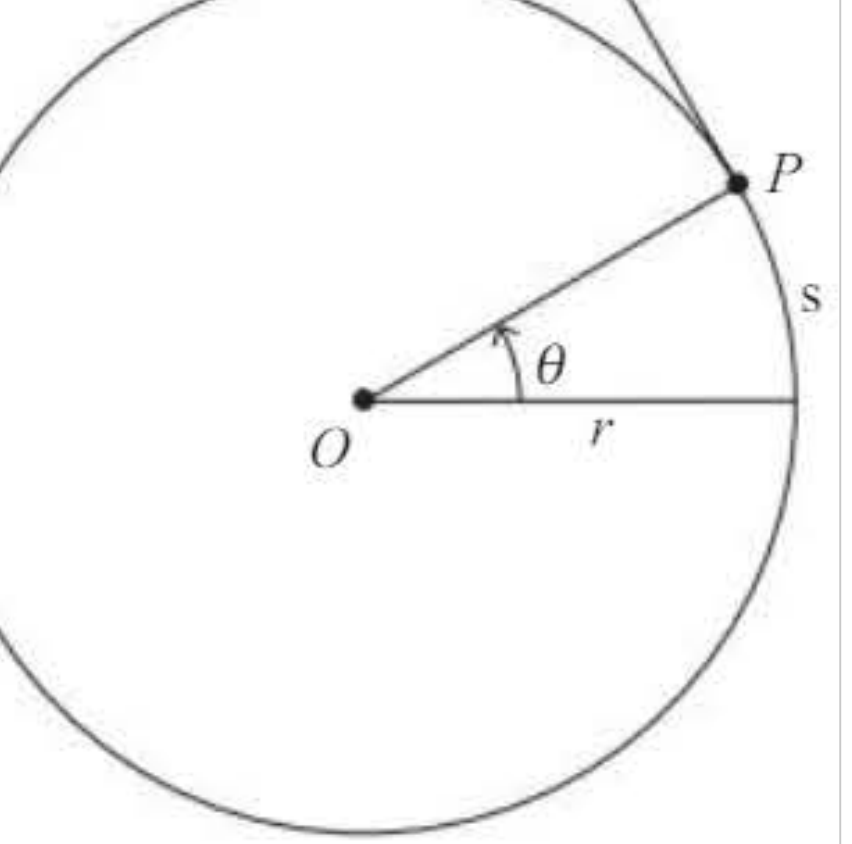
When a point mass moves in a circle with centre and radius , the distance it travels is called the arc length. The relationship between arc length and angular displacement is:
where must be measured in radians.
Important
Always use radians when working with circular motion formulas. To convert from degrees to radians, multiply by .
Linear velocity
Linear velocity () is the rate of change of distance along the circular path. For an object moving in a circle, the velocity is always directed along the tangent to the circle at that point.
The linear velocity is given by:
Since , we can differentiate to find the relationship between linear and angular quantities.
Important
The magnitude of the linear velocity remains constant in uniform circular motion, but its direction continuously changes as the object moves around the circle. This change in direction is what causes acceleration, even though the speed stays the same.
Angular velocity
Angular velocity () is the rate of change of angular displacement. It measures how fast the radius rotates about the centre.
Angular velocity is measured in radians per second (), though revolutions per minute (rpm) is sometimes used in practical applications.
Note
Key relationship: The linear velocity and angular velocity are connected by:
This fundamental equation shows that for a given angular velocity, objects further from the centre (larger ) move faster in terms of linear speed.
Time period
The time period () is the time taken for one complete revolution. During one revolution, the angular displacement is radians.
Using the definition of angular velocity:
Summary
Key equations for circular motion at constant speed:
- Arc length:
- Angular velocity:
- Linear velocity:
- Time period:
Unit conversions
Angular velocity can be expressed in different units. Here's how to convert between them:
| Object | rpm | rad/min | rad s⁻¹ |
|---|---|---|---|
| Vinyl record | 33 | ||
| Roundabout | 9 | ||
| Wind turbine | 10 | ||
| Car engine | 260 |
Note
Conversion tips:
- From rpm to rad/min: multiply by
- From rad/min to rad s⁻¹: divide by 60
- One revolution = radians
Centripetal acceleration
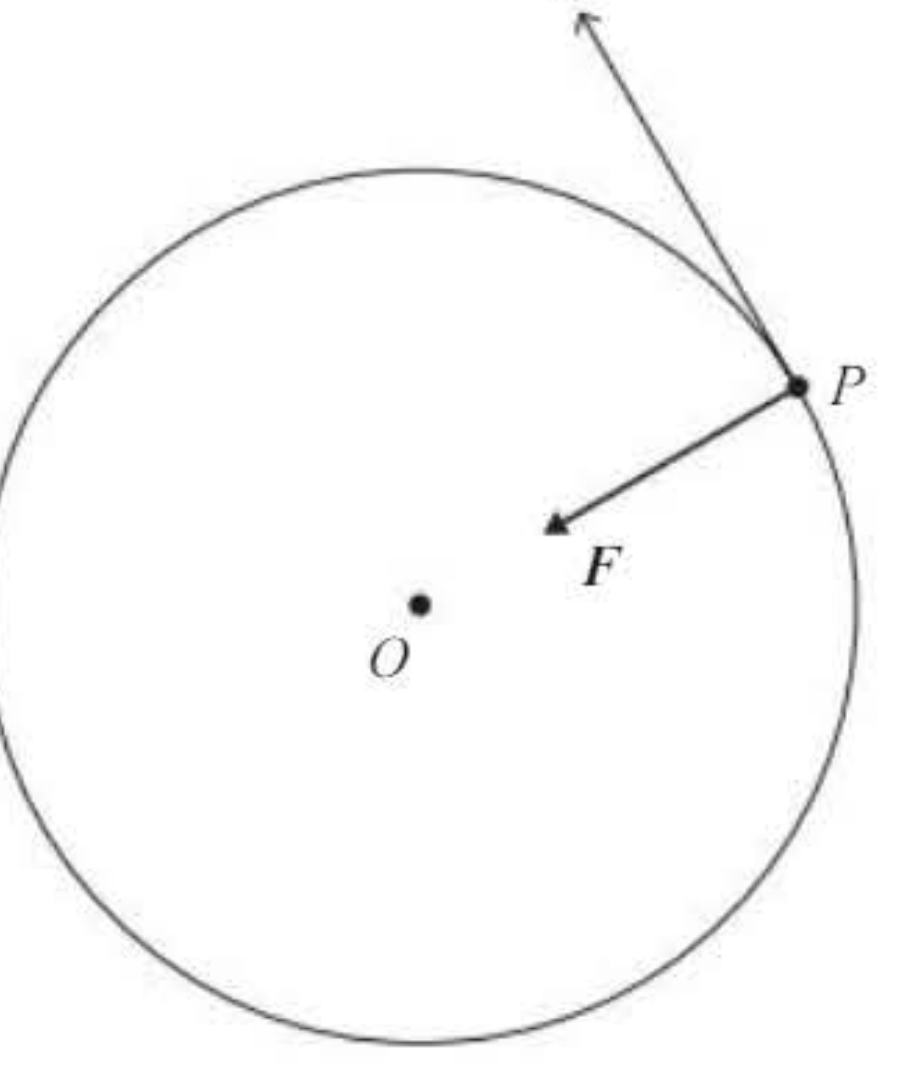
Although the speed is constant in uniform circular motion, the velocity changes because the direction changes. This change in velocity means there must be acceleration.
Consider a mass moving from point to point through a small angle in time . At both and , the velocity is directed along the tangent with magnitude .
The change in velocity along the direction is:
For small angles measured in radians, .
Therefore, the acceleration towards is:
As , this becomes:
Since , we can also write:
Or using :
Important
There is no linear acceleration along the tangent (the speed is constant). However, there is a linear acceleration of magnitude or directed towards the centre of the circle.
This acceleration is called centripetal acceleration because it points towards the centre. It changes the direction of the velocity but not its magnitude.
Summary
Summary for circular motion with constant angular velocity and radius :
- Constant speed along tangent:
- Acceleration towards centre:
Centripetal force
According to Newton's second law, if there is acceleration, there must be a force causing it. For circular motion, this force must be directed towards the centre of the circle.
Centripetal force is the name given to the resultant force that acts towards the centre of the circular path. The magnitude of this force is:
where is the mass of the object.
Important
Centripetal force is not a new type of force. It is the name for whatever force (or combination of forces) provides the acceleration towards the centre. Different situations provide centripetal force in different ways:
- For a car rounding a bend: friction between tyres and road
- For a satellite orbiting Earth: gravitational force
- For clothes in a spin dryer: reaction force from the drum
- For an object on a string: tension in the string
Note
Exam tip: Always identify what provides the centripetal force in a specific situation. Draw a clear force diagram showing all forces, then apply Newton's second law in the direction towards the centre.
Problem-solving strategy
To solve problems involving circular motion:
Step 1: Draw a clear diagram showing all forces acting on the moving object.
Step 2: Write and solve an equation for motion towards the centre of the circle using Newton's second law:
Important
Only consider forces (or components of forces) that act in the direction towards the centre. Forces perpendicular to this direction do not contribute to the centripetal force.
Worked example 1: Cyclist with spinning wheel
Example
Worked Example: Cyclist with spinning wheel
A cyclist is mending his bike with the wheel spinning at 200 revolutions per minute. A piece of grit is stuck in the tyre. The diameter of the tyre is 60 cm.
Part a: Calculate the angular speed in radians per second.
Solution:
Angular speed in rpm: rpm
Convert to rad/min: rad/min
Each revolution is radians.
Convert to rad s⁻¹: rad s⁻¹ (to 3 s.f.)
Part b: Calculate the linear tangential speed of the grit in metres per second.
Solution:
The radius is needed in metres: cm m
Linear speed:
m s⁻¹ (to 2 s.f.)
Part c: Calculate the acceleration towards the centre of the wheel.
Solution:
Acceleration towards centre:
m s⁻² (to 2 s.f.)
Exam tip: Always convert all measurements to SI units (metres, seconds, kilograms) before calculating.
Worked example 2: Mass on a string
Example
Worked Example: Mass on a string
The ends of a 2 m length of string are attached to a fixed point and a 3 kg mass. The mass rotates about on a smooth table. If the string breaks when the tension exceeds 530 N, find the maximum angular velocity in rpm.
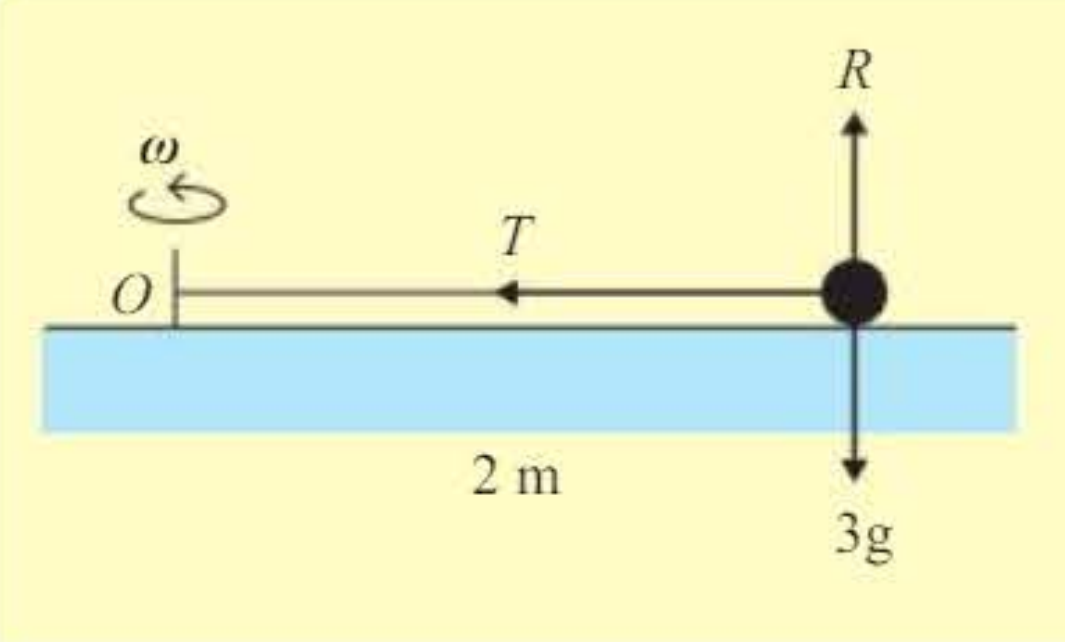
Step 1: Draw a diagram showing all forces.
The forces acting on the mass are:
- Reaction force (upwards)
- Weight (downwards)
- Tension (towards centre )
The vertical forces and balance each other and do not contribute to the centripetal force. Only the horizontal tension provides the centripetal force.
Step 2: Use Newton's second law for motion towards the centre.
Let be the maximum angular velocity.
At the point of breaking:
Convert to rpm:
Exam tip: When forces act in multiple directions, resolve them carefully. Only the component towards the centre contributes to centripetal force.
Worked example 3: Car on a circular bend
Example
Worked Example: Car on a circular bend
A car of mass 900 kg is driven round a circular bend on an icy road of radius 20 m. The frictional force between the tyres and road cannot exceed 250 N.
Part a: What is the maximum angular speed in rad s⁻¹?
Solution:
The friction provides the centripetal force. At maximum speed:
Part b: What is the maximum speed in km h⁻¹?
Solution:
Using :
Convert to km h⁻¹:
Exam insight: This example shows why cars must slow down significantly on icy roads when turning. The reduced friction means less centripetal force is available.
Common exam traps
Important
Watch out for these common mistakes:
Trap 1: Forgetting to convert angles to radians. The formulas , , and only work when and are in radians.
Trap 2: Confusing speed and velocity. Speed is constant in uniform circular motion, but velocity (which includes direction) is constantly changing.
Trap 3: Including forces that don't contribute to centripetal force. Only forces (or components) directed towards the centre contribute. Vertical forces in horizontal circular motion balance each other.
Trap 4: Forgetting to convert units to SI units (metres, kilograms, seconds) before calculating.
Trap 5: Thinking centripetal force is a new type of force. It's simply the name for whatever force causes the circular motion.
Remember!
Summary
Key Points to Remember:
- Angular displacement is measured in radians: in radians
- Arc length and radius are related by:
- Linear velocity is tangent to the circle:
- Angular velocity is the rate of rotation: in rad s⁻¹
- Centripetal acceleration always points towards the centre:
- Centripetal force is required for circular motion:
- Always convert to radians and SI units before calculating