Work, Energy, and Power (AQA A-Level Further Maths): Revision Notes
📚Revision Notes
Work, Energy, and Power
Introduction to work
When you need to move an object, you must apply a force to it. This process of applying a force to move an object through a distance is called work. The amount of work performed depends on two factors: the magnitude of the force applied and the distance the object travels in the direction of that force.
Work is a measure of energy transfer. It quantifies how much energy is transferred when a force causes an object to move.
Note
Work is only done when there is both a force AND movement in the direction of that force. No movement means no work done, regardless of how large the force is.
Work done by a constant force
Definition
When a constant force acts on an object and moves it through a distance, the work done is calculated by multiplying the force by the distance moved in the direction of the force.
Work done by a constant force = force × distance
where:
- = work done (joules, J)
- = force applied (newtons, N)
- = distance moved in the direction of the force (metres, m)
This formula applies when the force and displacement are in the same direction.
Units
The unit of work is the joule (J). One joule is defined as the work done when a force of one newton moves an object through a distance of one metre.
Important
Always ensure consistency in units: force in newtons (N), distance in metres (m), and work in joules (J). Incorrect units are a common source of errors in calculations.
Example: Constant horizontal force
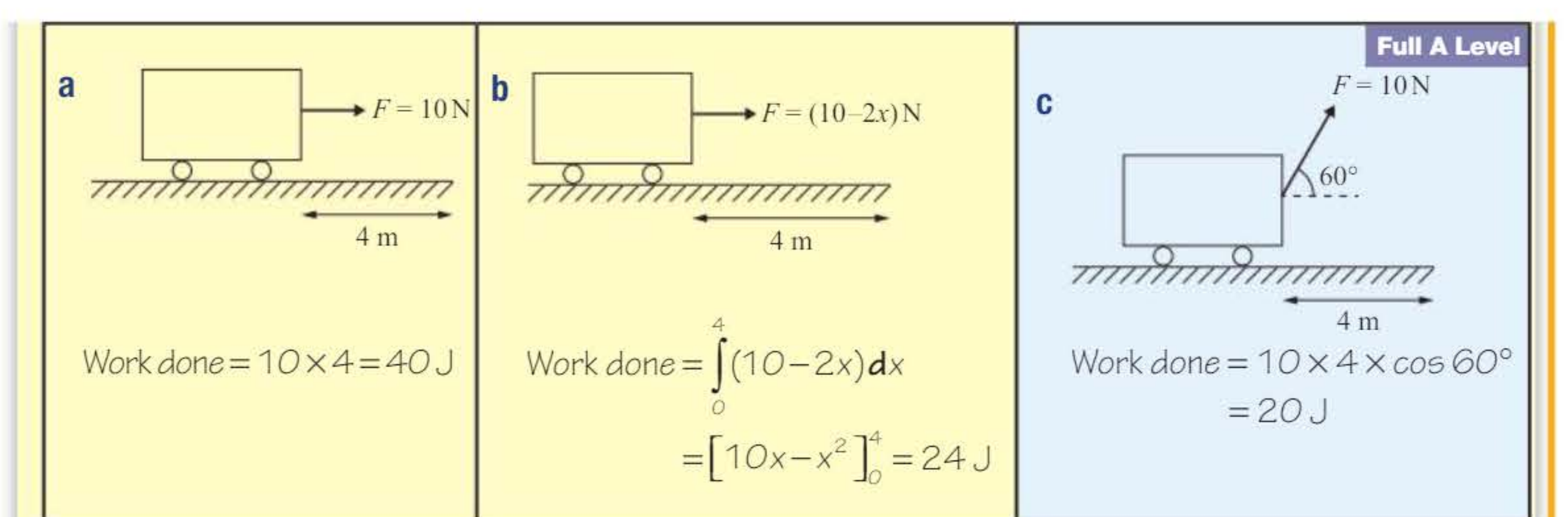
Consider a trolley being pushed horizontally with a constant force of 10 N over a distance of 4 m.
The work done is 40 joules.
Work done by a variable force
When the force acting on an object is not constant but varies with distance, you cannot simply multiply force by distance. Instead, you must use integration to calculate the total work done.
Formula
For a variable force that changes with position , the work done over a small distance is approximately .
Summing over the total distance gives:
Total work done by a variable force =
Note
The integral represents the area under a force-distance graph. This provides a visual way to understand work done - it's the total area between the force curve and the distance axis.
Example
Worked Example: Variable Force Integration
A force varies according to N, where is in metres. Find the work done as the object moves from to m.
Solution:
The work done is 24 joules.
Important
Exam tip: When you see a force that depends on distance, use integration to find work done. The limits of integration are the start and end positions.
Work done at an angle
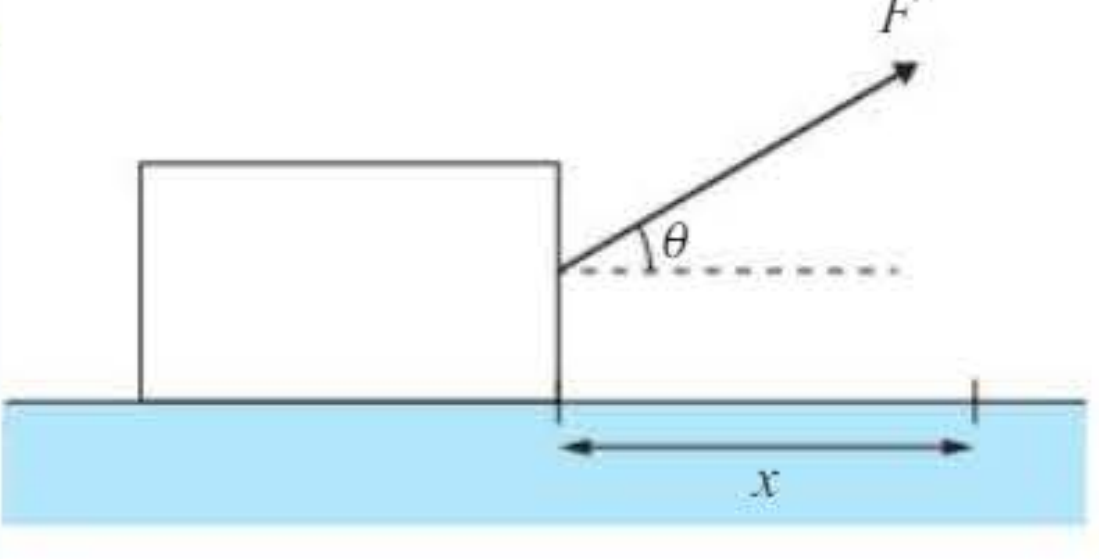
When a force acts at an angle to the direction of motion, only the component of the force in the direction of motion does work. The perpendicular component does no work because there is no movement in that direction.
Formula
For a constant force acting at an angle to the horizontal direction of motion:
Work done =
where is the angle between the force vector and the direction of displacement.
Example
Worked Example: Force at an Angle
A force of 10 N acts at 60° to the horizontal and moves an object 4 m horizontally.
Solution:
The work done is 20 joules.
Important
Exam tip: Always resolve forces into components parallel and perpendicular to the motion. Only the parallel component does work.
Multiple forces and work
When several forces act on an object, you must consider each force separately to determine which forces do work.
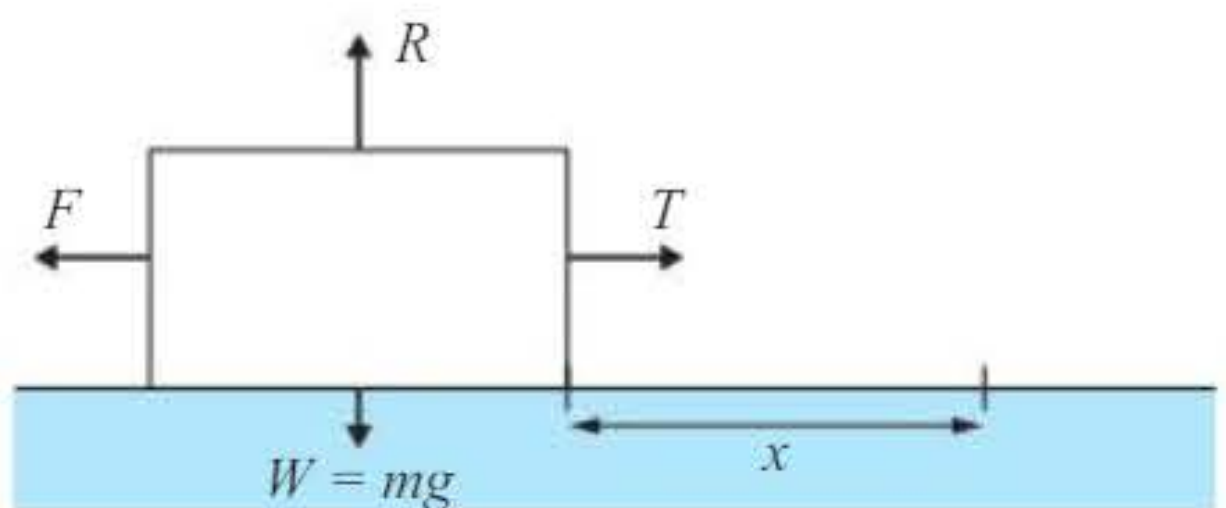
Consider an object being dragged along a rough horizontal surface. Four forces act on it:
- Weight () acts vertically downward
- Normal reaction () acts vertically upward
- Tension or tractive force () acts horizontally in the direction of motion
- Friction () acts horizontally opposing the motion
Which forces do work?
Important
Critical Rule: Perpendicular Forces Do NO Work
Weight and normal reaction do no work because they act perpendicular (at right angles) to the direction of motion. There is no displacement in the vertical direction.
Tension does work in the direction of motion. If the tension is and the object moves distance , the work done by the tension is:
Friction does negative work (work is done against friction). If the frictional force is and the object moves distance , the work done against friction is:
Key terminology
- Use the word "by" when a force does work in the direction of motion
- Use the word "against" when work is done to overcome a resisting force
Note
Note on notation:
- The letter is often used for any general force and also for frictional force
- The letter is often used for reaction force and also for resisting force
- The letter often represents tension in a rope or the tractive force of an engine
- The letter may also represent tractive force
Be clear about which forces you're referring to in your working.
Power
Power is the rate at which work is done. It measures how quickly energy is transferred or how fast work is performed.
Definition
If an engine performs work over a period of time, the average power of the engine equals the total work done divided by the time taken.
Units
The unit of power is the watt (W). One watt equals one joule per second.
Power for constant force and velocity
When a constant force N acts on an object moving at constant velocity m s, the object travels metres every second. The work done each second is joules.
Therefore, the power is:
where:
- = power (watts, W)
- = force (newtons, N)
- = velocity (metres per second, m s)
Note
For instantaneous power: If either the force or velocity varies, gives the power at that particular instant.
This is different from average power, which considers total work over total time.
Example
Worked Example: Average Power
A person pulls a crate with a rope parallel to a horizontal floor with constant tension of 15 N. The crate travels 4 m in 1.6 s.
Solution:
Work done = J
Average power = W
The average power is 37.5 watts.
Example
Worked Example: Instantaneous Power
The same crate passes point B with speed 3 m s. The power at this instant is:
Solution:
The instantaneous power is 45 watts.
Important
Exam tip: Use average power formula when given total work and total time. Use for instantaneous power when given speed at a specific moment.
Kinetic energy
Definition
Kinetic energy (KE) is the energy possessed by an object due to its motion.
When you apply a force to an object of mass initially at rest, it accelerates. After travelling distance , it reaches velocity .
Using Newton's second law:
Using the kinematic equation: with , we get
Therefore:
Work done by force:
This work done gives the object its kinetic energy.
Formula
Kinetic energy =
where:
- = mass (kilograms, kg)
- = velocity (metres per second, m s)
- KE is measured in joules (J)
Note
Key point: Kinetic energy is proportional to mass and proportional to the square of velocity.
This means doubling the speed quadruples the kinetic energy! This has important implications for road safety - a car travelling at 60 mph has four times the kinetic energy of one travelling at 30 mph.
Gravitational potential energy
Definition
Gravitational potential energy (GPE) is the energy possessed by an object due to its position in a gravitational field.
When you release an object of mass from height , it falls downward due to the gravitational force (its weight ).
Work done by gravitational force:
Before being released, the object had the potential to do this amount of work due to its elevated position.
Formula
Gravitational potential energy =
where:
- = mass (kilograms, kg)
- = acceleration due to gravity (approximately 9.8 or 10 m s)
- = height above reference level (metres, m)
- GPE is measured in joules (J)
Important
Important: The reference level (height = 0) can be chosen arbitrarily. Only changes in GPE are physically significant.
When solving problems, clearly state your chosen reference level. Often, ground level or the lowest point in the problem is chosen as .
Conservation of mechanical energy
Principle
The principle of conservation of mechanical energy states that the total mechanical energy (sum of KE and GPE) of a system remains constant, provided no work is done against friction or other non-conservative forces.
Energy equations with losses
When energy is lost to friction or air resistance:
or equivalently:
Important
Exam strategy:
- Draw a clear, labelled diagram showing all information
- When writing energy equations, ensure gains and losses are balanced correctly
- State your assumptions clearly (e.g., "assuming negligible friction")
- Be consistent with your choice of reference level for GPE calculations
Worked examples
Example
Worked Example 1: Object Falling with Air Resistance
A 4 kg object falls 12 m from rest under gravity. Take m s.
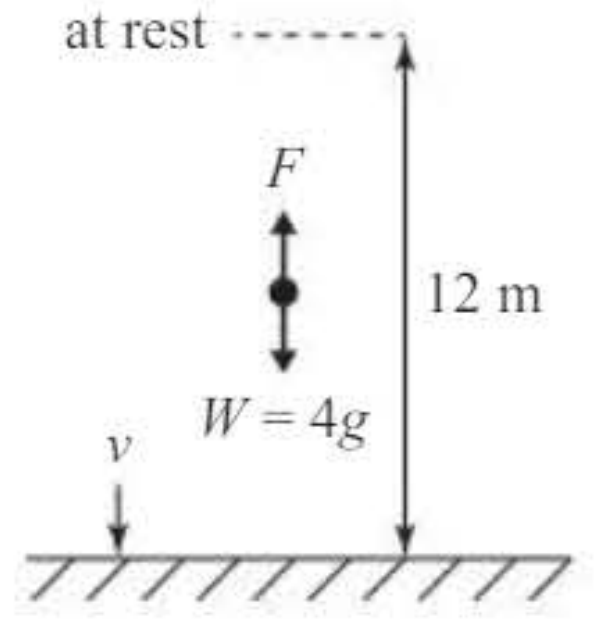
Part (a): Find the final speed if air resistance is negligible.
Solution:
Energy equation: GPE lost = KE gained
The final speed is 15.3 m s.
Part (b): If air resistance is modelled by a constant force of 5 N, find the final speed.
Solution:
Energy equation: GPE lost = KE gained + Work done against air resistance
The final speed is 14.3 m s.
Note: A limitation of this model is that air resistance actually increases with speed, not remains constant. A more realistic model would have air resistance dependent on velocity.
Example
Worked Example 2: Car Climbing a Slope
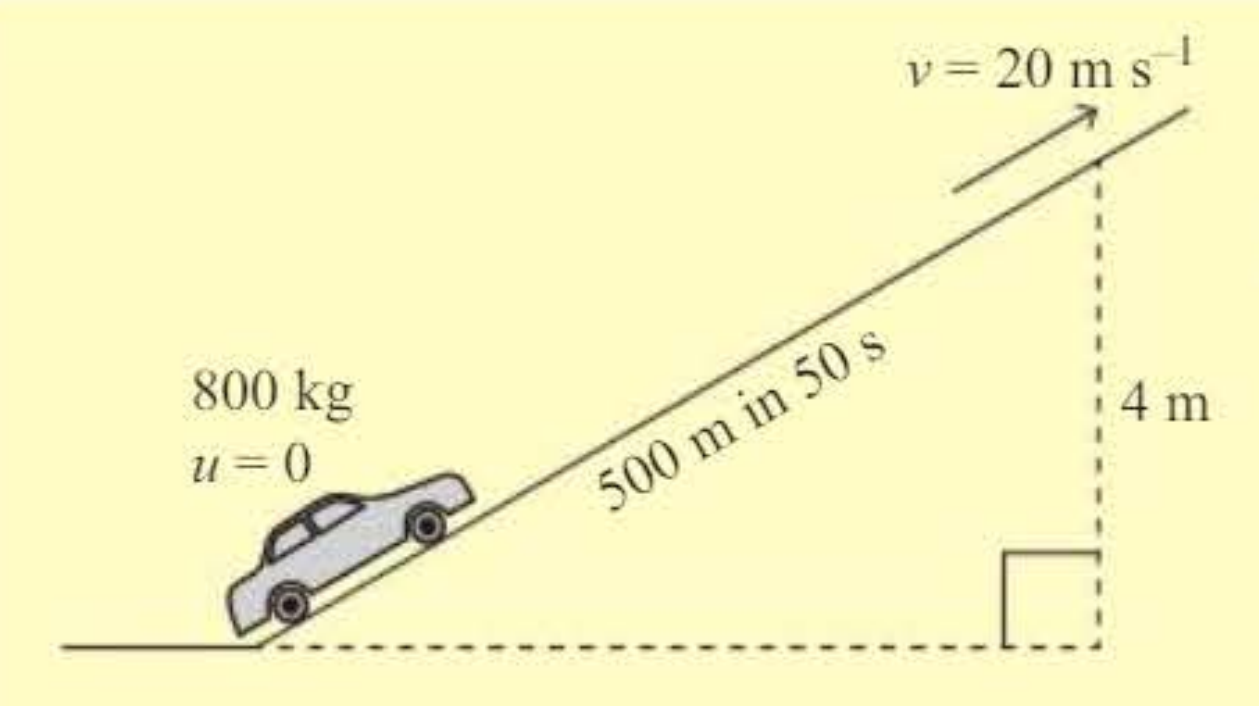
A car of mass 800 kg starts from rest at the foot of a slope. A constant tractive force N acts on it. The car climbs the slope, travelling 500 m in 50 s to reach a speed of 20 m s at a vertical height of 4 m.
Assume negligible energy is lost to friction or air resistance.
Part (a): Find the gain in GPE and KE.
Solution:
Gain in GPE:
Gain in KE:
Total energy gain = 32,000 J (GPE) + 160,000 J (KE)
Part (b): Find the tractive force.
Solution:
Work done by engine = Gain in GPE + Gain in KE
The tractive force is 384 N.
Part (c): Find the average power of the engine.
Solution:
The average power is 3.84 kW.
Part (d): Find the instantaneous power at the end of the journey.
Solution:
The instantaneous power is 7.68 kW.
Example
Worked Example 3: Metal Ingot with Friction
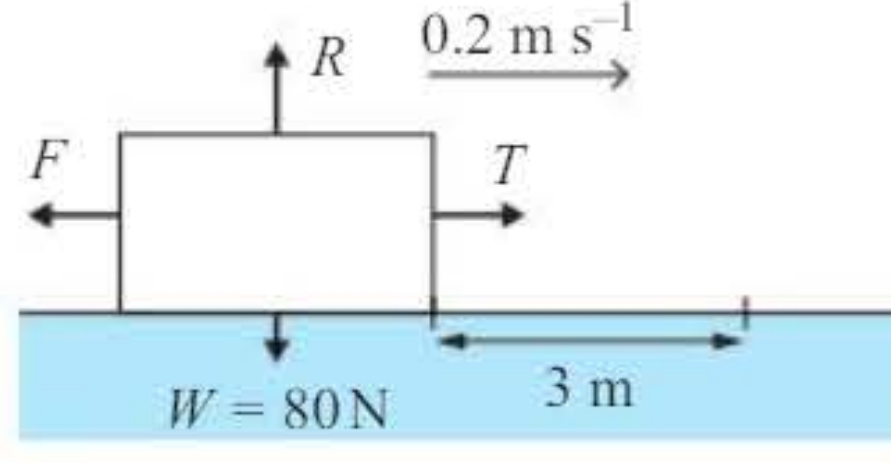
A metal ingot of weight 80 N is pulled at constant speed 0.2 m s for 3 m across a rough horizontal floor. There is a constant frictional force of 30 N.
Part (a): Find the work done by each force.
Solution:
Since there is no vertical motion, no vertical acceleration. Therefore, vertical forces do no work.
Resolving vertically: Reaction Weight N
Since horizontal motion is at constant speed, there is no horizontal acceleration. Therefore, resultant horizontal force is zero.
Resolving horizontally: Tension Friction N
The horizontal distance moved = 3 m
- Work done by tension: J
- Work done against friction: J
- Work done by weight and reaction: 0 J (perpendicular to motion)
Part (b): Find the power exerted by the tension.
Solution:
The power generated by the tension is 6 watts.
Example
Worked Example 4: Car on Slope with Resistance
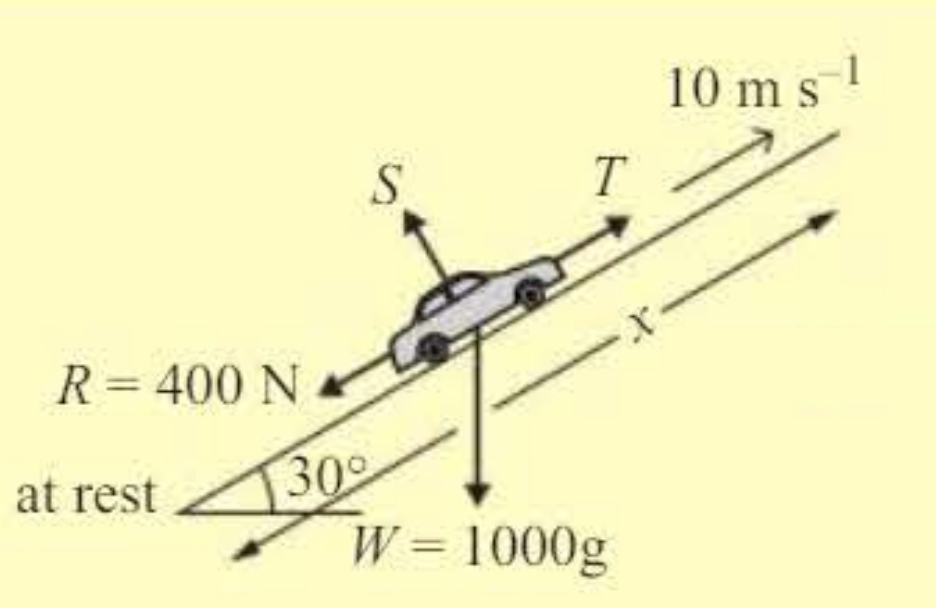
A car of mass 1 tonne (1000 kg) travels from rest up a slope at 30° to the horizontal with constant acceleration against a constant resistance of 400 N. At the top of the slope, it has speed 10 m s and the engine is working at 58 kW. Take m s.
Find the length of the slope.
Solution (Method 1: Using work and energy):
At top of slope: Power =
Let the length of the slope be metres.
Using right-angled triangle: vertical height gained = m
KE gained: J
Work done by engine: J
Work done against resistance: J
Energy equation:
Work done by engine = KE gained + GPE gained + Work done against resistance
Solution (Method 2: Using Newton's second law):
Component of weight down slope: N
Equation of motion parallel to slope:
Using with , :
The length of the slope is 100 metres.
Note: Both methods give the same answer, demonstrating the consistency of physics principles.
Important
Exam tip: For problems with non-constant acceleration, the energy method is often easier than using Newton's second law. However, if acceleration is constant, either method works - choose the one you're most comfortable with.
Summary
Key Points to Remember:
-
Work done by constant force: when force and displacement are in the same direction. Use when force acts at angle to the direction of motion.
-
Work done by variable force: Use integration: . The work done equals the area under the force-distance graph.
-
Power: Measures the rate of doing work. Average power = work done / time taken. For instantaneous power at constant force and velocity: .
-
Kinetic energy: . Energy due to motion. Gravitational potential energy: . Energy due to position in gravitational field.
-
Conservation of energy: Total mechanical energy (KE + GPE) remains constant if no energy is lost. When losses occur: Initial energy = Final energy + Work done against resistive forces. Always state your assumptions about energy losses clearly in exam questions.
-
Forces perpendicular to motion do NO work - this is a critical principle that appears frequently in exam questions.
-
Always check units - force in N, distance in m, time in s, mass in kg, to get work/energy in J and power in W.