Collisions (AQA A-Level Further Maths): Revision Notes
📚Revision Notes
Collisions
Introduction to collision mechanics
When two bodies collide and rebound, we need to determine their velocities after impact. This requires two key equations: the momentum equation and Newton's experimental law. The momentum equation comes from conservation of momentum, while Newton's law relates the speeds before and after impact through the coefficient of restitution.
Speed of approach and separation
The speed of approach is the component of speed along the line of impact at which the gap between two bodies decreases before they collide. In simple terms, it measures how quickly the objects are coming together.
The speed of separation is the component of speed along the line of impact at which the gap between two bodies increases after impact. This measures how quickly the objects are moving apart after collision.
Note
Understanding the difference between approach and separation speeds is crucial for applying Newton's experimental law correctly. The approach speed measures how fast objects come together before collision, while separation speed measures how fast they move apart after collision.
For example, if two particles are moving towards each other at m s and m s (opposite direction), the speed of approach is:
After collision, if they move at and , the speed of separation is:
Newton's experimental law
Important
Newton's Experimental Law
Newton's experimental law states that the ratio of speed of separation to speed of approach is constant for a given pair of materials:
This constant is called the coefficient of restitution.
Coefficient of restitution
The coefficient of restitution () is a measure of how elastic a collision is. It depends on the materials of the colliding bodies and has a value in the range:
Special cases:
-
: The impact is inelastic (no rebound occurs). The objects stick together or one doesn't bounce.
-
: The impact is perfectly elastic (maximum rebound). The objects bounce off with no energy loss.
-
: The impact is partially elastic. Most real collisions fall in this range.
Note
Real-world Example
A golf ball has when striking a hard surface like a golf club. This means it retains 80% of its rebound capability, which is why golf balls bounce quite well but not perfectly.
Formula for coefficient of restitution
For two objects with velocities and before impact, and velocities and after impact, the coefficient of restitution is:
Important
Signs Matter!
Take care with signs. Choose a positive direction and stick to it throughout the calculation. The numerator represents the speed of separation, and the denominator represents the speed of approach. Incorrect signs are one of the most common mistakes in collision problems.
Direct collisions in one dimension
For direct collisions between two objects in a straight line, we use two equations simultaneously:
-
Conservation of momentum:
-
Newton's experimental law:
These two equations allow us to solve for the two unknown velocities after impact.
Important
Exam Tip
Always write both equations before attempting to solve. Label them clearly as equation (1) and equation (2) so you can refer back to them. This systematic approach helps avoid algebraic errors and keeps your working organized.
Worked example 1: Two particles colliding
Example
Worked Example: Direct Collision Between Two Particles
Problem: A particle P with mass 4 kg and velocity 20 m s collides directly with particle Q with mass 12 kg travelling at 4 m s in the opposite direction. Given , calculate the velocities and after impact.
Solution:
Step 1: Calculate the speed of approach.
Taking the positive direction as the direction P is moving initially:
- P has velocity m s
- Q has velocity m s (opposite direction)
Speed of approach m s
Step 2: Write the momentum equation.
Step 3: Write Newton's equation.
Step 4: Solve equations (1) and (2) simultaneously.
Adding equations (1) and (2):
Substituting back into equation (1):
Answer: P moves at 7 m s in the opposite direction to its initial motion, and Q moves at 5 m s in the original positive direction. Both particles change direction after impact.
Note
Always check your signs carefully. A negative velocity means the object is moving in the opposite direction to your chosen positive direction. In this example, P rebounds and moves backward after colliding with the heavier particle Q.
Oblique impacts with fixed planes
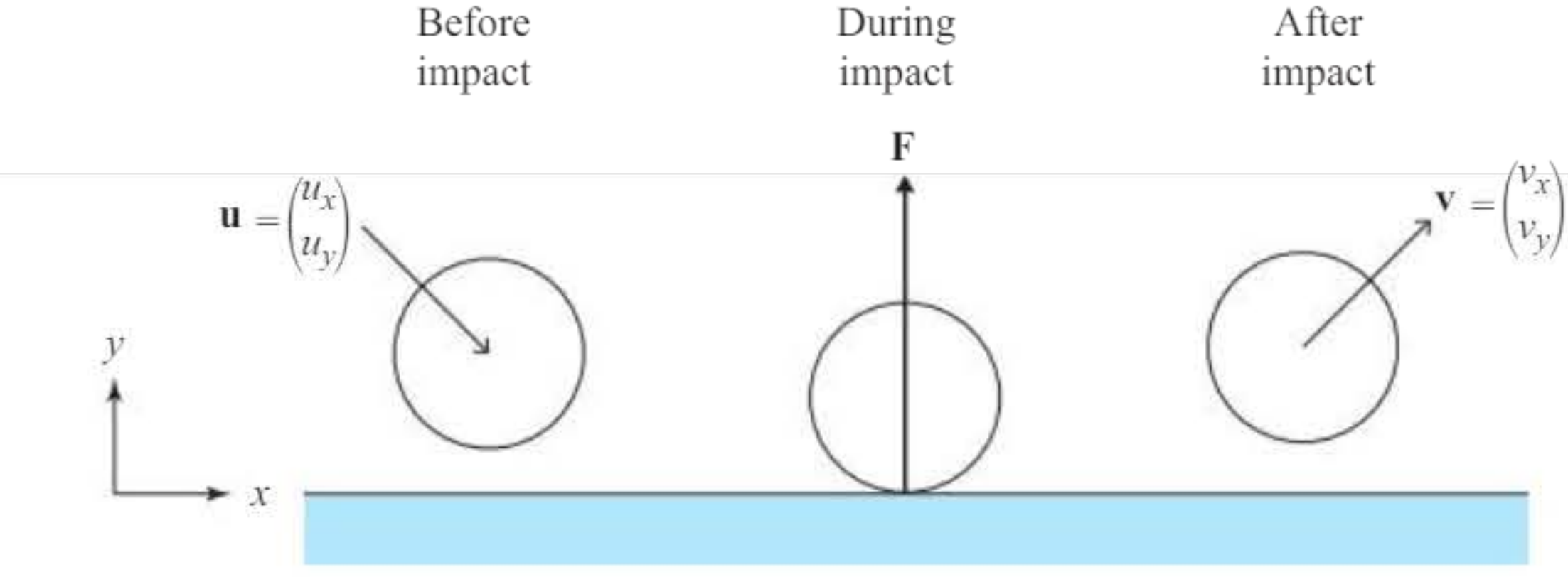
When a particle strikes a smooth, fixed plane at an angle, we must consider two directions separately: parallel to the plane and perpendicular to the plane.
Parallel to the plane: Since the plane is smooth, there is no friction force parallel to the plane. Therefore, momentum is conserved in this direction:
The horizontal component of velocity remains unchanged.
Perpendicular to the plane: The plane exerts a force perpendicular to its surface during impact. This is an external force, so momentum is not conserved in this direction. However, Newton's experimental law still applies:
where is the component of velocity perpendicular to the plane before impact, and is the component after impact.
Note
Key Principle for Oblique Impacts
The key to solving oblique impact problems is recognizing that:
- Motion parallel to the plane is unaffected (no friction on smooth surfaces)
- Motion perpendicular to the plane follows Newton's experimental law (impact force acts here)
This separation of components simplifies what might initially seem like a complex problem.
Worked example 2: Ball striking a smooth plane
Example
Worked Example: Oblique Impact with a Plane
Problem: A ball strikes a smooth fixed plane with velocity m s. The coefficient of restitution is . Find the final velocity after impact and the angle it makes with the plane.
Solution:
Step 1: Identify components parallel and perpendicular to the plane.
The plane is horizontal, so:
- Parallel component: m s
- Perpendicular component: m s (magnitude, approaching plane)
Step 2: Apply momentum conservation parallel to plane.
Since the plane is smooth, the horizontal component is unchanged:
Step 3: Apply Newton's experimental law perpendicular to plane.
Step 4: Write the final velocity.
Step 5: Calculate the angle using trigonometry.
Answer: The ball rebounds with velocity m s at an angle of approximately 24.8° to the plane.
Important
Exam Tip for Oblique Impacts
In oblique impact problems, always split the velocity into components parallel and perpendicular to the surface. Apply conservation of momentum in one direction and Newton's law in the other. Never try to apply both principles in the same direction.
Problem-solving strategy for collision problems
When solving collision problems involving elasticity, follow these three steps:
-
Draw and label a diagram showing the situation before and after the collision. Include all velocities and masses.
-
Check for external forces and determine whether momentum is conserved. If there are no external forces on the system, momentum is conserved.
-
Write the momentum equation and Newton's equation, taking care with signs, and solve them simultaneously.
Note
This systematic approach helps avoid errors and ensures you don't miss any important information. Even in exam conditions when time is limited, these three steps will save you time by organizing your thoughts and preventing mistakes.
Multiple collisions with walls
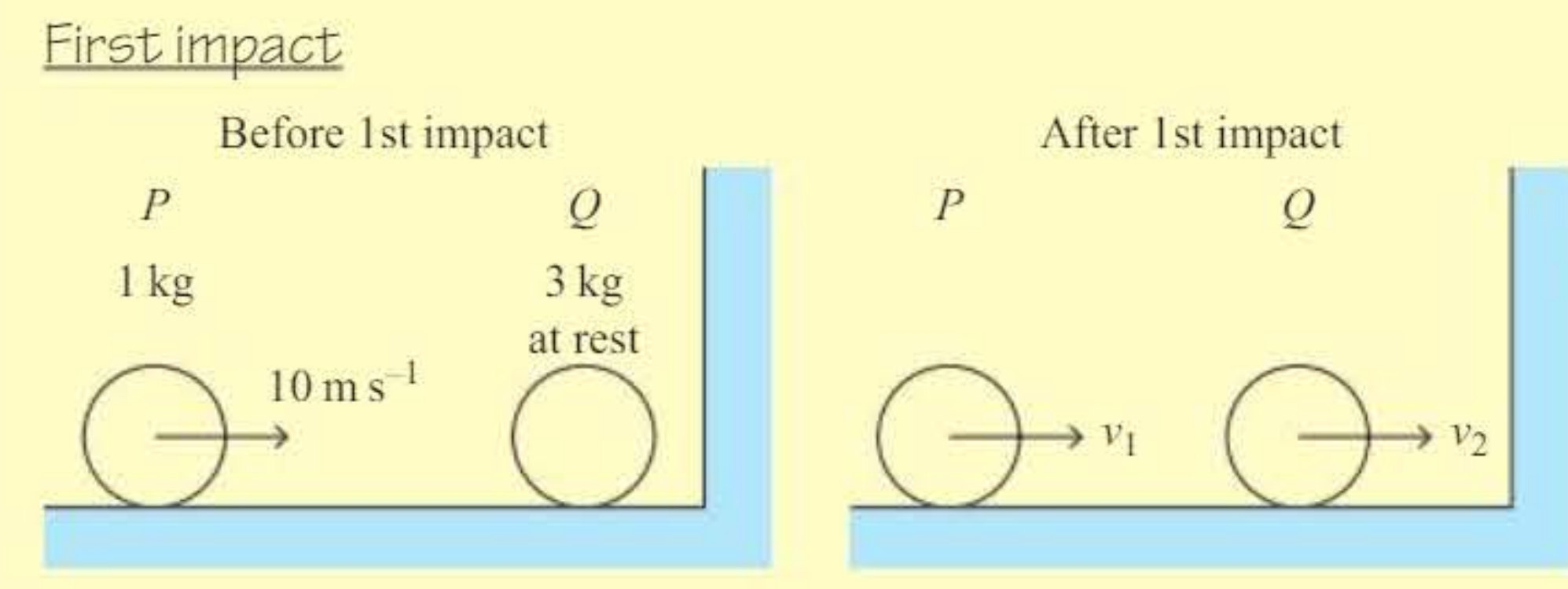
When collisions involve walls or barriers, external forces act on the objects hitting the wall, so momentum is not conserved for those objects. However, you can still use Newton's experimental law for impacts with the wall.
For multiple collisions, analyze each collision separately, then check whether subsequent collisions will occur based on the velocities.
Worked example 3: Two spheres with wall
Example
Worked Example: Multiple Collisions with a Wall
Problem: Two spheres P (mass 1 kg) and Q (mass 3 kg) lie on a smooth horizontal plane with line PQ at right angles to a vertical wall. P moves at 10 m s and collides directly with Q, which is initially at rest. Q then hits the wall and rebounds. The coefficient of restitution between the spheres is 0.4 and between Q and the wall is . Show that P and Q collide again if .
Solution:
First impact (P colliding with Q):
Step 1: Draw a diagram showing velocities before and after first impact.
Before: P at 10 m s, Q at rest. After: P at , Q at .
Step 2: Check for external forces.
There are no external forces during this collision, so momentum is conserved.
Step 3: Write equations.
Momentum equation:
Newton's equation:
Step 4: Solve simultaneously.
From equations (1) and (2):
P is now moving away from the wall, and Q is moving towards the wall.
Second impact (Q colliding with wall):
Step 1: Draw another diagram.
Before: Q at 3.5 m s towards wall. After: Q at away from wall.
Step 2: Note that momentum is not conserved because the wall exerts an external force on Q.
Step 3: Write Newton's equation only.
P and Q are now both moving away from the wall.
Condition for re-collision:
For P and Q to collide again, Q must be moving faster than P:
Therefore, P and Q collide again if .
Important
Collisions with Walls
In problems with walls, remember that the wall exerts an external force, so momentum is not conserved for the object hitting the wall. However, Newton's experimental law still applies. This is a key difference from particle-to-particle collisions.
Complex scenarios with multiple particles
When three or more particles are involved in successive collisions, analyze each collision separately using the same principles. After finding the velocities from one collision, use those as the initial conditions for the next collision.
Note
For complex scenarios with multiple particles, patience and organization are essential. Work through each collision methodically, keeping track of which particles are involved in each collision and what their velocities are at each stage.
Worked example 4: Three particles with successive collisions
Example
Worked Example: Three Particles with Two Successive Collisions
Problem: Particles P, Q, and R have masses 3 kg, 2 kg, and 1 kg with velocities 6 m s, 4 m s, and 2 m s respectively. They move in a straight line in this order. P strikes Q with perfect elasticity (). A second collision between Q and R has coefficient of restitution . Find the possible values of if there are no more collisions.
Solution:
First collision (P on Q):
Initially: P at 6 m s, Q at 4 m s, R at 2 m s. After first impact: P at , Q at , R still at 2 m s.
Momentum equation:
Newton's equation (with ):
Solving [1] and [2]:
Second collision (Q on R):
After second impact: Q at , R at .
Momentum equation:
Newton's equation:
From [3] and [4]:
Conditions for no more collisions:
For no further collisions, we need (so Q doesn't catch P) and (so R stays ahead of Q).
Condition 1:
Condition 2: From [4]: , so
Answer: Combining both conditions:
Important
Multiple Collision Problems
For multiple collision problems, work through each collision systematically. After finding velocities from one collision, check the velocity ordering to determine conditions for subsequent collisions or no further collisions. Always verify that your final answer satisfies all necessary conditions.
Summary and key points
Summary
Key Points to Remember:
-
The coefficient of restitution measures elasticity: for inelastic collisions (no bounce), for perfectly elastic collisions (maximum bounce), and for partial elasticity.
-
Use two equations for every collision problem: conservation of momentum (if no external forces) and Newton's experimental law ().
-
For oblique impacts with smooth planes, momentum is conserved parallel to the plane (no friction), but Newton's law applies perpendicular to the plane (where the impact force acts).
-
In multiple collision problems, analyze each collision separately and check velocity conditions to determine whether subsequent collisions occur.
-
Always take care with signs - choose a positive direction at the start and be consistent throughout your calculations. A negative velocity indicates motion in the opposite direction.