Distinctively Coastal Processes (AQA A-Level Geography): Revision Notes
📚Revision Notes
Distinctively coastal processes
Introduction to coastal geomorphological processes
Coastlines are dynamic environments shaped by the continuous interaction of various processes. These processes work together to create the unique landscapes we observe along our shores. Understanding these processes is essential for comprehending how coasts change over time.
There are two main categories of processes that shape coastlines:
Note
Marine processes – Operate upon a coastline and are connected with the sea, such as waves, tides and longshore drift. Marine processes are responsible for the direct erosion, transport and deposition of sediment along the coast.
Sub-aerial processes – Includes processes that slowly (usually) break down the coastline, weaken the underlying rocks and allow sudden movements or erosion to happen more easily. Material is broken down in situ, remaining in or near its original position.
Marine processes operate directly upon the coastline and are connected with the sea. These include the action of waves, tides and longshore drift. Marine processes are responsible for the direct erosion, transport and deposition of sediment along the coast.
Sub-aerial processes operate on the land but significantly affect coastal form. These processes slowly break down the coastline and weaken the underlying rocks, making sudden movements and erosion more likely. Importantly, material is broken down in situ (in its original position) or very close to where it started. Sub-aerial processes include weathering, mass movement and surface run-off.
The interaction between these marine and sub-aerial processes creates the distinctive character of coastal landscapes. As coastal systems develop over time, they tend toward a dynamic equilibrium where various processes balance each other out. However, changes in energy input can shift this balance, altering the characteristics of coastal features.
Sediment budget
The sediment budget is a fundamental concept in understanding coastal change. It represents the balance between sediment entering a coastal cell (inputs) and sediment leaving that cell (outputs).
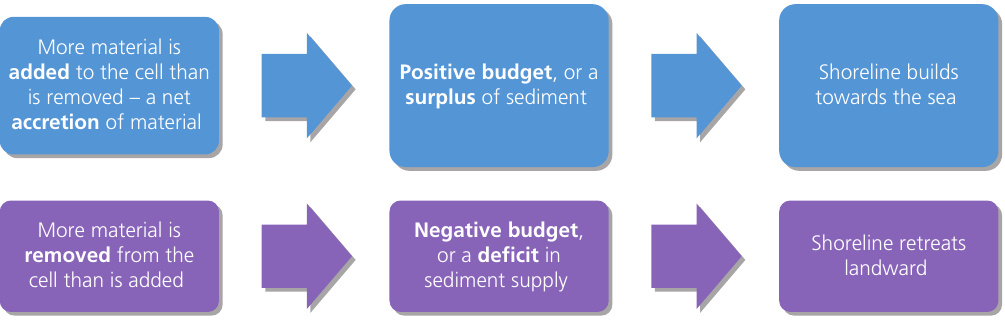
The sediment budget works as follows:
-
Positive budget (surplus): When more material is added to the coastal cell than is removed, there is a net accretion of sediment. This causes the shoreline to build seaward, a process known as progradation.
-
Negative budget (deficit): When more material is removed from the cell than is added, there is a deficit in sediment supply. This results in the shoreline retreating landward, leading to coastal erosion.
Note
Coastal erosion processes control the level of deficit by removing material from the shoreline. If erosion removes more sediment than is supplied by deposition and other sources, the coastline will recede. The sediment budget helps geographers identify where sediment comes from (sources) and where it accumulates or is lost (sinks).
However, calculating accurate sediment budgets is extremely complex and typically requires sophisticated computer models and extensive field measurements.
Overview of coastal processes
Coastal geomorphological processes form an interconnected system. The diagram below illustrates how different processes link together to shape the coastline.
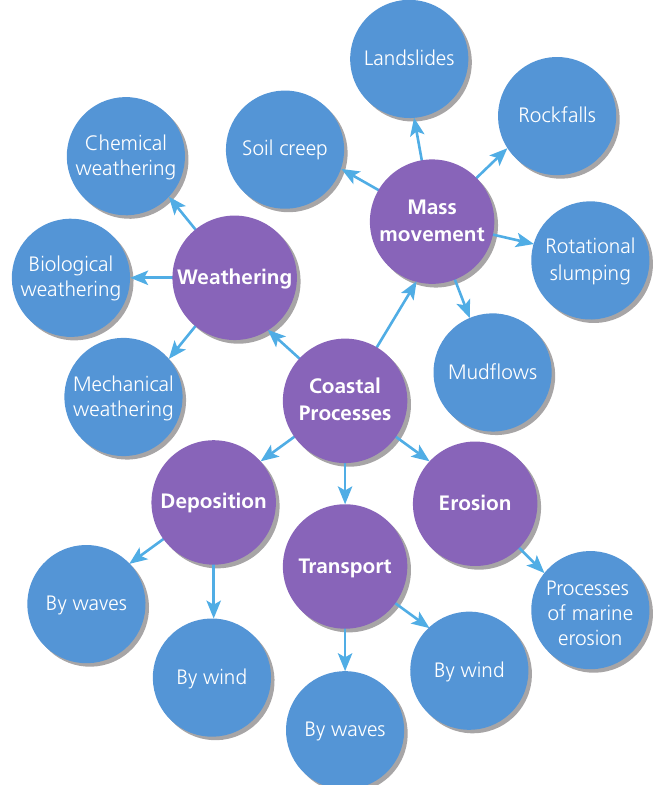
This system includes:
-
Weathering processes: Chemical, biological and mechanical weathering all break down rock material, preparing it for removal. Chemical weathering involves the decay of rocks through chemical reactions. Biological weathering occurs when plants and organisms break down rock. Mechanical weathering physically breaks rocks apart without changing their chemical composition.
-
Mass movement: Once material is weathered and weakened, gravity can cause it to move downslope. This includes soil creep (slow downhill movement), landslides, rockfalls, rotational slumping and mudflows. These processes deliver sediment to the coastal zone.
-
Marine processes: Waves are the primary agent of erosion, transport and deposition along the coast. Wind also plays a role in moving sediment, particularly in coastal dune systems.
The distinctive nature of coastal processes arises from this unique combination of land-based (sub-aerial) and marine influences working together.
Processes of marine erosion
Important
Waves can break on a coastline with considerable force. Research suggests that waves breaking at the foot of a cliff can generate energy of 25-30 tonnes per square metre. This immense power erodes coastlines through five main mechanisms.
Hydraulic action
Hydraulic action refers to the erosive impact of water itself, without the involvement of debris or rock fragments. The sheer force of the water exerts enormous pressure on rock surfaces, gradually weakening them.
This process is sometimes called wave pounding when waves crash directly against cliffs. The repeated impact of thousands of waves can cause significant damage over time, particularly to rocks with existing cracks or weaknesses.
Wave quarrying (cavitation)
Wave quarrying involves a more explosive form of hydraulic action. When a wave breaks against a cliff face, air becomes trapped and compressed within cracks, joints and fissures in the rock. The force of the water compresses this air, creating extremely high pressure within the rock structure.
As the wave retreats, this pressure is suddenly released, causing an explosive effect as the compressed air expands rapidly. This cycle of compression and release occurs repeatedly with each wave. Over time, the stress weakens the cliff face, and storms may remove large chunks of rock in dramatic fashion.
Note
Some researchers use the term cavitation to describe the effects of rapid pressure changes in areas of fast-flowing water, such as in rivers. The principles are similar – rapid pressure fluctuations cause structural damage to rock.
Abrasion and corrasion
Abrasion (also called corrasion) occurs when the sea uses the sediment it carries as tools to wear away the coastline. Sand, shingle and boulders are hurled against cliff faces, causing enormous damage through this grinding action.
This process is clearly visible along rocky coastlines where the waves crash against cliff lines. It's also apparent on inter-tidal rock platforms, where sediment is dragged back and forth across the surface with each wave, gradually wearing away the rock through friction and impact.
The effectiveness of abrasion depends on both the power of the waves and the amount of sediment available to act as erosive tools.
Attrition
Attrition doesn't directly erode the coastline, but it's an important related process. As rocks and pebbles are transported by waves and currents, they collide with each other. These collisions gradually wear down the fragments, making them smaller and more rounded.
Over time, angular boulders become smooth, rounded pebbles, and pebbles are eventually ground down into sand particles. This process makes the sediment easier to transport and helps explain why beach material often becomes finer along the coast in the direction of longshore drift.
Solution and corrosion
Solution (also called corrosion) is a form of chemical weathering that contributes to coastal erosion. It involves the dissolving of calcium-based rocks, particularly limestone and chalk, by slightly acidic seawater.
Note
Interestingly, seawater itself is not typically the main agent of solution. Pure seawater has a pH between 7.5 and 8.5, making it slightly alkaline. If seawater pH dropped below 7 (becoming acidic), it would likely kill much of the marine life. However, in localised areas where fresh water from the land mixes with seawater, conditions may become suitable for solution to occur.
Rainwater and groundwater flowing from the land can be slightly acidic, particularly if it has absorbed carbon dioxide from the atmosphere or organic acids from vegetation.
Some geographers also consider the effects of salt crystallisation, where salts from evaporated seawater form crystals within rock pores. As these crystals grow, they exert pressure on the rock, potentially causing it to break apart. This is definitely a weathering process but can contribute to the overall weakening of coastal rocks.
Factors affecting coastal erosion
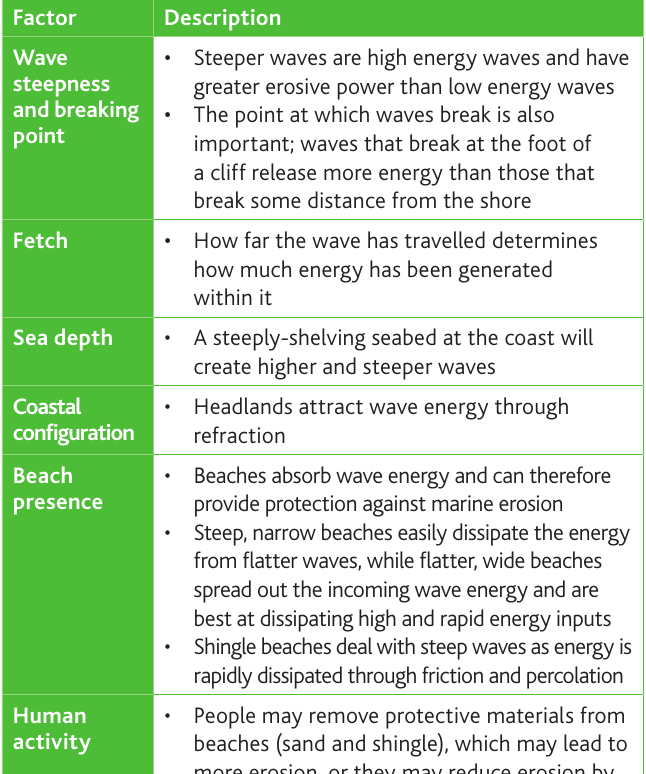
The rate at which coasts erode is influenced by numerous environmental and human factors. Understanding these factors helps explain why some coastlines erode rapidly whilst others remain relatively stable.
Wave characteristics
Wave steepness and breaking point are crucial factors. Steeper waves are high-energy waves with greater erosive power compared to low-energy waves. The point where waves break is particularly important – waves that break at the foot of a cliff release their energy directly against the cliff face, causing maximum erosion. In contrast, waves that break some distance from the shore lose much of their energy before reaching the coastline.
Fetch
Fetch refers to the distance of open water over which wind blows to generate waves. The longer the fetch, the more time waves have to build up energy. Therefore, coastlines exposed to large expanses of open ocean typically experience higher wave energy and faster erosion rates than sheltered coasts with limited fetch.
Sea depth
The depth of water near the coast affects wave behaviour. A steeply-shelving seabed (where water deepens rapidly close to shore) allows waves to maintain their energy right up to the coast, creating higher and steeper waves. These conditions promote more intense erosion.
Coastal configuration
The shape of the coastline influences erosion patterns. Headlands tend to attract and concentrate wave energy through a process called wave refraction. As waves approach a headland, they bend around it, focusing their energy on the protruding land. This makes headlands particularly vulnerable to erosion.
Beach presence
Beaches play a protective role by absorbing wave energy before it reaches the cliff or backing shore. The effect varies depending on beach characteristics:
-
Steep, narrow beaches composed of shingle easily dissipate wave energy. The friction and percolation of water through shingle removes energy efficiently. Shingle beaches can spread out incoming wave energy and are particularly effective at dissipating high and rapid energy inputs.
-
Flat, wide sandy beaches also provide protection, but shingle beaches deal with steep waves more effectively. Shingle beaches can cope with higher-energy conditions because water quickly percolates through the larger particles, and energy is rapidly dissipated through friction and percolation.
Important
Common Pitfall: Don't assume all beaches provide equal protection. Shingle beaches are particularly effective at dissipating wave energy through rapid percolation, making them better suited to protect against high-energy wave conditions than sandy beaches.
Human activity
Human interventions can either increase or decrease erosion rates. People may remove protective materials from beaches (such as sand and shingle extraction), which can increase vulnerability to erosion. Alternatively, humans may construct sea defences to reduce erosion.
Note
Coastal management strategies implemented in one location may inadvertently increase erosion rates elsewhere along the same coastline, as defences in one area can disrupt natural sediment movement.
Geological influences on erosion
One particularly important factor determining the nature and rate of erosional processes is the geology of the coastline.
Lithology
Lithology refers to the physical and chemical characteristics of rocks, especially their resistance to erosion and permeability.
Different rock types erode at vastly different rates. Very resistant rocks, such as granite, and to a lesser extent chalk, tend to erode much more slowly than weaker materials like clay. Strong, resistant rocks form prominent coastal features, whilst weaker rocks are eroded more rapidly, creating bays and inlets.
Note
The presence of joints (cracks in rocks) is significant because it affects permeability. Jointed rocks allow seawater to penetrate along lines of weakness, making them more vulnerable to erosion, particularly from hydraulic action and wave quarrying. Water can force its way into these natural fractures, gradually widening them and weakening the rock structure.
Variation in erosion rates due to rock type is known as differential erosion. This process is fundamental to creating the variety of coastal landforms we observe.
Rock structure
The structure and orientation of rocks also profoundly affect erosion patterns and the resulting coastline shape. When rocks lie parallel to the coast, they produce a very different type of coastline compared to when they lie at right angles (perpendicular) to the coast. These structural variations lead to distinctive coastal landscapes and will be explored further in your studies of coastal landforms.
The way rocks are arranged – their angle, layering and structural features – determines how waves attack them and influences which parts of the coast are most vulnerable to erosion.
Remember!
Summary
Key Points to Remember:
-
Coastal processes are interconnected systems involving both marine processes (waves, tides) and sub-aerial processes (weathering, mass movement) working together to shape coastlines.
-
The sediment budget determines coastal change – a positive budget leads to shoreline advance, whilst a negative budget causes coastal retreat.
-
Five main marine erosion processes attack coastlines: hydraulic action breaks rock through water pressure, wave quarrying uses trapped air explosively, abrasion grinds rock with sediment, attrition rounds transported material, and solution chemically dissolves susceptible rocks.
-
Multiple factors control erosion rates, including wave steepness and breaking point, fetch distance, sea depth, coastal shape, beach presence and human activity – all interact to determine how quickly a coast erodes.
-
Geology is fundamental to coastal evolution – lithology (rock type and characteristics) and rock structure determine which areas erode quickly and which resist, creating differential erosion that produces distinctive coastal landscapes.