Process, Time, Landforms and Landscapes (AQA A-Level Geography): Revision Notes
📚Revision Notes
Process, Time, Landforms and Landscapes
Understanding coastal landscapes through time
Coastal landscapes should not be viewed simply as static features. Each unique coastal landscape is an assemblage—a combination of different landforms that work together to create its distinctive character. To truly understand why a coastal landscape appears the way it does today, we must look beyond current processes and consider how different forces have shaped its features throughout history.
Note
When studying coastal landscapes, it's essential to adopt a temporal perspective—understanding how landforms have developed over time, not just how they appear today. This historical viewpoint reveals the complex interactions of processes that have created the distinctive features we observe.
Coastal environments are incredibly dynamic and constantly changing due to the large amounts of energy available from wind-driven waves, tides and currents. Where the sea and land meet, a wide variety of characteristic coastal landscapes form, including:
- Bays
- Estuaries
- Beaches
- Deltas
- Dunes
- Mud flats and salt marshes
Factors shaping coastal landscapes since the Holocene
The coastal landscapes we observe today are products of factors that shaped them during the Holocene period. The Holocene represents the time since the end of the last glacial period, roughly 12,000 years ago. Throughout this period, and continuing today, various factors have influenced and continue to modify coastal landscape features.
Key factors include:
- Local tectonic processes - movements of the Earth's crust affecting coastlines
- Sea level change - both global and local variations
- Climatic change - natural variations and those enhanced by human activity
- Changing ocean currents and wave regimes - alterations in water movement patterns
- Natural disasters or events - such as storms or tsunamis that dramatically reshape coasts
- Changing sources, types and amounts of sediment - affecting material available for landform construction
- The changing nature of human activity - coastal development, defences and management
Important
All these factors have continually operated over millennia, leaving their mark as features in present-day coastal landscapes. Contemporary coastal processes inevitably continue to alter and modify these features further. This means coastal landscapes are never truly static—they are constantly evolving systems shaped by both historical and ongoing processes.
Coastal sand dunes
What are coastal sand dunes?
Coastal sand dunes are mounds of sand formed through wind action. They represent a dynamic landform that constantly evolves and changes.
Like other coastal landforms, sand dunes can be studied using a systems approach. Understanding their formation and development requires examining the key inputs and processes involved.
Requirements for sand dune formation
For coastal sand dunes to develop, several important inputs must be present:
- A plentiful supply of sand - adequate sediment availability
- Strong onshore winds - to transport sand inland
- A large tidal range - exposing extensive areas of sand for wind transport
- An obstacle to trap the sand - such as driftwood, seaweed, rocks or litter at the back of the beach
- Vegetation growth - to encourage further accumulation and stabilisation of the dune
Note
Think of these five requirements as the essential ingredients for sand dune formation. Without any one of these inputs, the dune system cannot develop properly. The interaction between these factors determines where and how effectively sand dunes will form along a coastline.
How sand moves inland
Sand is predominantly moved inland through a process called saltation. This occurs because of differential heating between the land and sea, creating localised variations in atmospheric pressure.
During the day, wind on the coastal fringe generally blows from the sea towards the land. This happens because air moves towards areas of slightly lower atmospheric pressure generated over the land as the air warms and rises over the warmer land surface, from the slightly higher pressure over the cooler sea.
Where a large tidal range exists, substantial amounts of sand are exposed at low tide. This exposure, combined with onshore winds, contributes significantly to dune formation.
The sequence of sand dune development
The vegetation succession and development of the sand dune psammosere ecosystem involves distinct stages. The sequence of sand dune development from the beach inland is as follows:
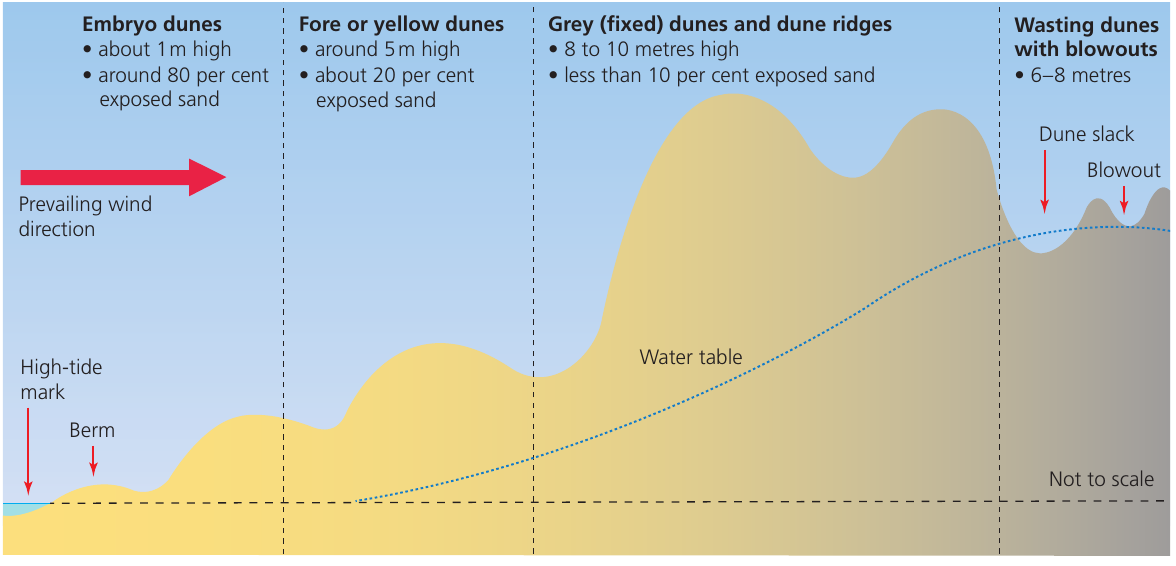
Embryo dunes
Sand becomes trapped by obstacles (seaweed, rock, driftwood, litter) at the back of the beach, possibly on the highest berm or storm beach. The first dunes to develop are called embryo dunes.
These dunes are suitable for colonisation by grasses, which can grow upwards through accumulating wind-blown sand. Pioneer species like marram grass stabilise the surface. Low, hummocky dunes form as roots and underground shoots (rhizomes) of marram grass bind the sand together.
Example
Embryo Dune Characteristics:
- Height: Approximately 1 metre high
- Exposed sand: Around 80% exposed sand
- Vegetation: Pioneer species like marram grass beginning to colonise
- Stability: Low stability, actively accumulating sand
- Location: At the back of the beach, near the berm
Foredunes (mobile dunes or yellow dunes)
Upward growth of embryo dunes raises their height, creating dunes beyond the reach of all but the highest storm tides. These are known as foredunes or mobile dunes.
Initially appear yellow because they contain little organic matter, as vegetation cover increases. As the dunes develop, humus is added to the sand, giving them a more grey colour. Can reach heights of up to 20 metres in places.
Example
Foredune Characteristics:
- Height: Approximately 5 metres high (can reach up to 20 metres)
- Exposed sand: About 20% exposed sand
- Appearance: Yellow colour due to low organic content
- Vegetation: Increasing vegetation cover, primarily marram grass
- Stability: Mobile, still actively developing
Grey (fixed) dunes and dune ridges
The dunes gradually become fixed as vegetation establishes more firmly. An organic layer develops as other types of vegetation colonise alongside the marram grass. The presence of plants adds organic matter to the dunes, which aids water retention.
These dunes appear more grey in colour due to increased humus content.
Example
Grey Dune Characteristics:
- Height: 8 to 10 metres high
- Exposed sand: Less than 10% exposed sand
- Appearance: Grey colour due to high organic matter content
- Vegetation: Diverse plant communities, well-established
- Stability: Fixed and stable, mature dune system
Dune slacks
Dune slacks are depressions that develop within the dune system. Found in places where the dunes meet the water table (which is on or near the surface). Conditions in dune slacks are often damp.
Note
Dune slacks provide unique habitats within the dune system. The damp conditions created where the water table reaches the surface support distinctive plant and animal communities that differ from the drier dune ridges. These areas are important for biodiversity within coastal dune systems.
Wasting dunes and blowouts
Behind the yellow and grey dunes, the supply of sand is gradually cut off. This creates smaller dune features in these areas, sometimes referred to as wasting dunes.
Alternatively, these areas may become zones of dune heath. Within this system, blowouts can form where wind has been funnelled through areas and removed the sand. Wildlife or human activity can often act as a catalyst for blowout formation.
Example
Wasting Dune Characteristics:
- Height: 6 to 8 metres high
- Formation: Reduced sand supply behind main dune ridges
- Features: May develop into dune heath; blowouts common
- Causes of blowouts: Wind funnelling, wildlife activity, or human trampling
The role of vegetation
Vegetation plays a critical role throughout sand dune development:
- Vegetation growth encourages further accumulation and growth of the dune
- Plants help stabilise dunes by binding sand with their root systems
- As vegetation cover increases, more organic matter is added to the sand
- This organic matter improves water retention capacity
- Different plant species colonise at different stages, creating a succession from pioneer species to more established plant communities
Important
The relationship between vegetation and dune stability is crucial to understand. Pioneer species like marram grass are specially adapted to survive in harsh, mobile sand conditions and are essential for initial dune stabilisation. Without vegetation, sand dunes would remain mobile and unstable, constantly shifting with the wind. The progressive increase in vegetation cover from embryo dunes to grey dunes represents a key indicator of dune maturity and stability.
Remember!
Summary
Key Points to Remember:
- Coastal landscapes are assemblages of landforms that must be understood through both present processes and historical development
- Multiple factors operating since the Holocene period (12,000 years ago) have shaped the coastal landscapes we see today
- Coastal sand dunes are dynamic landforms formed by wind action, requiring specific inputs including sand supply, onshore winds, large tidal range, obstacles and vegetation
- Sand dunes develop through a clear succession sequence: embryo dunes → foredunes (yellow/mobile) → grey (fixed) dunes → dune slacks → wasting dunes with blowouts
- Vegetation is essential for dune stabilisation and development, with increasing plant cover and organic matter characterising more mature dune stages