Processes of Transportation and Deposition (AQA A-Level Geography): Revision Notes
📚Revision Notes
Processes of Transportation and Deposition
Marine transportation
Wave and tidal energy that isn't consumed during erosion or lost through friction with the seabed can be used to move material along the coast. The transportation of sediment by the sea is an important mechanism of coastal change. It drives both erosion and deposition processes and represents a significant transfer of material along coastlines.
Note
The sea transports material through four main processes, each operating under different energy conditions and moving different sizes of sediment.
The sea transports material through four main processes:
Traction
This process involves the largest sediment. Heavy stones and boulders are rolled and pushed along the seabed and beach by the force of moving seawater. Traction requires high energy conditions to move these large particles, so it typically occurs during storms or in areas with powerful waves and strong currents.
Saltation
Smaller stones and pebbles bounce or jump along the seabed and beach in a leapfrog motion. This process happens in relatively high energy conditions. The movement works through a chain reaction: small particles are thrust upward from the seabed, only to fall back down. As these particles land, they dislodge other particles upwards, creating continuous bouncing movements across the seabed.
Note
The saltation process creates a domino effect where each falling particle triggers the movement of others, maintaining continuous sediment transport along the seabed.
Suspension
Very fine particles of sand and silt are carried along within the moving water itself. The material doesn't just get transported passively; it's also picked up from the seabed, mainly through turbulence in the water. Large amounts of suspended sediment, particularly near river mouths and estuaries, can give the sea a milky or cloudy appearance.
Solution
Dissolved minerals and chemicals are transported within the mass of moving water. This is an invisible form of transportation, as the materials are chemically dissolved rather than physically carried. The dissolved load can be substantial over time.

As waves rarely approach the coastline straight on, these transport processes combine to move material sideways along the coast.
Longshore drift
When waves approach the shore at an angle, material gets pushed up the beach by the swash in the same direction as the incoming waves. As the water runs back down the beach, the backwash drags material down the steepest gradient, which is usually perpendicular to the shoreline where gravity pulls the water most directly back to sea.
Important
Over time, sediment moves in a zigzag pattern along the coast. If material travels some distance through this process, it becomes progressively smaller and better sorted due to continued abrasion and selective transport.
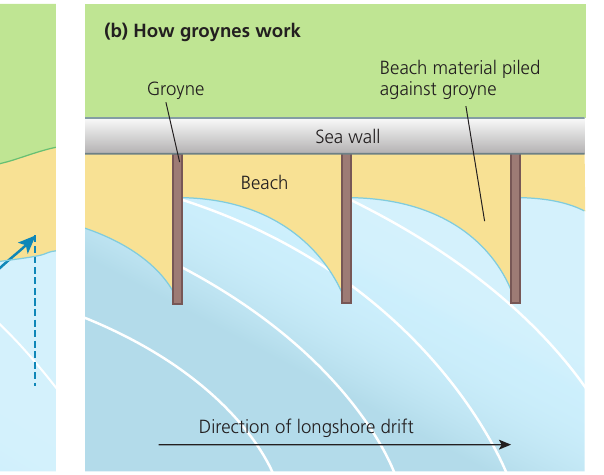
Obstacles such as groynes (wooden barriers built perpendicular to the beach) and piers can interrupt this drift. Sediment accumulates on the windward side of these structures, leading to entrapment of beach material. Deposition of trapped material occurs in sheltered locations, such as the head of a bay or where the coastline changes direction abruptly. In these areas, spits often develop.
Marine deposition
Deposition occurs when waves have low energy or where rapid coastal erosion provides an abundant supply of material. The sea lays down material when there is a reduction in energy. This happens due to a decrease in velocity or volume of water.
Note
When Does Deposition Occur?
Marine deposition happens in several specific situations that create favorable conditions for sediment accumulation:
Several situations lead to deposition:
- Sand and shingle accumulate more quickly than they are removed
- Waves slow down after breaking, reducing their carrying capacity
- Water pauses at the top of the swash before backwash begins, causing temporary settling
- Water percolates down into the beach material as backwash occurs, reducing the volume of water returning to the sea
These conditions are most common in sheltered bays, behind coastal defences, and in areas protected from prevailing winds and waves.
Aeolian deposition
Important
Aeolian processes refer to the entrainment, transport and deposition of sediment by wind. Wind plays a crucial role in shaping many coastlines.
Wind is an almost constant feature of coastal areas, not just because of the general pattern of prevailing winds that drives the waves. During the day, wind on the coastal fringe usually blows from the sea onto the land. Air moves in response to small pressure differences created by the warmer land and colder sea. When there is a large tidal range, extensive areas of sand may be exposed at low tide. This provides an ample supply of sediment to be picked up and transported by the wind.
Sand-sized sediment is the most significant material for creating depositional features at the coast. Once picked up by the wind, sand typically travels close to the ground and over relatively short distances before being deposited.
Surface creep
This process works similarly to traction in water. Wind rolls or slides individual sand grains along the surface. The grains maintain contact with the ground as they move.
Saltation
When wind is strong enough, it temporarily lifts sand grains into the airflow. The grains can be carried to heights of up to one metre and transported for distances between 20 and 30 metres before falling back to the surface.
Note
Both wind transport processes depend on wind speed and how dry or moist the sand source is. Wind action shapes and forms various coastal landforms, with beaches and sand dunes being the most obvious examples.
Sub-aerial weathering
Sub-aerial weathering encompasses processes that slowly break down the coastline. These processes weaken the underlying rocks, making them more vulnerable to sudden movements or erosion. Material is broken down in situ, meaning it remains in or near its original position rather than being transported away immediately.
Important
Weathering processes are common at the coast due to the presence of both air and water, as well as cycles of wetting and drying. These processes are essential in preparing rocks for erosion by weakening their structure.
Three main categories exist: mechanical/physical weathering, biological weathering, and chemical weathering.
Mechanical/physical weathering
These processes depend on the nature of the climate and physical forces acting on rocks.
Example
Worked Example: Freeze-Thaw Action
Freeze-thaw weathering is particularly common in areas where temperatures fluctuate above and below freezing:
Step 1: Water enters cracks in the rock during warmer periods
Step 2: When temperatures drop, the water freezes and expands by almost 10%
Step 3: The ice occupies more space and exerts pressure on the surrounding rock
Step 4: As this process repeats continuously, cracks widen progressively
Result: Eventually, rock fragments break off completely
Pressure release occurs where processes of erosion, weathering and mass movement remove overlying material from rock. The rock beneath experiences pressure release as the weight above it is unloaded. This unloading mechanism causes the rock to expand slightly, which develops weaknesses such as cracks and joints. These allow the rock to expand further, making it increasingly susceptible to other erosion and weathering processes.
Biological weathering
These are processes that lead to rock breakdown through the action of vegetation and coastal organisms. Biological weathering is particularly active on coastlines.
Some marine organisms have specially adapted features that enable them to bore into solid rock. The piddock, a type of shellfish, is especially effective at drilling into rock. These organisms are particularly active in areas with chalk geology, creating a distinctive sponge-like rock surface pitted with holes.
Seaweed attaches itself firmly to rocks. The action of the sea can be powerful enough to cause swaying seaweed to prise away loose rocks from the seafloor.
Note
Other organisms, such as algae, secrete chemicals capable of promoting solution weathering. Animals including rabbits and cliff-nesting birds can weaken cliffs as they burrow or dig into them, creating passages that compromise structural integrity.
Chemical weathering
Chemical weathering occurs where rocks are exposed to air and moisture, allowing chemical processes to break down the rock material.
Solution is the main chemical process at coasts. It combines with erosion to produce many distinctive coastal features. When minerals dissolve in water, they are removed in solution.
Oxidation causes rocks to disintegrate when oxygen dissolved in water reacts with certain rock minerals. This particularly affects ferrous (iron-rich) rocks, producing distinctive brownish or yellowish staining of the rock surface.
Hydration makes rocks more susceptible to further chemical weathering. It involves the physical addition of water to minerals in the rock. This causes the rock to expand, creating stress which can itself cause the rock to disintegrate. The process weakens the rock and can create or widen cracks and joints, allowing further chemical weathering to occur.
Note
Hydrolysis is where mildly acidic water reacts or combines with minerals in rocks to create new, more soluble salts. These salts degrade the rock, but both are likely to be weaker than the parent rock, making it more susceptible to further degradation.
Carbonation occurs where carbon dioxide dissolved in rainwater creates a weak carbonic acid. This reacts with calcium carbonate in rocks like limestone and chalk to create calcium bicarbonate, which then dissolves easily in water. Carbonation is more effective with cooler temperatures, as this increases the amount of carbon dioxide that can dissolve in the water. As levels of carbon dioxide in the atmosphere continue to rise due to industry and fossil fuel burning, there are increasing levels in rainwater too, making it mildly acidic.
Important
Acid rain results from unnaturally high levels of other gases associated with industry and fossil fuel combustion in the atmosphere. These also react with rainwater, creating weak sulphuric and nitric acids. This acid rain then reacts with various minerals in different rocks, weakening or even dissolving them.
Remember!
Summary
Key Points to Remember:
-
The four main marine transportation processes are traction (rolling), saltation (bouncing), suspension (carrying in water), and solution (dissolved transport).
-
Longshore drift moves material along the coast in a zigzag pattern when waves approach at an angle, with swash pushing material up the beach and backwash dragging it back down.
-
Marine deposition occurs when wave energy decreases, typically in low energy environments or where abundant sediment is supplied by erosion.
-
Aeolian processes (wind action) transport sand through surface creep and saltation, playing an important role in shaping coastal features like dunes.
-
Sub-aerial weathering includes mechanical processes (freeze-thaw, pressure release), biological processes (organisms and vegetation), and chemical processes (solution, oxidation, carbonation, acid rain) that weaken rocks in situ before erosion occurs.