Ecosystems and Processes (AQA A-Level Geography): Revision Notes
📚Revision Notes
Ecosystems and processes
What is an ecosystem?
An ecosystem brings together living organisms and their non-living surroundings into a working system. Within an ecosystem, organisms interact with each other and with their environment in complex ways.
Ecosystems can vary greatly in size. They might be as vast as a tropical rainforest stretching across thousands of square kilometres, or as small as a single tree or even a puddle. The key feature is that all the components work together as a unit.
Important
An ecosystem is a system in which organisms interact with each other and the environment.
Ecosystems function as open systems. This means energy and materials can enter and leave the system. The different parts of an ecosystem work together in a balanced way, with energy flowing through in one direction whilst nutrients cycle between components.
The structure of ecosystems
Each ecosystem has two main components:
- Abiotic (non-living)
- Biotic (living)
These components interact continuously, shaping the character and functioning of the ecosystem.
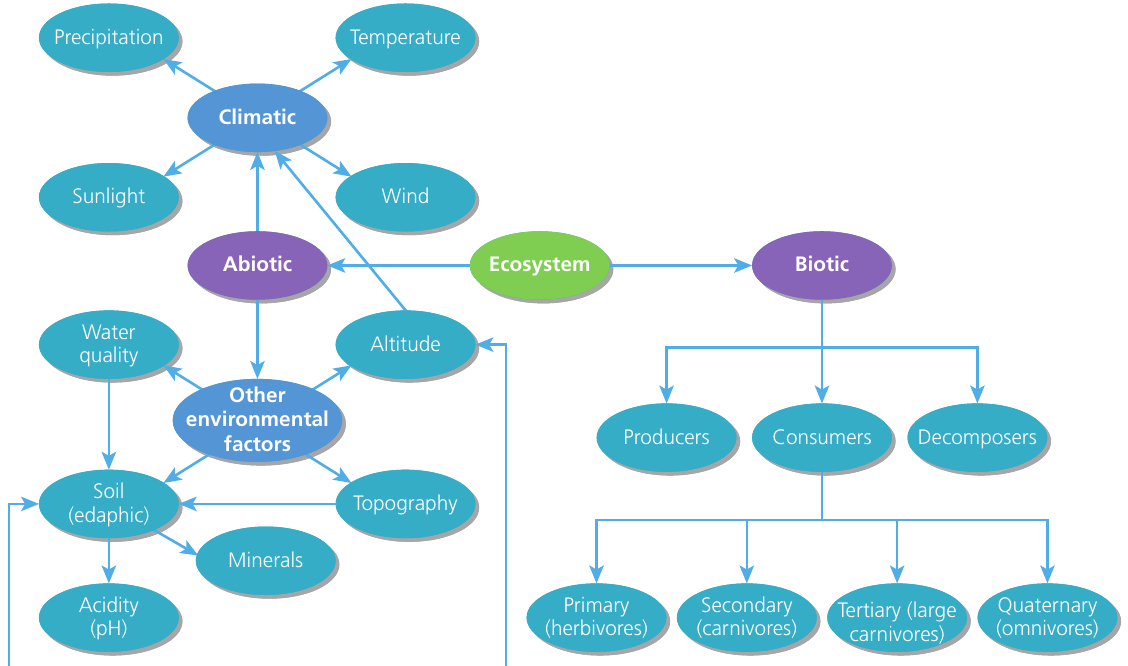
Abiotic components
Abiotic factors include all the non-living elements within an ecosystem. These factors have a powerful influence on which organisms can survive, how they behave, where they live, and how they interact with one another.
Note
The abiotic factors present vary between different ecosystems. For example, aquatic ecosystems are influenced by factors like water depth, acidity levels (pH), and water clarity, whilst terrestrial ecosystems depend more on factors such as rainfall, air temperature, and soil characteristics.
Climatic factors
These environmental factors have the greatest influence on ecosystem characteristics:
Precipitation (rainfall)
- Rainfall amounts vary depending on several factors including distance from the equator (latitude), position within a continent, and landscape features
- Some locations receive year-round precipitation whilst others experience seasonal droughts or very little rainfall throughout the year
- Temperature also varies with latitude - equatorial regions remain warm whilst polar regions stay cold, with temperate zones experiencing moderate conditions
- Continental interiors typically experience a wider temperature range compared to coastal areas
- Humidity levels determine the amount of moisture present in the air and soil, which directly affects rainfall patterns
Sunlight
- Provides the energy source for photosynthesis
- Amount received varies by latitude and season
- Also affected by aspect (direction slopes face) and cloud cover
Wind
- Can bring precipitation to an area
- Can also have a drying effect depending on humidity levels
- Stronger winds occur at higher altitudes
- Wind can cause physical damage to plants and discourage tree growth above certain elevations (the tree line)
Temperature
- Affects rates of biological processes
- Influences which species can survive in different locations
- Varies with latitude, altitude, and proximity to oceans
Topography
Topography refers to the layout and shape of the land surface, including features like elevation, gradient, and the direction slopes face (aspect).
For example, in the Northern Hemisphere, south-facing slopes receive more direct sunlight and therefore more solar energy than north-facing slopes. This creates warmer, drier conditions that support different plant and animal communities.
Altitude
Altitude means the height above sea level. The types of organisms found in mountainous areas change with elevation because climate changes as you go higher.
Note
Key altitude effects:
Temperature drops as altitude increases (approximately 1°C for every 100 metres gained), creating increasingly severe winters at higher elevations. This temperature change, combined with increased wind speeds and precipitation patterns, creates distinct life zones - bands of similar ecosystems occurring at similar altitudes around mountains.
Mountain ranges force air masses to rise, causing cooling and precipitation, creating rain shadows on the opposite side. Wind speed increases with height, causing physical damage to vegetation and discouraging tree growth. Only specially adapted plants like grasses, sedges, mosses, shrubs and lichens can survive the extreme cold and strong winds of alpine zones.
Biotic components
The biotic components are the living organisms found within an ecosystem. This includes plants, animals, and micro-organisms such as bacteria and fungi.
Biotic components can be organised into three functional groups based on how they obtain energy:
Producers
Important
Producers (also called autotrophs) are organisms that manufacture their own food using energy from the sun.
Green plants possess chlorophyll, a pigment that allows them to transform sunlight into stored chemical energy through the process of photosynthesis. During photosynthesis, plants use carbon dioxide from the air, water from the soil, and solar energy to create glucose (sugar) and oxygen.
The chemical energy created and stored by producers provides the foundation for all other life in the ecosystem. Some of this stored energy is used by the plant itself for growth and survival, whilst the remainder stays stored in the plant tissues for future use.
Consumers
Important
Consumers (also called heterotrophs) are animals that cannot produce their own food and must therefore obtain energy by eating other organisms.
Animals lack chlorophyll and cannot perform photosynthesis. They depend entirely on producers (or other consumers) for their energy and nutrients.
There are four types of consumer, organised by their position in the food chain:
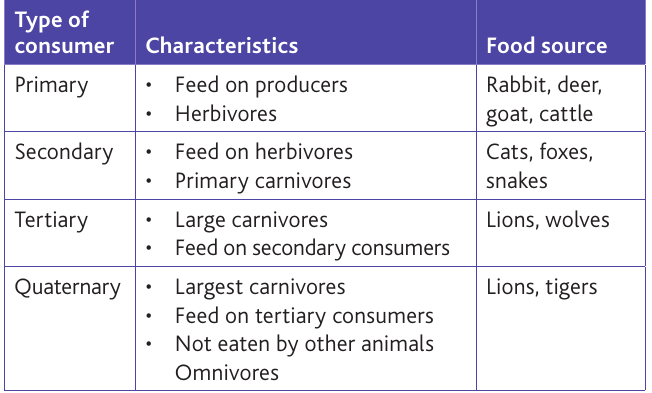
Primary consumers are herbivores that feed directly on plant material (the producers). Examples include rabbits, deer, goats, and cattle.
Secondary consumers are carnivores that hunt and eat herbivores. These primary carnivores include animals like cats, foxes, and snakes.
Tertiary consumers are large carnivores that feed on secondary consumers. Examples include lions and wolves.
Quaternary consumers represent the top level of the food chain. These apex predators are the largest carnivores, feeding on tertiary consumers but not being eaten by other animals themselves. Lions and tigers are examples. These animals are also omnivores, meaning they can eat food from multiple trophic levels.
Note
Trophic level refers to an organism's position in the food chain. Level 1 consists of autotrophs which produce their own food. Level 2 organisms consume level 1, level 3 consume level 2, and so on.
Decomposers
Decomposers include bacteria and fungi that break down dead organic material from both producers (plants) and consumers (animals). They obtain their energy and nutrients from this dead matter.
As decomposers break down dead organisms, they release simple inorganic and organic substances back into the environment as by-products of their metabolism. This makes nutrients available again for use by producers.
Note
These nutrients are continuously recycled and re-used by the producers. This creates a cyclical exchange of materials between the living community (biotic components) and the non-living environment (abiotic components) of the ecosystem.
Energy flows in ecosystems
Energy movement through ecosystems follows a specific pattern. Organisms require energy for growth, maintenance, reproduction, and movement. Therefore, all ecosystems must have both a source of energy and a way for energy to be lost from the system.
Energy input
All the energy used by living things ultimately comes from the Sun. Energy enters ecosystems through photosynthesis performed by plants and certain bacteria.
However, energy capture is quite inefficient. Less than two per cent of the incoming sunlight is actually captured by plants. Of the energy that plants do capture, more than half is used by the plants themselves for respiration or is lost as heat.
Important
This means only a small fraction of the sun's energy becomes stored in plant tissues and available to consumers. At each step up the food chain (each trophic level), more energy is lost through respiration and heat. This is why ecosystems typically cannot support many levels of consumers.
Energy cycling
The continuous recycling of nutrients between the biotic community and the abiotic environment ensures the long-term functioning of ecosystems. Whilst energy flows in one direction through the system (from sun to producers to consumers to decomposers, with loss at each stage), nutrients cycle repeatedly between living organisms and the non-living environment.
Remember!
Summary
Key Points to Remember:
- Ecosystems contain both abiotic (non-living) and biotic (living) components that interact together
- Abiotic factors like precipitation, temperature, sunlight, wind, topography, and altitude determine which organisms can survive in an ecosystem
- Biotic components are organised into:
- Producers (plants making food through photosynthesis)
- Consumers (animals eating other organisms at four different levels)
- Decomposers (bacteria and fungi breaking down dead material)
- Ecosystems are open systems where energy flows in one direction - from the sun through producers to consumers - with significant energy loss at each stage
- Nutrients cycle continuously between living organisms and the non-living environment through decomposition and re-use