Energy Flows (AQA A-Level Geography): Revision Notes
📚Revision Notes
Energy Flows
Ecosystems as open systems
An ecosystem functions as an open system, meaning it continuously exchanges both energy and materials with its surroundings. This is essential for understanding how energy moves through the living world.
Note
An open system is one that exchanges both energy and materials with its surroundings, unlike a closed system which only exchanges energy, or an isolated system which exchanges neither.
The ecosystem receives various inputs and produces several outputs:
Inputs include:
- Solar radiation from the Sun (the primary energy source)
- Plants arriving through seed dispersal
- Animals entering through migration
- Soil organic matter from erosion and deposition
Outputs include:
- Longwave radiation released to space
- Heat released to the surrounding environment
- Plants leaving through dispersal
- Animals leaving through migration
- Soil organic matter lost through erosion and leaching
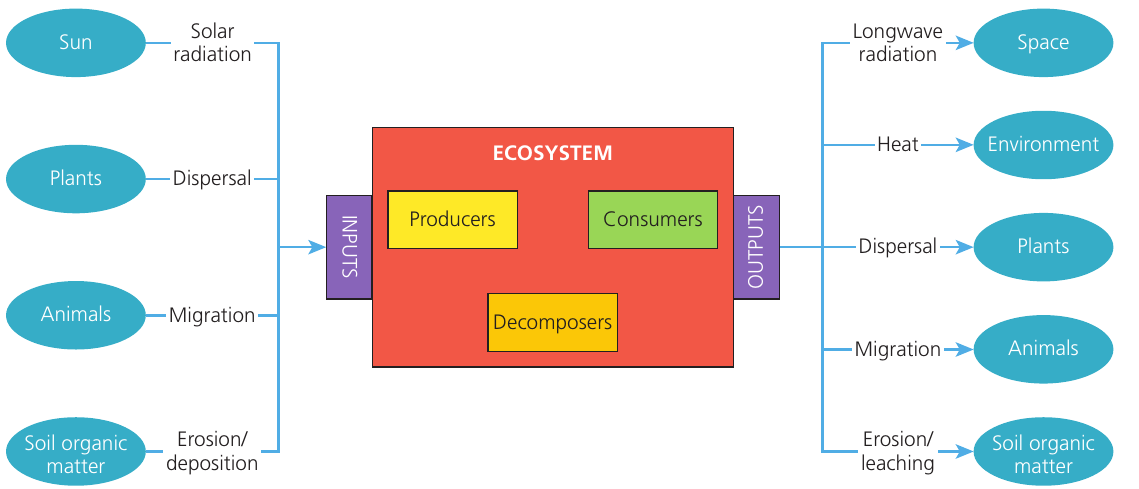
This exchange of energy and materials allows the ecosystem to function, but it's important to note that whilst materials can cycle through the system, energy follows a one-way path, ultimately being lost as heat.
Biotic components and energy relationships
Within an ecosystem, living organisms are organised into three main functional groups that work together to transfer and transform energy.
Producers
Producers are the foundation of all ecosystems. These are green plants that contain chlorophyll, a pigment that enables them to capture light energy from the Sun and convert it into chemical energy through photosynthesis. Because producers manufacture their own food, they are also called autotrophs.
The chemical energy stored by producers serves two purposes:
- Some is used immediately for the plant's own growth and survival
- The remainder is stored in the plant's tissues for future use
This stored energy becomes available to other organisms in the ecosystem.
Consumers
Consumers are animals that lack chlorophyll and cannot produce their own food through photosynthesis. This means they must obtain their energy by eating other organisms - either plants or other animals. For this reason, consumers are also known as heterotrophs.
Consumers are organised into four levels based on their position in the food chain:
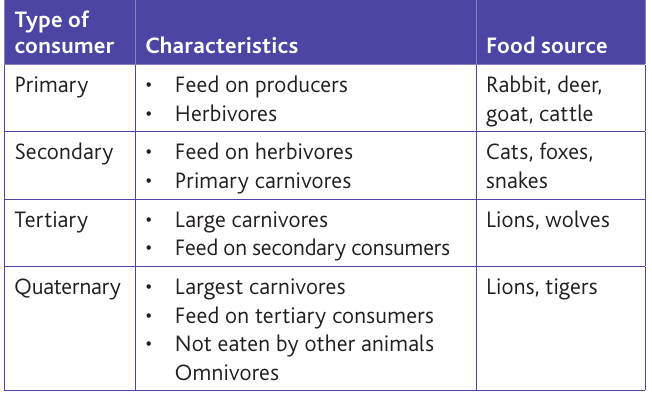
Primary consumers (herbivores) feed directly on producers. Animals such as rabbits, deer, goats and cattle obtain their energy by eating plant material.
Secondary consumers are primary carnivores that obtain their energy by eating herbivores. Cats, foxes and snakes are examples of animals at this level.
Tertiary consumers are large carnivores that feed on secondary consumers. Lions and wolves occupy this position in food chains.
Quaternary consumers are the largest carnivores in an ecosystem. These apex predators, such as lions and tigers, feed on tertiary consumers and are not typically eaten by other animals. Some quaternary consumers are omnivores, meaning they can eat both plants and animals.
Decomposers
Decomposers, such as bacteria and fungi, play a vital role in ecosystems by breaking down dead organic material from both producers and consumers. When they feed on this dead matter, they release simple inorganic and organic substances back into the environment as by-products of their metabolism.
Note
Decomposers create a cyclic exchange of materials between the biotic community (living organisms) and the abiotic environment (non-living components). This nutrient cycling is essential for ecosystem sustainability, as it ensures that vital nutrients are returned to the soil where they can be reused by plants.
This process creates a cyclic exchange of materials between the living organisms (the biotic community) and the non-living environment (the abiotic environment) of the ecosystem. Whilst materials cycle in this way, energy does not - it flows in one direction only.
Energy source and capture
All the energy that drives life in ecosystems ultimately comes from the Sun. Energy enters living systems through the process of photosynthesis carried out by plants and some bacteria.
Important
Energy capture is remarkably inefficient. Less than 2% of incoming sunlight is actually captured by plants. The remaining 98% of light energy is lost and never enters the ecosystem's energy flow.
Even worse, of the small amount of energy that plants do capture, more than half is immediately used in respiration and lost as heat. This means that only a tiny fraction of the Sun's energy becomes available to power the entire ecosystem.
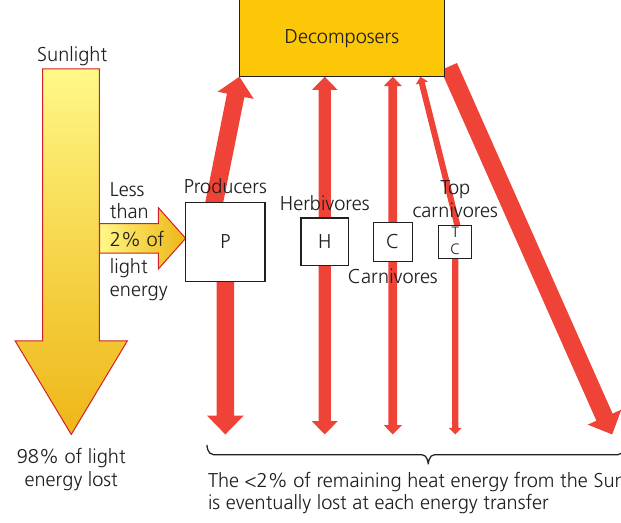
This diagram illustrates the dramatic energy losses that occur. The large yellow arrow on the left represents incoming sunlight, but notice how little of this energy actually moves through the system.
Energy transfer through ecosystems
Energy moves through the ecosystem via different pathways, but all transfers result in significant energy loss.
Direct access to plant energy
Two groups of organisms have direct access to the energy stored in plant tissues:
Herbivores feed on plants whilst they are alive, consuming leaves, stems, roots, or other plant parts. These primary consumers take in energy directly from the producers.
Decomposers feed on plant material after it has died, breaking down fallen leaves, dead roots, and other organic matter. This gives them access to plant energy that herbivores never consumed.
Energy in herbivore biomass
The term biomass refers to the mass of living tissue in organisms. Much of the energy contained in herbivore biomass follows two main pathways:
Carnivores consume herbivores, transferring energy up to the next trophic level. These meat-eaters rely entirely on the energy stored in herbivore tissues.
Decomposers also play a role here, breaking down herbivore waste products and eventually the bodies of dead herbivores.
Energy distribution patterns
In most ecosystems, the majority of plant energy doesn't actually flow through herbivores. For example, in grassland ecosystems, only about 10% of the energy stored in plants is consumed by grazing animals such as antelope. The remaining energy eventually becomes available to decomposers.
Note
Decomposers receive most of the energy in many ecosystems, making them critically important to ecosystem function. This is because herbivores typically consume only a small fraction of available plant material - leaves fall, plants die, and roots decay, all becoming food for decomposers rather than herbivores.
Energy use and loss
At every level of the food chain, organisms use most of the energy they consume just to stay alive, with very little passing to the next level.
Herbivore energy use
When herbivores eat plants, they use almost all of the energy intake for maintenance - the energy required for respiration and maintaining their bodies. This includes powering movement, regulating body temperature, and carrying out essential life processes.
The small amount of energy not used for maintenance goes towards building herbivore biomass - the flesh and blood of the animal itself.
Carnivore energy use
Carnivores face similar energy constraints. Almost all of the energy they obtain from eating herbivores goes towards maintenance functions. Very little energy is available for growth or storage.
Note
This explains why carnivore populations are typically much smaller than herbivore populations - there simply isn't enough energy available to support large numbers of predators. This energy limitation creates the characteristic pyramid shape of ecosystems, with many producers, fewer herbivores, and even fewer carnivores.
Decomposer energy use
Decomposers receive most of the plant energy in ecosystems and use over half of this energy for maintenance. Their metabolic processes require substantial energy to break down complex organic molecules.
The remaining energy may:
- Be locked up in soil organic material, where it becomes unavailable for immediate use
- Be consumed by organisms that feed on decomposers
The fate of energy
Ultimately, all of the energy originally captured by plants through photosynthesis is transformed and lost as heat. Unlike materials (such as nutrients), energy does not recycle through the ecosystem. It follows a one-way path: captured from the Sun, transferred through organisms, and eventually radiated away as heat energy.
Important
This is why ecosystems require a constant input of solar energy to function - the energy is continually being lost and must be replaced. Energy flows in one direction only, whereas materials (nutrients) cycle repeatedly through the ecosystem.
Biomass and net primary productivity
Understanding biomass
Biomass is an important concept in ecology that describes the mass of living organisms in an ecosystem. The term can be used in three different ways:
- Community biomass - the total mass of all living species in a particular ecosystem
- Species biomass - the mass of one specific species within an ecosystem
- Dead and decaying material - including leaf litter and decaying organic material on a forest floor
In some ecosystems, such as forests, dead and decaying material can form a substantial component of the total biomass.
Biomass in different ecosystems
The distribution and type of biomass varies considerably between different ecosystem types:
Example
Biomass Distribution in Different Ecosystems
Marine aquatic systems - The plant biomass consists mainly of tiny phytoplankton drifting in the water, along with some larger rooted plants in shallower areas.
Animal biomass in oceans - Small aquatic fauna such as krill make up a disproportionately large amount of the animal biomass. Despite their small individual size, their vast numbers mean they represent huge quantities of living tissue in the ocean ecosystem.
Forest ecosystems - These contain very large amounts of biomass, both living (the trees themselves) and dead/decaying (forest floor material).
Understanding biomass is important because it represents stored energy. The greater the biomass, the more energy is stored in living (or recently living) tissues within that ecosystem.
Remember!
Summary
Key Points to Remember:
-
Ecosystems are open systems that require constant inputs of solar energy, as energy flows through in one direction and is lost as heat, unlike materials which cycle.
-
Less than 2% of sunlight is captured by plants through photosynthesis, and over half of this captured energy is immediately lost through respiration as heat - this means very little solar energy actually enters the ecosystem.
-
Most energy goes to maintenance at every trophic level - herbivores, carnivores and decomposers all use almost all their energy intake just for respiration and maintaining their bodies, leaving very little to pass to the next level.
-
Decomposers receive most plant energy in many ecosystems because herbivores typically consume only a small fraction of plant material - the rest eventually dies and becomes available to decomposers.
-
Energy doesn't recycle - unlike nutrients that cycle through ecosystems, energy follows a one-way path from the Sun through organisms and is ultimately lost as heat, which is why constant solar input is essential.