Human Population and Ecosystems (AQA A-Level Geography): Revision Notes
📚Revision Notes
Human Population and Ecosystems
Understanding ecosystems and human connections
An ecosystem consists of living communities (plants, animals, and microorganisms) interacting with their non-living environment as a functioning unit. These systems are dynamic and constantly changing. Humans are not separate from ecosystems but form an integral part of them.
Important
An ecosystem is a dynamic complex of plant, animal, and micro-organism communities and their non-living environment interacting as a functional unit. Humans are an integral part of ecosystems.
The relationship between human populations and ecosystems has become increasingly important as our numbers have grown and our impact on natural systems has intensified. Understanding this relationship is crucial for sustainable development and maintaining the services that ecosystems provide.
What are ecosystem services?
Ecosystem services represent the many ways that natural systems benefit human society. These are the advantages we gain from functioning ecosystems, ranging from tangible resources like food and water to less obvious benefits such as climate regulation and cultural value.
Important
Ecosystem services are the benefits that people obtain from ecosystems.
The Millennium Ecosystem Assessment
The Millennium Ecosystem Assessment (MEA) conducted a comprehensive analysis of Earth's ecosystem services. This major study examined 24 different ecosystem services and revealed concerning findings:
Note
Key MEA Findings:
- 15 out of 24 services were being degraded or used beyond sustainable levels
- The decline particularly affects disadvantaged populations globally
- These changes pose significant barriers to achieving development goals
- Reduced services contribute to poverty and hunger in developing nations
The MEA organised ecosystem services into four main categories, each playing distinct but interconnected roles in supporting human life.
The four categories of ecosystem services
Note
Four Categories Acronym: Remember PRSC - Provisioning, Regulating, Supporting, Cultural
Provisioning services
These services involve the tangible products we harvest or extract from ecosystems:
- Food production (crops, livestock, fish, wild foods)
- Fresh water supplies
- Wood and fibre materials
- Fuel sources
- Biochemical and genetic resources
Regulating services
These services help maintain stable conditions and processes within ecosystems:
- Climate regulation at local and global scales
- Flood prevention and water flow control
- Disease regulation and pest control
- Water storage and purification
- Air quality maintenance
- Pollination of crops
Supporting services
These fundamental services underpin all other ecosystem functions:
- Soil formation and maintenance
- Nutrient cycling (such as nitrogen and phosphorus cycles)
- Primary production (photosynthesis creating organic matter)
- Oxygen production
Cultural services
These services provide non-material benefits that enhance quality of life:
- Aesthetic appreciation and inspiration
- Spiritual and religious significance
- Educational opportunities
- Recreational activities
- Sense of place and cultural identity
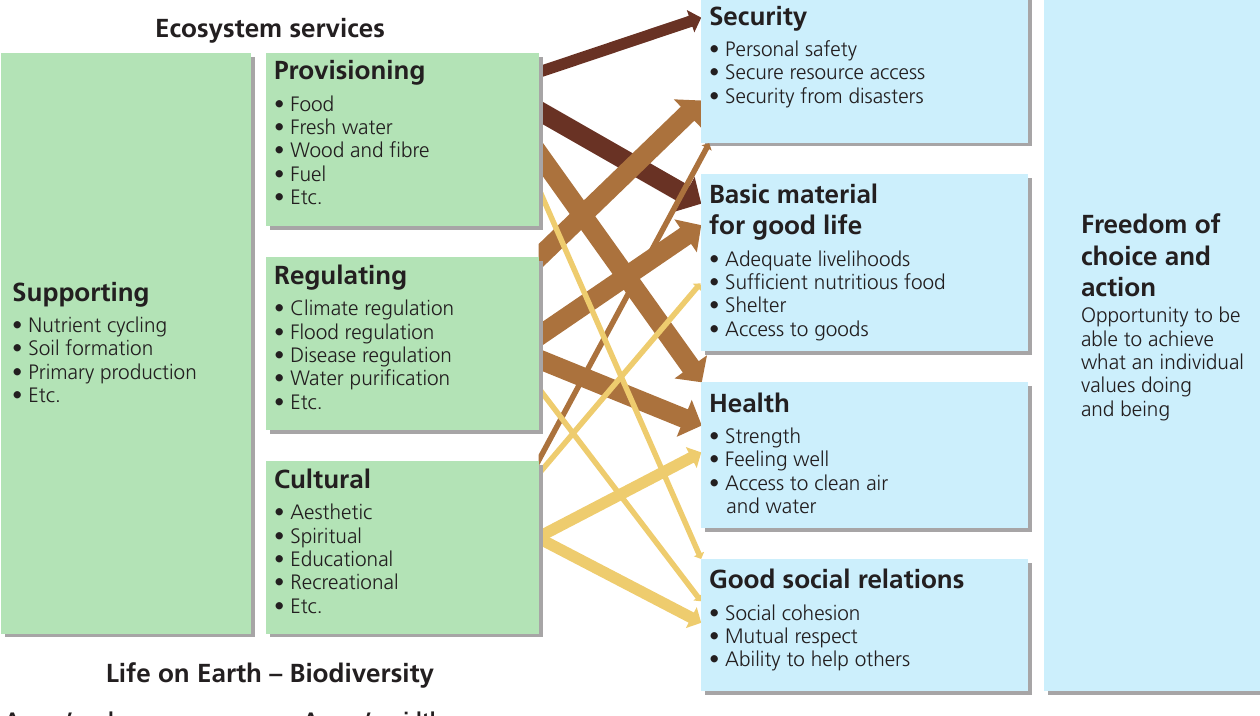
How ecosystem services support human well-being
The MEA identified five key components that constitute human well-being, all connected to ecosystem services in varying degrees:
- Security - including personal safety, secure access to resources, and protection from disasters
- Basic material needs for a good life - adequate livelihoods, sufficient nutritious food, shelter, and access to goods
- Health - strength, feeling well, and access to clean air and water
- Good social relations - social cohesion, mutual respect, and ability to help others
- Freedom of choice and action - opportunity to achieve what individuals value in life
Note
Well-being Components Acronym: Remember SHBSF - Security, Health, Basic materials, Social relations, Freedom
The connections between ecosystem services and these well-being components vary in strength. Some aspects of well-being are heavily dependent on ecosystem services (shown by strong linkages in the diagram), whilst others are more influenced by social and economic factors (weaker linkages).
The diagram shows arrow colours indicating the potential for socioeconomic factors to mediate these linkages, and arrow width representing the intensity of connections between services and well-being.

The relationship between human population growth and biodiversity loss
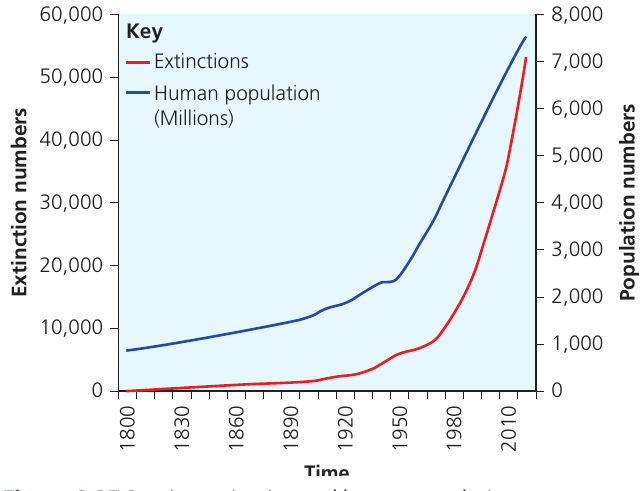
Historical data reveals a stark correlation between the expansion of human populations and the loss of species. From 1800 to the present day, both metrics have increased dramatically, but especially since 1950.
Important
Critical Population and Extinction Trends:
- Global population reached 6 billion in the year 2000
- Projections suggest population will reach between 8.1 and 9.6 billion by 2050
- Species extinctions have accelerated alongside population growth
- The rate of both changes increased sharply from 1950 onwards
This relationship illustrates how human population growth places increasing pressure on ecosystems. As more people require more resources, natural habitats face conversion, fragmentation, and degradation. The loss of biodiversity, in turn, threatens the ecosystem services upon which human well-being depends.
Drivers of ecosystem change
Whilst natural processes do cause ecosystem changes, current alterations are predominantly driven by human activities. These anthropogenic factors operate through five main indirect pathways:
Note
Five Drivers Acronym: Remember DESCT - Demographic, Economic, Sociopolitical, Cultural/religious, Technological
- Demographic changes - population size, density, and distribution patterns
- Economic drivers - global economic activity, trade patterns, and market forces
- Sociopolitical factors - governance systems, policy decisions, and institutional frameworks
- Cultural and religious influences - beliefs, values, and attitudes toward nature
- Scientific and technological developments - innovations that alter how we use resources
The role of consumption
The most significant driver of current ecosystem change is increasing consumption. This involves:
- Growing use of ecosystem services per person
- Rising demand for fossil fuels
- Expanding resource extraction to meet consumer demands
Important
Since 1950, global economic activity has grown rapidly. Despite periodic downturns, the overall trend continues upward. This economic expansion, combined with growing populations and increasing per capita consumption, creates mounting pressure on ecosystems worldwide.
As one environmental leader noted, the natural world provides us with essentials including food, water, and clean air, plus cultural and health benefits that we often take for granted because they appear free.
Managing ecosystems for the future
How we manage ecosystems today will determine future outcomes for both environmental health and human well-being. Two contrasting scenarios illustrate the potential pathways ahead.
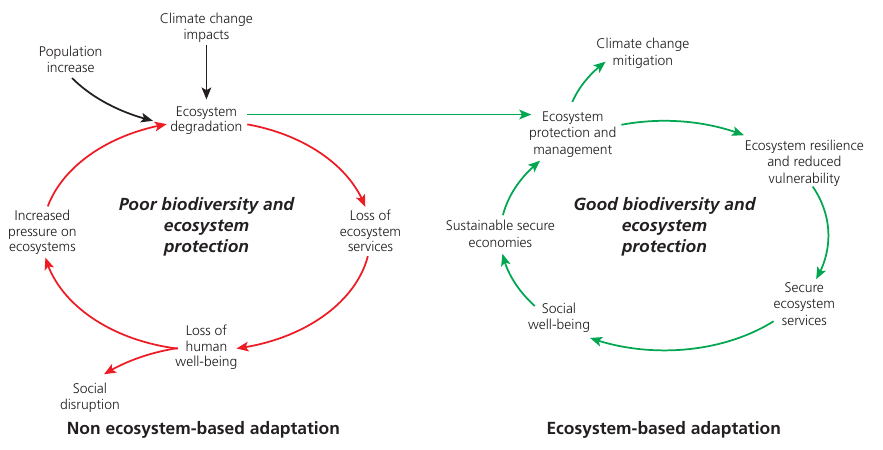
The vicious cycle: poor ecosystem management
When biodiversity and ecosystems receive inadequate protection, a negative reinforcing cycle develops:
- Ecosystem degradation occurs
- Loss of ecosystem services follows
- Human well-being declines
- Social disruption increases
- Greater pressure falls on remaining ecosystems
- Further degradation results
Note
This negative feedback loop, combined with climate change impacts, leads to continued deterioration. Population increases compound the problem, creating additional stress on already damaged systems.
The positive pathway: ecosystem-based adaptation
Alternatively, when ecosystems receive good protection and biodiversity is valued:
- Climate change mitigation becomes more effective
- Ecosystem resilience increases
- Reduced environmental vulnerability results
- Secure ecosystem services are maintained
- Social well-being improves
- Sustainable economies develop
- Further ecosystem protection is prioritised
Note
This approach recognises that healthy ecosystems provide the foundation for climate adaptation, economic stability, and social well-being. By protecting biodiversity and managing ecosystems sustainably, we create a reinforcing positive cycle.
The UK example
A 2011 government-sponsored National Ecosystem Assessment valued UK ecosystem services in economic terms. The findings showed that parks, lakes, forests, and wildlife contribute billions of pounds to the economy. Beyond monetary value, simply living near green spaces provides health benefits worth up to £300 per person annually.
Example
Real-World Impact: Declining Bee Populations
The economic importance of nature appears most clearly in food production. Organisms such as soil microbes, earthworms, and pollinating insects are essential.
In the UK, declining bee populations currently threaten food production, forcing farmers to either produce less or spend more to achieve the same output. This demonstrates how the loss of one ecosystem service (pollination) directly impacts human well-being through reduced food security and increased costs.
The assessment also revealed challenges:
- About 30% of key ecosystem services are degrading
- Around 20% are improving (notably air quality)
- Critical regulating services controlling climate, pollution, and water quality face particular threats
Summary
Summary
Key Points to Remember:
-
Ecosystem services are essential for human survival - they provide food, water, climate regulation, and countless other benefits that support all aspects of human well-being.
-
Human population growth correlates strongly with biodiversity loss - as populations have expanded since 1800, species extinctions have accelerated, particularly since 1950.
-
Consumption per person matters as much as population size - growing per capita consumption of resources and fossil fuels drives ecosystem degradation alongside population growth.
-
Management approaches determine future outcomes - poor ecosystem protection creates a vicious cycle of degradation, whilst ecosystem-based adaptation creates positive reinforcing loops of resilience and well-being.
-
Ecosystem health and human well-being are interconnected - protecting biodiversity and managing ecosystems sustainably benefits both environmental systems and human societies, whilst degradation harms both.