Local Ecosystems: Ponds (AQA A-Level Geography): Revision Notes
📚Revision Notes
Local Ecosystems: Ponds
What is a pond?
A pond is a distinctive type of local freshwater ecosystem. According to the UK's Biodiversity Action Plan (BAP), ponds are defined as water bodies that meet specific criteria.
Important
Pond Definition
Pond: Small, permanent or seasonal water bodies up to two hectares in size. They are depressions where water collects, creating quiet environments with shallow depth.
The shallow nature of ponds is particularly significant. Because the water depth is limited, sunlight can penetrate right to the bottom. This allows plants to grow throughout the water column - some grow entirely underwater, some partially on the surface, whilst others (such as reeds and bulrushes) grow along the pond's edge.
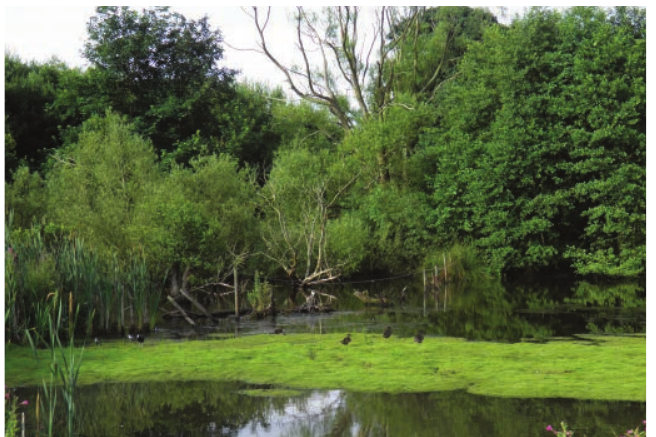
Characteristics of pond ecosystems
Like all ecosystems, ponds consist of two main components working together: abiotic (non-living) environmental factors and biotic communities of organisms.
Abiotic environmental factors
Four key abiotic factors shape pond ecosystems:
- Temperature - influences metabolic rates of organisms and water density
- Water flow - affects oxygen levels and sediment distribution
- Salinity - determines which species can survive in the water
- Percentage of dissolved oxygen - essential for aquatic animal respiration
Note
The salinity of a water body determines which species can inhabit it. Marine organisms have adapted to tolerate salt water, whilst freshwater organisms cannot survive in salty conditions. Interestingly, freshwater ecosystems often contain plant species that actively absorb salts from the water, protecting freshwater organisms from salt exposure.
Four pond habitats
A pond ecosystem contains four distinct habitats, each supporting different communities of organisms:
The shore The nature of the shoreline determines what organisms can live there. Rocky shores may prevent plant growth, whilst muddy or sandy shorelines support diverse life including algae, earthworms, snails, protozoa, insects, small fish and micro-organisms.
The surface film This habitat at the water's surface is home to pond skaters and free-floating organisms that take advantage of the water-air interface.
Open water The open-water habitat supports sizeable fish (such as carp and pike), along with plankton and phytoplankton. This is where much of the pond's primary production occurs.
The pond bottom The depth of the pond determines the characteristics of this habitat:
- Shallow ponds (less than 30 cm) with sandy bottoms provide nesting sites for earthworms, snails and insects
- Deeper ponds (over 30 cm) typically have muddy bottoms where micro-organisms like flatworms and dragonfly nymphs reproduce and survive
Pond food chains and trophic levels
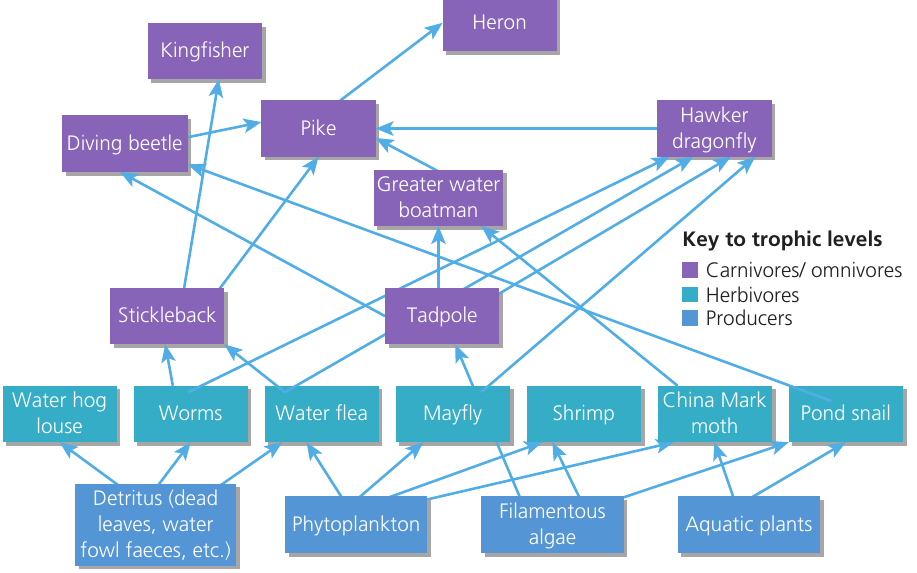
A pond's food chain consists of three basic trophic levels (feeding levels), each representing a step in the transfer of energy through the ecosystem.
First trophic level: producers
The foundation of the pond food chain consists of producers and autotrophs. These organisms include phytoplankton and aquatic plants that create their own food through photosynthesis. They capture energy from sunlight and convert it into chemical energy stored in organic compounds.
Phytoplankton encompasses a wide variety of algae species, whilst zooplankton refers to tiny insect larvae and similar organisms that feed on plankton.
Second trophic level: herbivores
The second trophic level comprises herbivores - organisms that consume plants. In pond ecosystems, herbivores include:
- Insects (such as mayflies)
- Crustaceans (like water fleas)
- Invertebrates (including pond snails, water hog lice, China Mark moths, shrimps and worms)
These organisms inhabit the pond and consume plant material, transferring energy from producers to higher trophic levels.
Third trophic level: carnivores and omnivores
The third trophic level consists of carnivores - organisms that feed on both plants and the herbivores from lower trophic levels. Examples include:
- Various fish species (pike, stickleback)
- Predatory invertebrates (diving beetles, greater water boatmen, hawker dragonflies)
- Amphibians (tadpoles)
- Birds (kingfishers, herons)
These top predators regulate populations of herbivores and smaller carnivores, maintaining balance in the ecosystem.
The role of decomposers
Decomposers are essential organisms found at the bottom of the food chain. They break down dead organic matter (dead leaves, animal faeces, deceased organisms) into simpler substances. This decomposition process releases vital nutrients including nitrogen, phosphorus and magnesium back into the water.
Note
These recycled nutrients become available for autotrophs and second trophic level organisms to use, creating a perpetual flow of energy through the pond's ecosystem. Without decomposers, nutrients would remain locked in dead matter and the ecosystem would collapse.
The importance of ponds
Ponds provide crucial support for numerous plant and animal species. In the UK, more than 150 priority species are directly associated with pond habitats. They are particularly valuable for insects, with damselflies and dragonflies being especially dependent on pond environments.
Key species supported by ponds
Amphibians Ponds provide essential breeding grounds for protected species such as:
- Great crested newts
- Common toads
They also support grass snakes and Daubenton's bats, along with water voles.
Birds Waterbirds rely heavily on ponds for feeding and nesting:
- Swans, moorhens and tufted ducks use ponds for both activities
- Waders (lapwings, redshanks, snipes) probe the muddy margins searching for invertebrates
Connectivity Ponds serve as stepping stones between isolated habitat patches, creating corridors that link up the countryside. This allows species to move about freely, maintaining genetic diversity and population health.
Current state of UK ponds
Important
Critical Status of UK Ponds
Recent research reveals that 80 per cent of wildlife ponds in the UK are in a 'poor' or 'very poor' state. The country has lost almost 500,000 ponds in the last 100 years. This dramatic loss has severely affected wildlife populations, as ponds provide many species with suitable breeding grounds and feeding habitat.
Urban development, land-use change, agricultural drainage, in-filling and fragmentation, combined with poor management practices, have been the primary causes of pond loss. This decline continues today.
Human pressures on pond ecosystems
Fresh waters face numerous threats from human activities:
Water abstraction
Excessive removal of groundwater and surface water has caused many spring-fed ponds to dry up completely. This eliminates the habitat and all organisms dependent upon it.
Pollution and eutrophication
Pollution poses a serious threat, particularly eutrophication. This process results from excessive application of inorganic fertilisers in surrounding agricultural areas and will be explained in detail below.
Land use and management issues
Inappropriate land use practices damage pond ecosystems:
- Urban, industrial and agricultural development within catchment areas
- Poor management practices including afforestation, land drainage and overgrazing
- Inter-basin water transfer schemes
- Construction of dams and reservoirs
Invasive species
The introduction of invasive plant and animal species threatens native populations. A notable example is the floating pennywort, a North American plant introduced to the UK in the 1980s through the aquatic nursery trade.
This aggressive invader:
- Roots in shallow margins of slow-flowing water bodies
- Thrives particularly in ditches, slow-flowing dykes and lakes
- Causes de-oxygenation of the water, affecting fish and invertebrate populations
- Reduces native white-clawed crayfish populations by over 50 per cent when present
Eutrophication explained
Important
Eutrophication
Eutrophication: The process by which water bodies become enriched with excessive nutrients (particularly nitrogen and phosphorus), leading to rapid algae growth, oxygen depletion and eventual ecosystem collapse.
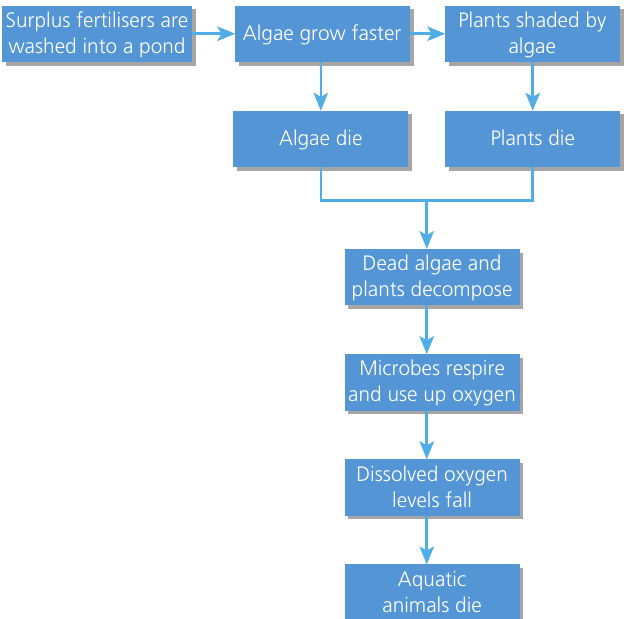
The eutrophication process follows a destructive sequence:
Stage 1: Nutrient input Surplus fertilisers from agricultural land wash into a pond through surface runoff or groundwater seepage.
Stage 2: Algal bloom The excess nutrients cause algae populations to grow rapidly, creating dense algal blooms that cover the water surface.
Stage 3: Light competition The thick layer of algae blocks sunlight from penetrating deeper into the water. Plants growing below become shaded and cannot photosynthesise effectively.
Stage 4: Plant death Both the algae (after exhausting nutrients) and the shaded aquatic plants die in large numbers.
Stage 5: Decomposition Dead algae and plants decompose. Microbes breaking down this organic matter respire aerobically, consuming large quantities of dissolved oxygen from the water.
Stage 6: Oxygen depletion Dissolved oxygen levels fall dramatically due to microbial respiration during decomposition.
Stage 7: Aquatic animal death As oxygen concentrations drop, aquatic animals (fish, invertebrates) suffocate and die, leading to ecosystem collapse.
This process creates "dead zones" where few organisms can survive. Eutrophication represents one of the most serious threats to freshwater ecosystems globally.
Succession in a pond: a hydrosere
Over time, an area of open freshwater (such as a pond) will naturally transform and eventually develop into woodland. This ecological succession process in a freshwater environment is called a hydrosere.
Note
If left undisturbed for enough time (typically over 200 years), the pond will progress through five distinct stages, with different habitats succeeding one another.
Stage 1: Open water
Deep freshwater cannot support rooted, submerged plants because insufficient light reaches the pond bottom for photosynthesis. At this stage, the pond contains only micro-organisms and plankton floating in the water column.
Stage 2: Rooted plants
Over time, sediments are transported into the pond by streams and rainwater. Large quantities of sediment can accumulate in this manner, gradually reducing the water depth.
As the pond becomes shallower, rooted submerged plants (such as starwort and pondweed) can establish. Waterlilies (rooted but with floating leaves) may also appear. The increased plant life attracts a variety of invertebrates and fish to the pond.
The vegetation traps and holds incoming sediment, accelerating the process of making the water shallower. Decomposing dead plant and animal matter provides food for detritivores and releases nutrients into the water, promoting further plant growth.
Stage 3: Swamp stage
By this stage, the water may be too shallow to support fully submerged plants. Instead, emergent plants (such as yellow iris) grow partly in and partly out of the water. These plants have developed tall, flexible, spear-shaped leaves that allow them to cope with fluctuating water levels, always keeping some portion above water for photosynthesis.
The water in swamp areas teems with invertebrate life, creating an ideal breeding ground for amphibians.
Stage 4: Marsh stage
Swamp plants adapted to grow in partially submerged conditions gradually die out as the marsh floor progressively rises above the water level.
Some species (like yellow iris) that thrive equally well in swamp or marsh conditions continue to flourish, whilst other marsh plants (such as water mint) become established. Tree seedlings, particularly willows that favour wet soil conditions, begin to grow.
Willow trees have exceptionally high transpiration rates, releasing large quantities of water from the sediment into the atmosphere through their leaves. Combined with the silt-trapping effect of marsh plants, this accelerates the rate at which the marsh dries out.
Stage 5: Carr and woodland stages
The soil remains wet but is no longer completely waterlogged. Air can now enter along root channels. Willow and alder trees dominate the ground layer, shading out lower-lying marsh vegetation.
This creates a varied woodland floor plant community including:
- Sedges
- Rushes
- Ferns
- Small flowering herbs adapted to low light levels and wet conditions
These shade-tolerant species flourish in damp conditions. Willows support a wide range of invertebrate species (more than 450 different types), providing abundant food for insectivorous birds.
In drier areas of the site, increasingly aerobic decomposition accelerates nutrient recycling, raising the organic matter and nutrient content of the soil. Tree transpiration continues drying out the soil to the point where climax tree species (such as oak, beech or ash) can become established.
Pond conservation: the Million Ponds Project
One significant national conservation initiative is the Million Ponds Project - a 50-year programme established by various charities and coordinated by Freshwater Habitats Trust. The project aims to create an extensive network of new ponds across England, Scotland and Wales, reversing a century of pond loss and ensuring the UK eventually has over one million countryside ponds.
Phase I (2008-2012)
The first phase focused on creating networks of clean water ponds across England and Wales. The project also sought to change attitudes, embedding pond creation as a routine activity in land management practices.
To achieve these aims, the project:
- Funded new ponds and pond complexes for threatened freshwater plants and animals
- Provided technical and on-the-ground support for pond creation
- Engaged with and trained a wide range of stakeholders
- Published best practice information in the extensive Pond Creation Toolkit, including the BAP species map
- Raised the profile of ponds with policy makers and media
The team worked with landowners and managers to create over 1,000 ponds, supporting around half (49 out of 105) of the rare and declining pond species designated as national conservation priorities under the UK government's Biodiversity Action Plan.
Note
One critical element was ensuring these new ponds contained clean water. This proved vital because most countryside ponds had become badly damaged by pollution, and evidence demonstrated that pond wildlife was declining across the UK.
Phase II (2012-2020)
The second phase of the Million Ponds Project expanded operations across England and Wales, focusing on:
Identifying Important Areas for Ponds (IAPs) These core areas were designated nationally to protect existing high-quality ponds and create stepping stones connecting them across the wider countryside.
Landscape-scale pond creation Projects were developed in targeted areas like the New Forest and in more intensively managed landscapes, such as catchments in Oxfordshire and Leicestershire.
Policy integration The project investigated opportunities to embed pond creation into national policy initiatives, such as conservation credits, which could potentially create thousands of clean water ponds in the future.
Research partnerships The team worked with academic partners to develop applied research projects.
Expansion to Northern Ireland In 2014 and 2015, discussions with Natural England indicated that clean water pond creation would form an important part of the England Biodiversity Strategy. The objective was ensuring 90 per cent of Priority Habitats were in good condition by 2020, with thousands of new high-quality ponds created each year.
Remember!
Summary
Key Points to Remember:
-
Ponds are small, shallow freshwater bodies (up to 2 hectares) that support over 150 UK priority species including amphibians, birds, fish and invertebrates.
-
Food chains in ponds have three trophic levels: producers (phytoplankton, aquatic plants), herbivores (insects, snails, crustaceans), and carnivores (fish, beetles, birds). Decomposers recycle nutrients from dead organisms back into the ecosystem.
-
Eutrophication is a major threat caused by fertiliser runoff. Excess nutrients → algal bloom → plants die from lack of light → decomposition uses oxygen → aquatic animals suffocate.
-
Hydrosere succession transforms ponds into woodland through five stages over 200+ years: open water → rooted plants → swamp → marsh → carr/woodland. Each stage creates conditions for the next.
-
80% of UK ponds are in poor condition and 500,000 have been lost in the last century. The Million Ponds Project aims to reverse this decline by creating a network of one million clean water ponds.