Succession (AQA A-Level Geography): Revision Notes
📚Revision Notes
Succession
What is succession?
Ecological succession describes how ecosystems progressively develop and transform over extended time periods. Nothing in nature stays the same – environments and the communities of organisms living within them are in constant flux.
Important
Succession is the term used to describe the changes in the composition of a community of plants and animals over time. These changes lead to an increase in the complexity of the structure and the variety of species present.
The process occurs when conditions become more suitable for certain species, allowing them to thrive, while the die-off happens when conditions become less favourable. This results in a shift in the dominant plant species present at different points in time.
Types of succession
There are two main categories of succession, determined by the initial state of the area where the process begins:
Primary succession
This type occurs on completely fresh surfaces that have never previously supported life. The area starts as a lifeless, barren environment with no soil or organic matter present.
Note
Examples of primary succession include:
- Recent lava flows from volcanic eruptions
- Newly exposed rock surfaces from retreating glaciers
- Rock exposed as ice sheets melt
All these environments start with no soil and no organic matter – they are truly starting from scratch.
Secondary succession
This type takes place on ground that previously supported living communities but has experienced disturbance or damage. Unlike primary succession, some soil and organic matter typically remain, allowing for faster recovery.
Note
Examples of secondary succession include:
- Areas where trees have been felled in woodland
- Land cleared for agriculture but later abandoned
- Habitats recovering after fire damage
The key difference: soil and some organic matter already exist, giving secondary succession a "head start" compared to primary succession.
Types based on starting surface
Ecologists classify succession based on the initial surface conditions where the process begins. Each type has its own characteristics:
Lithosere
A succession beginning on newly exposed bare rock surfaces. This might include freshly erupted volcanic lava or rock revealed as glaciers retreat.
Psammosere
A succession starting on bare sand environments, commonly found in coastal sand dunes.
Hydrosere
A succession that begins in freshwater environments, such as ponds or lakes.
Halosere
A succession that starts in saltwater conditions, for example in salt marshes.
Note
Memory Aid: Think of LIPH to remember the four types:
- Lithosere (rock)
- Psammosere (sand) - yes, it's out of order but easier to remember!
- Hydrosere (freshwater)
- Halosere (saltwater)
Key concepts in succession
Seres and seral stages
When succession progresses, it moves through several distinct phases. The complete sequence of all stages is called a sere, whilst the individual phases within this sequence are known as seral stages.
Alternatively, the entire progression may be referred to as a prisere.
As succession advances through each new stage, several changes occur:
- The structure becomes increasingly complex
- The total amount of living matter (biomass) increases
- The variety of different species grows
- Net primary productivity rises
- Greater flows of nutrients and energy occur
Pioneer species
The first organisms to colonise a barren area are called pioneer species. These remarkable organisms possess special adaptations that enable them to survive in extremely harsh conditions where most species cannot establish themselves.
Example
Pioneer Species in Action: Lichens
In lithosere succession, lichens typically act as pioneers. They can:
- Extract energy from sunlight despite minimal nutrients
- Tolerate very dry, windy, and soil-free conditions
- Begin breaking down rock to form the first particles of proto-soil
These adaptations make lichens perfect first colonisers of bare rock surfaces.
Species diversity
Throughout succession, species diversity (the range and variety of different species present) steadily increases. Early stages feature only hardy pioneer species, but as conditions improve, more species can colonise and establish themselves.
Important
Key Pattern: Species diversity shows a clear trend during succession:
- Early stages: Low diversity (only hardy pioneers)
- Middle stages: Rapidly increasing diversity (more species can survive)
- Climax stage: High diversity (complex, stable community)
This increase is predictable and directional – it always moves in the same direction.
The succession process
How succession works
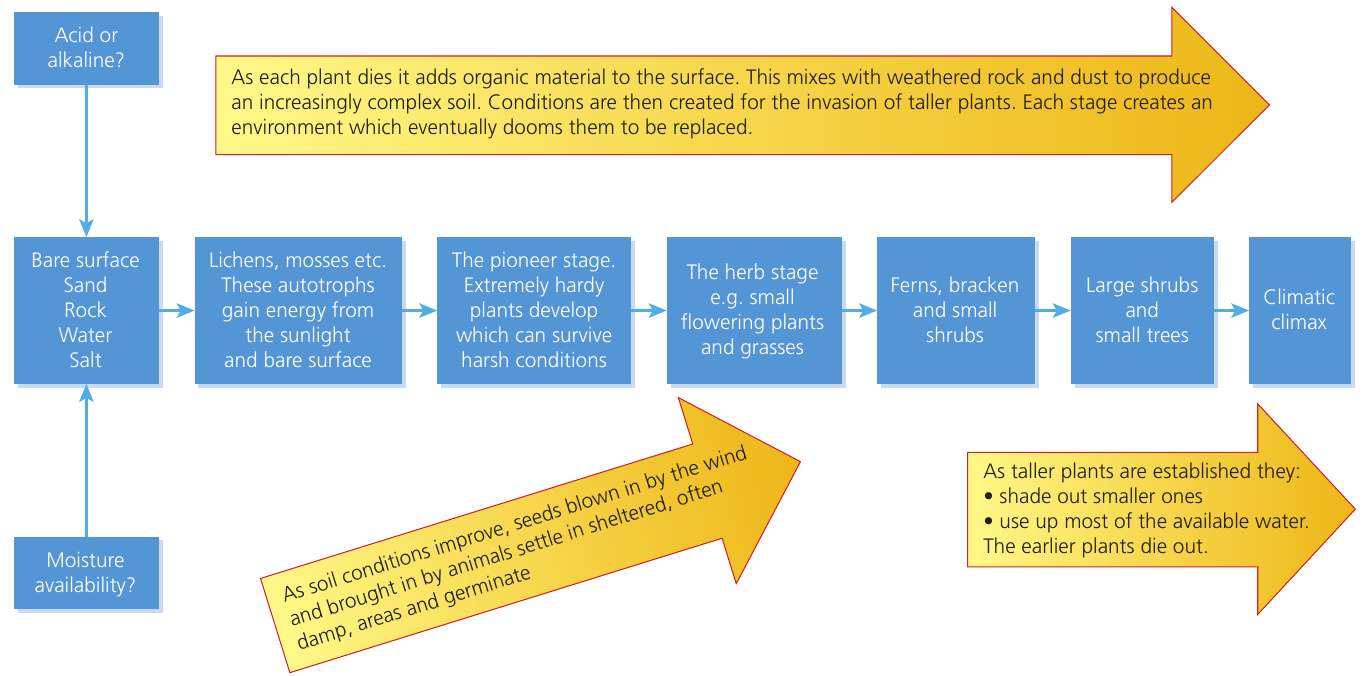
Succession is both directional and usually predictable. Seres gradually transition from one stage to another following a recognisable pattern.
As each plant dies, it contributes organic material to the surface. This material combines with weathered rock fragments and windblown dust to create increasingly complex soil. Better soil conditions then enable taller, more demanding plants to invade and become established. Each stage essentially creates an environment that eventually leads to its own replacement.
Note
Key environmental changes during succession:
- Soil depth progressively increases
- Organic content of soil rises
- Water retention capacity improves
- Nutrient availability grows
- Shelter from wind increases
Notice how each change improves conditions for more complex plant communities.
As soil quality improves and nutrients accumulate, wind-dispersed seeds can germinate in the more sheltered, damper areas.
How organisms interact with their environment
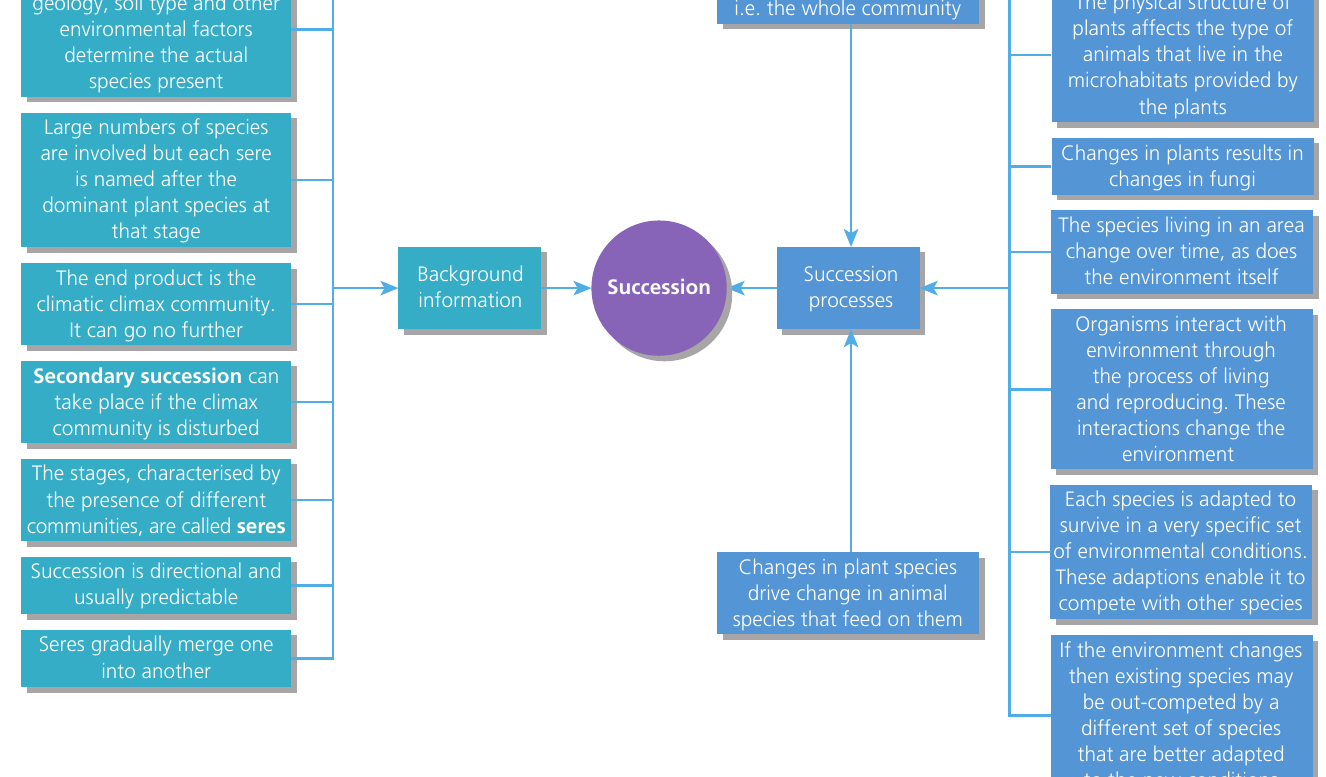
The physical characteristics of plants directly affect the type of micro-organisms and animals that can inhabit an area. For example, the plant structure determines what microhabitats are available.
As plant communities transform, this causes corresponding changes in:
- Herbivores (plant-eating animals)
- Carnivores (meat-eating animals that feed on herbivores)
- Fungi and decomposers
The species present in a location gradually change over time, and as they do, the physical and chemical characteristics of the environment itself also transform.
Important
Critical Concept: Each species possesses adaptations enabling it to thrive under very specific environmental conditions. These adaptations allow it to compete successfully with other species. However, if environmental conditions shift, existing species may be out-competed by different species better adapted to the new circumstances.
This is why succession progresses – each stage changes the environment, favouring different species in the next stage.
Stages of succession: lithosere example
Let's examine the detailed progression of a lithosere succession, which demonstrates the general principles applicable to all succession types.
Bare rock surface
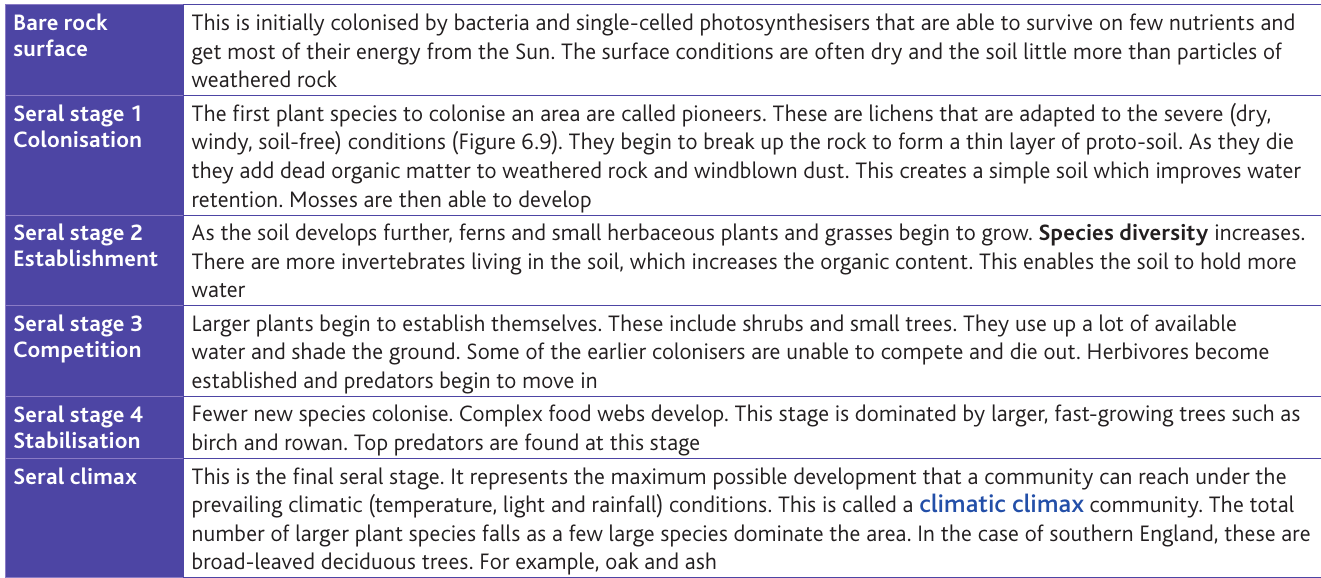
The starting point is bare rock – sand, rock, water, or salt – depending on the succession type. The surface is initially colonised by bacteria and simple single-celled photosynthetic organisms. These pioneers can survive with very few nutrients and obtain their energy directly from sunlight. Surface conditions are often very dry, with minimal moisture retention in the weathered rock.
Seral stage 1: Colonisation
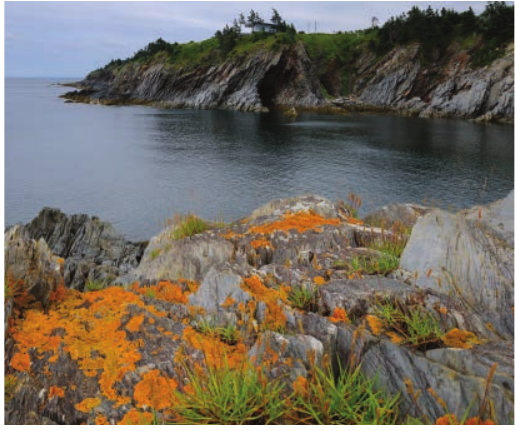
The first plant species capable of colonising the area are pioneers – typically lichens adapted to survive severe dry, windy, and soil-free conditions. They begin breaking up the rock surface to form a thin layer of proto-soil.
Example
Stage 1: The Pioneer Phase
What happens:
- Lichens attach to bare rock
- They secrete acids that slowly break down rock
- Dead lichens mix with rock particles to form basic soil
- This creates enough soil for mosses to establish
Environmental change: Water retention improves slightly as soil develops.
Species present: Mainly lichens, then mosses appear later in this stage.
As pioneers die, they add dead organic matter to weathered rock and windblown dust. This creates basic soil that improves water retention. Mosses can then develop in these slightly improved conditions.
Seral stage 2: Establishment
As soil develops further, ferns and small herbaceous plants and grasses begin to grow. Species diversity increases at this stage. More invertebrates start living in the soil, which increases the organic content and enables the soil to hold more water.
Example
Stage 2: Building Complexity
What happens:
- Soil is now deep enough for small plants with roots
- Grasses and herbaceous plants establish
- More organic matter accumulates
- Invertebrates (insects, worms) colonise the soil
Environmental change: Soil depth and nutrient content increase significantly.
Species diversity: Increases as more niches become available.
Seral stage 3: Competition
Larger plants begin establishing themselves, including shrubs and small trees. These use much of the available water and shade the ground, reducing light for smaller plants. Some earlier species are unable to compete and die out. Herbivores become more established, and predators begin moving into the area.
Note
Understanding Competition: At this stage, the environment has improved enough to support larger plants. However, these larger plants now compete with the smaller pioneers for resources. The pioneers, which thrived in harsh conditions, cannot compete with taller plants for light and water, so they gradually disappear.
This is a normal part of succession – each stage paves the way for the next.
Seral stage 4: Stabilisation
Fewer new species colonise as competition intensifies. Complex food webs develop during this stage. The area becomes dominated by larger, fast-growing trees such as birch and rowan. Top predators are found at this stage.
Seral climax
This represents the final seral stage – the maximum possible development that a community can achieve under the prevailing climatic conditions (temperature, light, and rainfall). This is also called the climatic climax community.
The total number of larger plant species decreases as a few large species come to dominate the area. In southern England, these are typically broad-leaved deciduous trees such as oak and ash.
Important
The Climatic Climax: This represents the end product – the community cannot progress any further under existing environmental conditions.
The climax is stable and self-sustaining unless disturbed by external factors (fire, human activity, climate change).
Climatic climax and related concepts
Climatic climax
A useful way to describe the final outcome of succession is the concept of a climatic climax community. This is the ultimate stage in succession – an association of plants and animals that represents the maximum development possible under the environmental conditions of that location.
Climate, microclimate, geology, soil type, and other environmental factors determine what the actual climax community will be in any given area. It can progress no further.
Note
What Determines the Climax Community?
The type of climatic climax depends on:
- Temperature and rainfall patterns
- Soil type and geology
- Microclimate factors (altitude, aspect)
- Local environmental conditions
For example, southern England reaches a deciduous woodland climax, while Scottish highlands might reach a moorland or coniferous forest climax due to different climatic conditions.
Secondary succession and disturbance
Secondary succession can occur if the climatic climax community experiences disturbance. The succession sequence essentially restarts, though often more rapidly than primary succession since soil and organic matter already exist.
Time scales
Time scales vary enormously – from hundreds to thousands of years. Climate, microclimate, geology, soil type, and other environmental factors all determine how quickly succession progresses.
Note
Time Scale Examples:
- Primary succession on bare rock: typically 1000+ years to reach climax
- Secondary succession on abandoned farmland: may take 100-200 years
- Hydrosere (pond to woodland): often 500+ years
The presence of soil and organic matter in secondary succession significantly speeds up the process.
Predictability
Large numbers of species are involved, but each sere is typically named after the dominant plant species present at that particular stage. Succession is directional and generally predictable, with seres gradually merging from one stage into another.
Remember!
Summary
Key Points to Remember:
-
Succession is the progressive change in plant and animal communities over time, leading to increased complexity and species diversity
-
Primary succession occurs on completely new surfaces (lava, bare rock), whilst secondary succession happens on previously colonised but disturbed areas (cleared woodland, abandoned farmland) – secondary is faster because soil already exists
-
Pioneer species are the first colonisers, adapted to harsh conditions with minimal nutrients (such as lichens on bare rock) – they prepare the way for other species
-
Succession progresses through seral stages, with each stage modifying the environment to create conditions that favour the next stage – eventually reaching the climatic climax
-
Species diversity increases throughout succession as soil develops, water retention improves, and more niches become available for different organisms
-
Each stage replaces itself – by improving conditions, early species make the environment suitable for more competitive species that eventually out-compete them
-
The process is directional and predictable – succession follows recognisable patterns, though the time scale varies from hundreds to thousands of years