Terrestrial Ecosystems (Case Study: South Downs) (AQA A-Level Geography): Revision Notes
📚Revision Notes
Terrestrial Ecosystems (Case Study: South Downs)
Introduction to terrestrial ecosystems
Understanding ecosystems is fundamental to studying how the natural world functions. An ecosystem brings together all living organisms (plants, animals, and other life forms) in a particular area along with their physical environment. These components interact and depend on each other, creating a complex web of relationships that functions as a single ecological unit.
Important
Ecosystem
An ecosystem is the complete collection of living organisms (plants, animals and other life forms) existing together in a specific area with their physical environment. These components interact and depend on each other, functioning together as a unified ecological system with unique characteristics that cannot be found in the individual parts alone.
Terrestrial ecosystems are those found on land rather than in water. They can range dramatically in size, from tiny ecosystems within a few square metres to vast biomes spanning entire continents. All terrestrial ecosystems share the common feature of being land-based rather than aquatic or marine environments.
Note
The interconnected nature of ecosystems means that changes in one component can have cascading effects throughout the entire system. This interdependence makes understanding ecosystem function critical for conservation and environmental management.
Nutrient cycling in ecosystems
Ecosystems function through the continuous movement of nutrients between different components. Nutrients are the essential chemical elements and compounds that organisms need to survive, grow and carry out life processes. The way these nutrients cycle through an ecosystem directly affects how efficiently energy can be captured and used. For instance, plants cannot produce new cells and grow if they lack access to essential nutrients.
The three nutrient stores
Within any ecosystem, nutrients are held in three main compartments or stores:
- Soil: A mixture containing weathered rock particles, air, water and decomposed organic material at the Earth's surface
- Litter: Dead organic matter (such as fallen leaves and dead organisms) that sits on top of the soil
- Biomass: The total mass of all living plant and animal material in the ecosystem
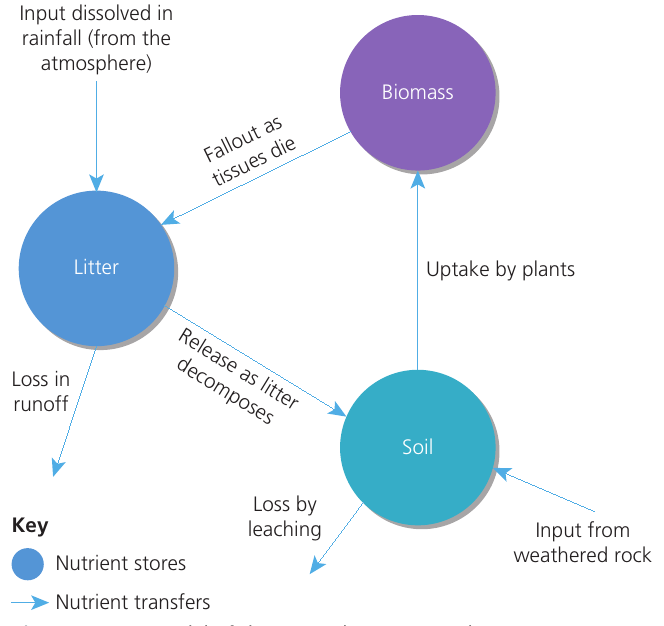
These stores are not isolated from each other. Nutrients constantly move between them through various transfer processes:
- Atmospheric input: Nutrients dissolved in rainfall enter the litter store from the atmosphere
- Fallout: As plant tissues die, nutrients transfer from biomass to litter
- Decomposition: Microorganisms and decomposers break down litter, releasing nutrients into the soil
- Plant uptake: Plants absorb nutrients from the soil through their roots, transferring them to biomass
- Weathering: Physical and chemical breakdown of rocks releases new nutrients into the soil
- Losses: Nutrients can leave the system through runoff (water flowing over the surface) or leaching (water carrying dissolved nutrients down through soil layers)
Note
The balance between nutrient inputs and losses determines the overall fertility and productivity of an ecosystem. Systems with high inputs and low losses tend to be more productive, while those with high losses or low inputs may struggle to support diverse communities.
Soil formation and nutrient cycling
The soil itself develops through a continuous process involving multiple interacting factors. Rock beneath the surface slowly breaks down through weathering. Dead organic matter from plants falls to the ground, where decomposer organisms break it down. Rainwater and air penetrate the soil layers, facilitating chemical reactions. These processes work together to create fertile soil that can support plant growth.
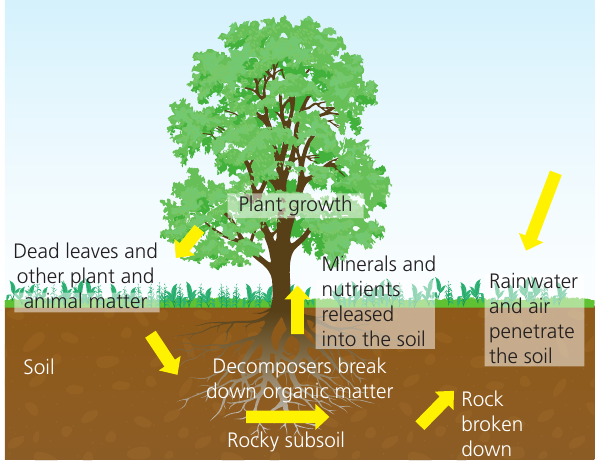
The cycle continues as plants grow by extracting minerals and nutrients from the soil. When plant material dies and falls to the ground, decomposers break it down, returning those nutrients to the soil. This creates a circular flow where nutrients are continually recycled rather than lost from the system.
Example
Worked Example: Nutrient Cycling in Action
Consider a leaf falling from a tree in autumn:
Step 1: Fallout - The dead leaf transfers nutrients from biomass to the litter store
Step 2: Decomposition - Fungi and bacteria break down the leaf over several months, releasing nutrients into the soil
Step 3: Plant uptake - Tree roots absorb these nutrients from the soil in spring
Step 4: Growth - The tree uses these nutrients to produce new leaves and grow
This cycle demonstrates how the same nutrients can be used repeatedly within the ecosystem, rather than being permanently lost.
The South Downs: a UK terrestrial ecosystem
Location and physical characteristics
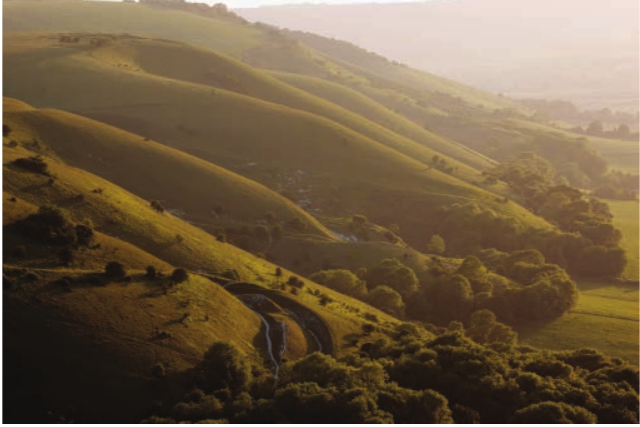
The South Downs represent an excellent example of a terrestrial ecosystem in the UK. This landscape consists of a chalk ridge stretching approximately 100 km from near Winchester in the west to the dramatic sea cliffs of Beachy Head in the east. The ridge forms an escarpment reaching heights exceeding 200 metres in places.
The most distinctive feature of the South Downs is the contrast between its two slopes. The northern side features a steep, mostly north-facing scarp slope that dominates the landscape. This steep face is only broken by narrow, steep-sided river gaps where the rivers Meon, Arun, Adur, Ouse and Cuckmere flow southward through the ridge. In contrast, the southern side has a gentle, south-facing dip slope with well-drained, easily worked soils.
Note
The underlying geology consists of tilted layers of relatively soft chalk rock containing bands of harder flint nodules. Both the chalk and flint formed from the remains of marine organisms and plants in ancient seas over 100 million years ago. This geological history has profoundly shaped the ecosystem that exists today.
Abiotic factors
Climate
The South Downs benefit from some of the most favourable climatic conditions in Britain. This area of southern England experiences the highest average daytime temperatures found anywhere in the British Isles, combined with the highest sunshine averages on the British mainland. Rainfall falls below the UK average at approximately 950 mm per year.
These climatic variations create different conditions within the ecosystem. The warm, dry dip slope facing south and the cooler, damper scarp slope facing north provide a range of microclimates. This environmental variety supports different plant and animal communities and creates suitable conditions for various wildlife species. Some species exist at the northern edge of their geographical distribution range here in the South Downs.
Topography
The distinctive topography directly influences what grows where. The steep north-facing scarp slopes prevented historical ploughing, which is why they still support much of the remaining ancient woodland and chalk grassland today. The gently sloping south-facing dip slopes experience hot, dry conditions that favour cereal crops growing. Very little semi-natural habitat remains on the dip slope due to centuries of agricultural use. The narrow, steep-sided and flat-floored river gaps cutting through the ridge add further landscape diversity.
Geology, soils and drainage
The chalk bedrock gives rise to thin, infertile, well-drained soils. These soils lack many essential minerals, particularly potassium and phosphates, though they contain abundant calcium. This creates a distinctive soil type called rendizina, which permits only slow rates of plant growth. However, this apparent disadvantage actually supports high biodiversity, as it allows many small, slow-growing herb species to coexist in the downland turf without being outcompeted by faster-growing plants.
Important
Rendizina
Rendizina is a thin, well-drained, calcium-rich but nutrient-poor soil type that forms over chalk bedrock. Its infertile nature paradoxically supports high plant diversity by allowing slow-growing species to thrive.
More fertile conditions exist in some locations. Deeper soils are present on the plateau areas, dip slope and in valley bottoms. These more fertile soils either support cultivation or woodland. In a few places, a thin covering of wind-blown soil called 'loess' remains over the chalk. This loess derives from dry conditions during the last Ice Age and produces highly unusual plant communities known as 'chalk heath'.
Note
The river floodplains that cut through the chalk downs contain water-borne silt deposits, creating highly fertile soils. Traditionally, the poorly drained floodplain areas served as grazing marsh, but increased drainage has enabled conversion to arable farming in many locations.
Biotic factors
The South Downs ecosystem contains remarkable habitat diversity despite its relatively small geographical area. Many different habitat types exist, each supporting distinct communities of plants and animals.
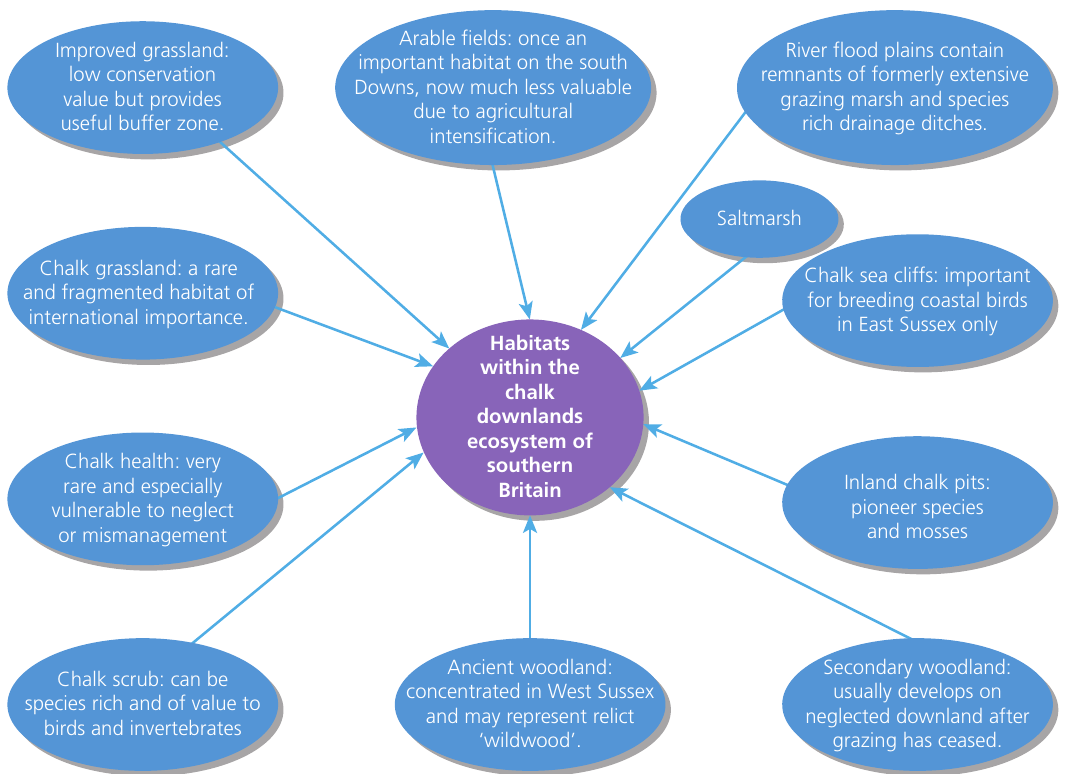
The major habitats within the chalk downlands ecosystem include:
- Chalk grassland: A rare habitat of international importance, maintained by grazing and supporting exceptionally high plant diversity
- Chalk heath: An extremely rare and vulnerable habitat occurring where acidic soil deposits overlie the chalk
- Chalk scrub: Species-rich areas valuable for birds and invertebrates
- Ancient woodland: Concentrated in West Sussex, these woods may represent relict wildwood
- Secondary woodland: Develops on abandoned downland where grazing has ceased
- Arable fields: Once an important habitat, now much less valuable due to agricultural intensification
- Improved grassland: Low conservation value but provides useful buffer zones
- River floodplains: Contain remnants of formerly extensive grazing marsh and species-rich drainage ditches
- Saltmarsh: Coastal habitat types
- Chalk sea cliffs: Important breeding sites for coastal birds in East Sussex
- Inland chalk pits: Support pioneer species and mosses
Chalk heath
Chalk heath represents an extremely rare habitat found only in a few scattered locations on the South Downs. It develops where deposits of acidic soil created by wind-blown material overlie the alkaline chalk bedrock. This unusual combination of conditions supports acid-loving species such as heathers growing alongside typical chalk-loving plants.
Important
Chalk heath was probably much more widespread historically. However, its vulnerability to soil disturbance and scrub encroachment has caused it to dwindle in extent. Today, Ivinghoe Heath National Nature Reserve contains what experts regard as Britain's best example of chalk heath, though other chalk heath areas exist within the South Downs.
Unimproved chalk grassland
Unimproved chalk grassland typically contains exceptionally high species richness, with up to 56 different plant species recorded in just one square metre. Traditional management through sheep or rabbit grazing maintains this habitat. Historically, extensive areas of the South Downs (mainly in East Sussex) supported unimproved grassland, but this habitat is now scarce, fragmented and threatened by changing land use patterns.
Legal protection helps safeguard the remaining areas. Some locations have been designated as Sites of Special Scientific Interest (SSSI), while others fall under Annex 1 of the EC Habitats Directive. The best remaining examples now receive consideration as Special Areas of Conservation, representing the highest level of protection available.
Important
Sites of Special Scientific Interest (SSSI)
Sites of Special Scientific Interest (SSSI) are areas of land legally protected in the UK due to their important wildlife, geological features or natural features. They represent some of the country's most valuable natural assets.
Factors influencing change in the downland area
The chalk downland ecosystem faces multiple pressures that threaten its integrity and biodiversity. Understanding these factors is essential for effective conservation management.
Habitat fragmentation
Many habitats within the South Downs National Park have become highly fragmented in recent decades. Chalk grassland, chalk heath and unimproved grazing marsh now exist as isolated patches within agricultural land or unmanaged areas. This fragmentation creates several serious problems for wildlife:
Increased risk of local extinctions: On small, isolated sites, species populations may lack the genetic diversity or population size needed to sustain themselves without appropriate management. Chalk grassland fragments prove particularly vulnerable to scrub invasion, which can rapidly eliminate the grassland habitat.
Increased edge to area ratio: When a habitat sits directly next to intensively worked farmland, edge effects become significant. Spray drift carrying pesticides or fertilisers and nutrient-rich runoff from fields can penetrate inwards from the edges, degrading the high-value habitat.
Restricted species movement: Movement between small, isolated habitat patches becomes severely restricted, particularly problematic for many chalk grassland plant species that lack wind-dispersed seeds. Similarly, many invertebrates will not willingly cross open arable fields, restricting their ability to colonise new areas. Even mobile butterflies face challenges moving between isolated fragments.
Note
The combination of these three factors means that habitat fragmentation doesn't just reduce the total area of suitable habitat - it fundamentally changes how species can survive and interact within the remaining fragments. This makes fragmentation one of the most serious threats to biodiversity conservation.
The role of grazing
The myxomatosis epidemic that began in the mid-1950s demonstrated that rabbit grazing plays a vital role in maintaining many chalk habitats. The disease caused massive rabbit population declines, and many chalk grassland areas rapidly changed character without grazing pressure. Although rabbit populations have largely recovered and once again provide significant grazing pressure on the South Downs, the epidemic revealed how dependent the ecosystem had become on this single grazing species.
Important
Relying on a single grazing species creates vulnerability in the ecosystem. The myxomatosis epidemic showed how quickly valuable habitats can be lost when that single species is removed. Modern conservation management aims to use multiple grazing species to reduce this risk.
Leisure use impacts
Increasing recreational use of the South Downs creates additional pressures on the ecosystem. Activities including hang gliding, mountain biking and four-wheel drive vehicle rallies can disturb rare species and damage grass cover. Even seemingly low-impact activities cause problems when concentrated in sensitive areas. The resulting erosion of thin soils can have long-lasting effects on the ecosystem.
Global changes influencing ecosystems
Climate change impacts on UK ecosystems
Ecosystems face their greatest challenge from global climate change. This adds new stress to systems already dealing with pollution, land conversion and invasive species. While some organisms might benefit from changing conditions, far more species face losing out according to UK government projections.
Climate change will force UK wildlife and plant communities to adapt in various ways. Some species may shift their ranges northwards to track suitable climate conditions. Others may face competition from newly arriving non-native species better adapted to the changing conditions. Habitats themselves may come under increasing pressure from multiple sources:
- Salt marshes may be lost through coastal erosion driven by sea-level rise
- Beech woodland could become susceptible to summer droughts
- Species may experience reduced food availability if earlier breeding periods no longer align with food availability
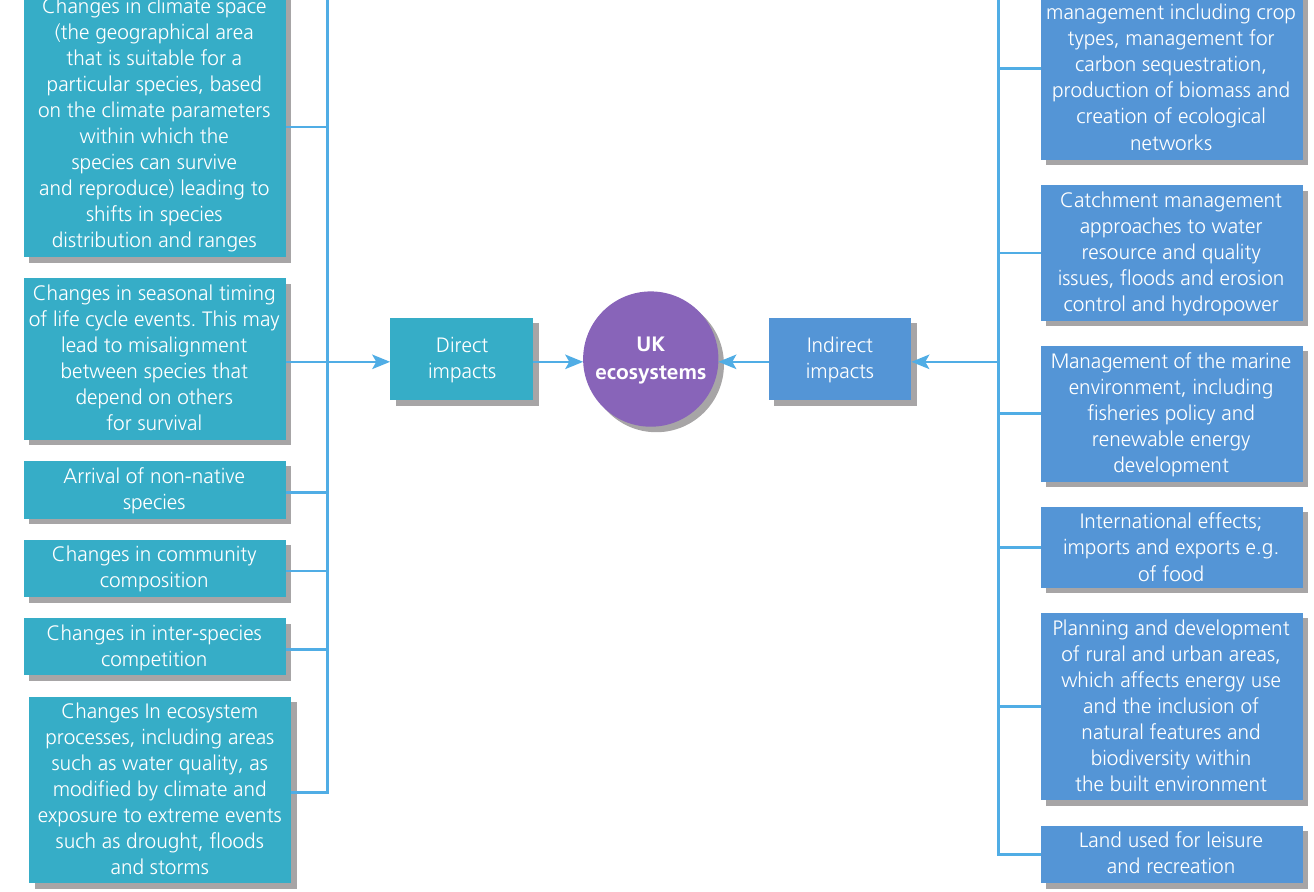
The diagram above summarises the UK government's assessment of potential climate change impacts on ecosystems. These fall into two categories:
Direct impacts include:
-
Changes in climate space: The geographical area with suitable climate conditions for particular species shifts, affecting where species can survive and reproduce. This leads to changes in species distribution and ranges.
-
Seasonal timing misalignment: Life cycle events may occur at different times, potentially creating mismatches between species that depend on each other for survival.
-
Arrival of non-native species: As conditions change, new species may establish that were previously unable to survive in UK conditions.
-
Community composition changes: The mix of species in particular locations changes, affecting inter-species competition and ecological relationships.
-
Ecosystem process changes: Physical and biological processes are modified, including water quality changes and increased exposure to extreme events such as droughts, floods and storms.
Note
Direct impacts represent the immediate physical and biological responses to changing climate conditions. These changes happen relatively quickly and can cascade through the ecosystem, affecting multiple species and processes simultaneously.
Indirect impacts include:
-
Land management changes: Including different crop types, altered management approaches for carbon sequestration, and changes to biomass production and ecological networks.
-
Catchment and water resource management: New approaches to managing water resources and quality issues, flood control and erosion prevention, and hydropower development.
-
Marine environment management: Changes to fisheries policies and renewable energy development.
-
Socio-economic drivers: Including changes to social values, working practices, policies and resource use patterns.
-
International trade effects: Impacts from imports and exports of food and other resources.
-
Planning and development: Rural and urban planning decisions affecting energy use, inclusion of natural features, and biodiversity within built environments.
-
Leisure and recreation: Land use changes driven by recreational demands.
Important
Indirect impacts result from human responses to climate change rather than the climate changes themselves. These can sometimes have even greater effects on ecosystems than direct climate impacts, as they involve large-scale changes to how land is managed and used.
On a global scale, atmospheric warming represents the greatest cause of species extinctions for millions of species over the coming decades. The combination of direct climate impacts and indirect human responses to climate change will fundamentally reshape ecosystems worldwide, including treasured landscapes like the South Downs.
Summary
Key Points to Remember:
-
Terrestrial ecosystems are land-based systems where living organisms interact with their physical environment, functioning as an ecological unit. They range from small-scale habitats to vast continental biomes.
-
Nutrient cycling moves essential elements between three main stores (litter, biomass and soil) through processes including decomposition, plant uptake, weathering, and losses via leaching and runoff.
-
The South Downs is a 100 km chalk ridge in southern England with distinctive steep north-facing scarp slopes and gentle south-facing dip slopes, supporting diverse habitats despite thin, infertile rendizina soils.
-
Habitat fragmentation threatens the South Downs ecosystem by creating isolated patches that increase extinction risk, edge effects and restrict species movement between suitable areas.
-
Climate change poses the greatest long-term threat to UK ecosystems through both direct impacts (species range shifts, seasonal timing changes) and indirect impacts (land management changes, policy responses, altered resource use).