Glacial Erosion, Transport and Deposition (AQA A-Level Geography): Revision Notes
📚Revision Notes
Glacial Erosion, Transport and Deposition
How glaciers erode the landscape
Glaciers are powerful agents of erosion. As warm-based glaciers move downhill, they reshape the landscape through their immense weight and movement. This erosive power is particularly strong in upland regions where glaciers flow. Two main processes work together to erode the bedrock beneath and beside glaciers.
Abrasion
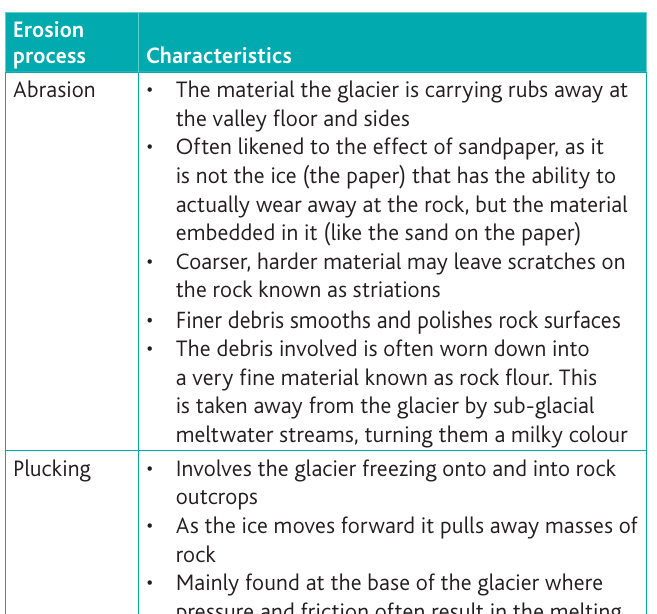
Abrasion occurs when debris embedded in the glacier grinds against the bedrock below and at the valley sides. Think of this process like sandpaper - the ice itself doesn't erode the rock, but rather acts as a backing that holds the abrasive material in place. The rocks, stones and sediment frozen into the base of the glacier do the actual erosive work as the ice moves forward.
Note
The Sandpaper Analogy
This process is comparable to sandpaper - the ice acts as the backing material while embedded rocks and stones do the actual erosive work. It's not the ice (the paper) that has the ability to actually wear away at the rock, but rather the debris it carries.
This grinding action produces several distinctive features:
- Striations - scratches and grooves carved into bedrock by harder, coarser rocks dragged across the surface
- Smoothed and polished surfaces - created by finer particles that buff the rock
- Rock flour - extremely fine sediment produced when debris is ground down to a powder-like consistency
Rock flour is often carried away from the glacier by meltwater streams, giving these waters a distinctive milky appearance.
Plucking
Plucking is a freeze-thaw process that removes chunks of bedrock from beneath the glacier. This occurs when:
Example
How Plucking Works: Step-by-Step
- Meltwater at the base of the glacier penetrates into cracks and joints in the bedrock
- The water refreezes, bonding the ice to the rock
- As the glacier moves forward, it pulls away masses of rock that are now frozen to its base
This process is most effective at the glacier base where:
- Pressure and friction generate heat, creating meltwater
- The melting point of ice is reached or exceeded
- Rock surfaces have been weakened by freeze-thaw weathering (frost shattering)
The weight and movement of the glacier can also simply break away rock fragments, incorporating them into the ice. Plucking typically occurs on well-jointed rocks and surfaces already weakened by weathering, resulting in a jagged, rough landscape.
Important
Key Erosion Processes
Abrasion is the process where material embedded in glacial ice grinds against bedrock, acting like sandpaper to wear away rock surfaces.
Plucking involves the glacier freezing onto bedrock and pulling away rock fragments as it moves.
How glaciers transport material
Valley glaciers are highly effective transport systems, capable of moving enormous quantities of debris. This material comes from two main sources: rock eroded from beneath and beside the glacier, and rockfall debris from valley sides. The position where debris is transported determines what it is called.
The glacier carries material in three distinct zones:
- Supra-glacial debris - material transported on the glacier's surface
- En-glacial debris - material buried within the ice itself
- Sub-glacial debris - material at the glacier's base, which may include rock fragments from plucking, material washed down crevasses (called moulins), and debris eroded from the bedrock
Note
Understanding Moraine Terminology
The term moraine technically refers to a landform deposited by ice, but is commonly used to describe material being transported as well. These different transport zones create distinctive ridges of debris.
These different transport zones create distinctive ridges of debris called moraine. Three main types form during transport:
- Lateral moraine - debris carried along the glacier's edges
- Medial moraine - forms where two glaciers merge, combining their lateral moraines
- Ground moraine - material beneath the glacier
Glacial deposition
The vast quantities of material transported by a glacier must eventually be deposited. This happens in two main situations:
- At the snout - when the glacier melts and releases its debris load
- During flow changes - when the glacier becomes overloaded with material and can no longer transport it all, or when the glacier alternates between compressing and extending flow, reducing the ice mass at specific locations
Till deposits
The material deposited directly by ice is known as till. This term has largely replaced the older term "boulder clay," though boulder clay remains useful for describing certain specific till types.
Important
Defining Till
Till is an unsorted mixture of rocks, clay and sand that was transported and deposited by glacial ice. The material is angular and sub-angular in shape, unlike river or beach sediments which are rounded and smooth.
Till has distinctive characteristics that reveal information about its source:
- Shape - stones are angular to sub-angular because they haven't been rounded by water transport
- Composition - reflects the geology over which the ice passed
- Unsorted nature - all sizes mixed together, from clay particles to large boulders
Case study evidence
Till deposits provide evidence of past ice movement and source areas. For example:
Example
Evidence from Till Deposits
- Till in south Lancashire contains rocks from the Lake District, carried by ice moving south
- Till in southern Scotland includes riebeckite from Ailsa Craig in the Firth of Clyde
- Till in East Anglia contains granite from southern Norway, proving not only that ice moved across this area but that sea levels must have been considerably lower to allow ice to cross what is now the North Sea
Summary
Key Points to Remember:
- Two main erosion processes - abrasion grinds rock like sandpaper, while plucking freezes onto and tears away rock fragments
- Three transport zones - supra-glacial (on top), en-glacial (within), and sub-glacial (beneath) debris
- Distinctive features - abrasion creates striations and rock flour, plucking creates jagged landscapes
- Till characteristics - unsorted, angular stones reflecting source geology
- Moraine types - lateral (sides), medial (merged glaciers), and ground (beneath) mark different transport positions