Human Occupation and Development (AQA A-Level Geography): Revision Notes
📚Revision Notes
Human occupation and development
Introduction to human activity in cold environments
Although cold regions present challenging conditions with harsh climates and tough landscapes, small groups of people have lived in these areas since the end of the Last Glacial Maximum during the Holocene period. However, as global population continues to grow and economic development seeks to exploit untapped natural resources, the human impact on cold environments is becoming more significant.
Note
These fragile landscapes face increasing pressure from human activities, making it essential to understand how people affect these delicate ecosystems and why their recovery from disturbance is so limited.
Environmental fragility
Understanding fragile environments
Scientists have become increasingly concerned about the concept of environmental fragility in cold regions. A fragile environment can be understood as an ecosystem where there exists a delicate balance between non-living elements (such as climate, geology, and soils) and living components (including animals and plants).
Important
A fragile environment is one that is highly susceptible to disturbance by human activity, becomes easily damaged, and then recovers very slowly - if it recovers at all. Not all natural environments are equally fragile; some ecosystems can cope well with major natural events like forest fires or volcanic eruptions, whilst others struggle to handle even minor human interference.
Why cold environments are particularly fragile
Cold environments fall into the category of fragile environments for several specific reasons:
- Limited growing seasons: Short summers combined with long, harsh winters severely restrict plant growth opportunities
- Slow plant development: The challenging climate conditions mean that plants grow at a very slow rate, making it difficult for vegetation to establish and spread
- Extended recovery periods: Any disruption to the ecosystem takes an exceptionally long time to be corrected naturally
- Permanent damage potential: Some estimates suggest that an area of tundra could take over 50 years to return to its former condition after interference - including something as simple as tyre tracks in the permafrost, which may take 50 years to completely revegetate
The significance of slow recovery
The extended recovery time presents a critical issue. Whilst human activity can cause very rapid changes to cold environments, the natural processes that would restore these ecosystems operate extremely slowly. This means that changes and damage affecting fragile cold environments accumulate over time and can quickly become permanent features of the landscape.
Important
This is especially concerning when considering issues related to climate change, where the impacts build upon one another. The mismatch between the speed of human-caused damage and the pace of natural recovery is a fundamental challenge in cold environments.
Human impacts on fragile cold environments
Range of human activities
Despite the hostile conditions that characterise cold environments, people are now present in almost all of these regions. Very few cold environments remain completely unexploited by human activity.
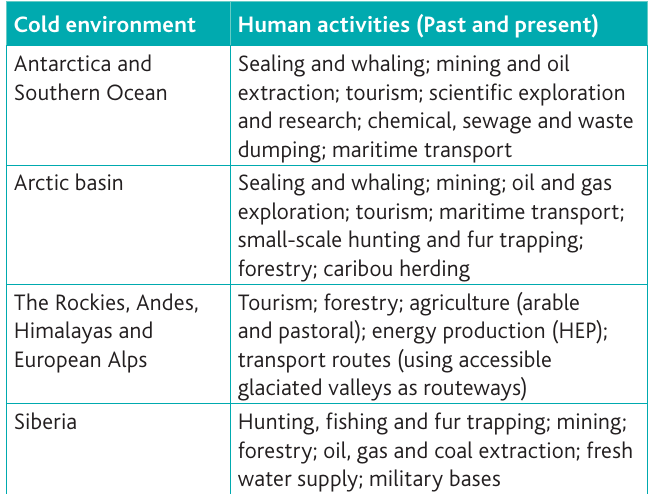
The table above illustrates the limited but diverse range of activities that people undertake in various cold environments. Each region has developed its own pattern of human use based on accessibility, available resources, and historical patterns of occupation:
- Antarctica and Southern Ocean: Activities include sealing and whaling (historically), mining and oil extraction, tourism, scientific exploration and research, chemical and sewage waste dumping, and maritime transport
- Arctic basin: Human activities encompass sealing and whaling, mining, oil and gas exploration, tourism, maritime transport, seal-skin hunting and fur trapping, forestry, and caribou herding
- The Rockies, Andes, Himalayas and European Alps: These mountain regions support tourism, forestry, agriculture (both arable and pastoral farming), energy production through hydroelectric power, and transport routes that use accessible glaciated valleys as highways
- Siberia: Activities include hunting, fishing and fur trapping, mining, forestry, oil and gas extraction, coal extraction, freshwater supply, and military bases
Note
Notice how resource extraction activities (particularly oil, gas, and minerals) appear across nearly all cold environment regions, highlighting the global demand for these resources despite the challenging conditions and environmental risks involved.
Categories of human impacts
Human activities affect cold environments through multiple interconnected pathways. The relationships between different types of impact are complex and often reinforce one another.
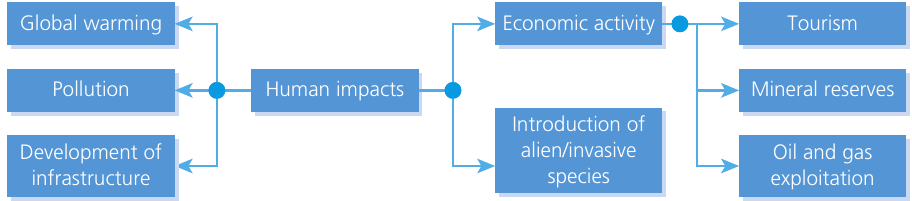
The diagram above shows how human impacts branch into several major categories:
- Global warming: Changes to atmospheric composition affecting worldwide temperatures
- Pollution: Contamination of air, water, and land through human activities
- Development of infrastructure: Construction of roads, buildings, pipelines, and other permanent structures
- Economic activity: Resource extraction and commercial operations
- Tourism: Recreational visits and associated facilities
- Introduction of alien/invasive species: Non-native organisms that disrupt local ecosystems
- Mineral reserves exploitation: Extraction of valuable minerals and metals
- Oil and gas exploitation: Drilling and extraction of fossil fuels
Important
These impacts do not occur in isolation - they interact with and amplify one another, creating cumulative effects on cold environments. For example, infrastructure development may facilitate increased tourism, which in turn increases pollution and the risk of introducing invasive species.
Why human activity is limited in cold regions
In the early twenty-first century, it may not be the range of human activities that makes cold environments susceptible to damage. Rather, it is the scale of some impacts that continues to increase, making these activities more damaging over time.
The limited range of human activities in cold landscapes results from several factors:
Physical constraints: The inaccessibility and remoteness of many cold environments naturally limits the extent of human activity. Harsh weather conditions, difficult terrain, and isolation make it challenging and expensive to establish permanent operations.
Resource limitations: Cold environments have limited living and non-living natural resources available for exploitation. The restricted biodiversity found in most cold environments affects their ability to be used sustainably. In many cases, the fragility of these ecosystems makes it nearly impossible for humans to use them in ways that meet present needs without compromising them for future generations.
Note
The concept of sustainable use is particularly challenging in cold environments. Unlike more productive ecosystems that can regenerate relatively quickly, cold environments lack the resilience needed to recover from exploitation while continuing to meet human needs.
Ecosystem sensitivity: The low productivity and limited species diversity mean that plants are highly specialised. Any disruption causes significant difficulty when it comes to regeneration. In such circumstances, species struggle greatly to adapt to changed environmental conditions.
Food chain instability: Wide variations occur in the amount of energy held at each level of different food chains because population numbers change rapidly. For example, fluctuations in the populations of lemmings and arctic hares - both of which are liable to short-term and long-term changes - have consequences for the populations of their predators, such as arctic foxes and snowy owls.
Long-term implications: Disruption to the functioning of the biome has extended consequences over time. This explains why there has been considerable concern over proposed exploitation of resources such as oil reserves in northern Alaska that fall within the Arctic National Wildlife Refuge.
Scale of human impacts
Humans affect fragile cold environments at multiple scales, each with different characteristics and implications:
Individual level impacts
Individual people can have direct effects on local landscapes. For example:
- Tourists walking on delicate vegetation can cause damage that takes decades to repair
- Single vehicles creating tracks across permafrost
- Personal waste disposal contributing to local pollution
Note
The impact of individual actions may seem small, but when multiplied by thousands of tourists or workers in cold environments, the cumulative effect becomes significant and long-lasting.
Community level impacts
Communities may have broader effects on their surrounding environments through:
- Changing land use patterns in their local area
- Altering the permafrost through development and infrastructure
- Modifying drainage patterns and water flows
- Introducing new species to the local ecosystem
Global scale impacts
Individual actions and community activities can contribute to worldwide effects:
- Adding to emissions of greenhouse gases
- Contributing to broader patterns of climate change
- Participating in global resource extraction industries
- Supporting international tourism and transport networks
Important
To a greater or lesser extent, global human activity over the last few hundred years has had, and continues to have, impacts on all fragile cold environments through resource exploitation and climate change. Every person on Earth contributes to these global-scale impacts, regardless of whether they have ever visited a cold environment.
Recent and prospective impact of climate change
Climate change as a contemporary issue
Climate change has emerged as a major challenge in twenty-first century Geography and is explored widely across multiple areas of study. The majority of climate scientists agree that the Earth's climate is changing, with recent decades showing a pattern of accelerated warming of average global temperatures.
Natural climate variability
The Earth's climate constantly changes naturally, as demonstrated by the cycles of glacials and interglacials discussed in previous sections. These natural variations have occurred throughout Earth's history without human influence.
The enhanced warming debate
However, many scientists argue that there has been an enhanced rate of change recently that can only be explained when the impacts of human activity are included in the analysis. The causes of climate change remain subject to scientific debate, and the proposed impacts also vary widely across different regions of the globe.
Note
Whilst the causes of climate change are not straightforward to determine, understanding both natural and human factors is essential for comprehending the future of cold environments. The key distinction is between normal climate variability and the potentially accelerated warming attributed to human activities.
Remember!
Summary
Key Points to Remember:
-
Fragile environments are ecosystems with a sensitive balance between living and non-living components that are easily damaged by human activity and very slow to recover - tundra can take over 50 years to regenerate after disruption
-
Cold environments are particularly fragile because of short growing seasons, slow plant growth rates, limited biodiversity, and extended recovery times that make them vulnerable to even minor human interference
-
Human activities in cold regions include resource extraction (oil, gas, minerals), tourism, research, traditional practices (hunting, herding), and infrastructure development - though the range of viable activities is limited by harsh conditions
-
Human impacts operate at multiple scales - from individual tourists damaging vegetation, to communities changing land use patterns, to global contributions to climate change through greenhouse gas emissions
-
The key concern is the mismatch between impact and recovery - human activities can cause rapid changes to cold environments, but natural processes to restore these ecosystems are extremely slow, making damage cumulative and potentially permanent