Case Study: Hurricane Michael, Northern Florida, USA (2018) (AQA A-Level Geography): Revision Notes
📚Revision Notes
Case Study: Hurricane Michael, Northern Florida, USA (2018)
Overview
Hurricane Michael struck the southeastern United States in October 2018, becoming one of the most devastating hurricanes in recent US history. The storm made landfall on the Florida Panhandle as an exceptionally powerful hurricane, causing widespread destruction and loss of life across multiple states.
Important
A category 5 hurricane is the most intense classification on the Saffir-Simpson scale, featuring sustained wind speeds exceeding 252 km/h (157 mph). These storms cause catastrophic damage to buildings, infrastructure, and vegetation.
Hurricane development
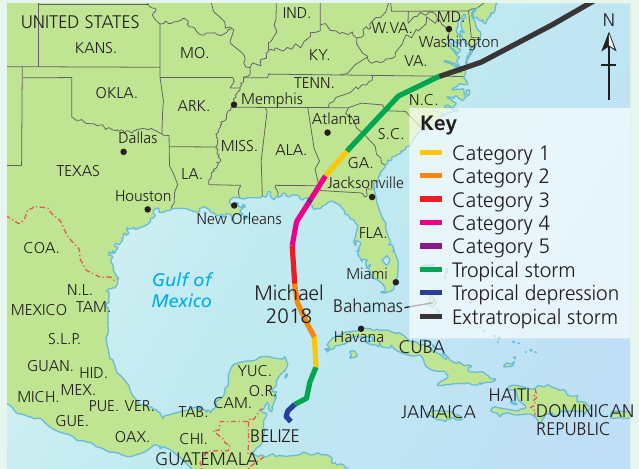
Hurricane Michael began as a tropical depression that formed in the western Caribbean Sea between Cuba and Mexico during the weekend of 6-7 October 2018. The storm system had already brought heavy winds and torrential downpours to parts of Mexico and Cuba during the Sunday night and Monday morning.
The depression rapidly intensified as it tracked northward through the Gulf of Mexico. By 9 October, having strengthened to a category 2 storm, Michael began moving north through the Gulf. The hurricane made landfall early in the afternoon of 10 October, having briefly reached category 5 intensity.
At first, meteorologists classified the storm as a category 4 hurricane. However, the National Hurricane Center in Florida later determined that Michael had been more intense than initially thought, with winds estimated at over 250 km/h. This made Hurricane Michael one of only four category 5 hurricanes ever to reach land in the USA, and the most powerful storm to hit the US mainland since Hurricane Andrew in 1992.
Note
The storm's rapid intensification from a tropical depression to a category 5 hurricane occurred over just four days (6-10 October), demonstrating how quickly these dangerous weather systems can develop in favorable conditions.
Risk and vulnerability
The storm came ashore on the coast of Florida near Mexico Beach, a small coastal town in Bay County with a population of just 1,000 residents. After making landfall, the hurricane reduced in strength as it moved inland, tracking through parts of Georgia to the north and east, then continuing into South Carolina.
Important
The affected regions were particularly vulnerable because parts of Georgia, North Carolina, and South Carolina had already been suffering from the effects of Hurricane Florence earlier that same year. This meant communities were still recovering from previous storm damage when Hurricane Michael struck.
Impacts
Hurricane Michael caused a trail of destruction stretching from Florida (particularly the area around Mexico Bay and Panama City) through to Georgia, North Carolina, and South Carolina.
Deaths and casualties
The human cost of Hurricane Michael was severe, with casualties occurring both during and after the storm:
- The hurricane's powerful winds, storm surge, and torrential rainfall directly caused 16 fatalities across the states of Florida, Virginia, North Carolina, and Georgia
- An additional 43 people died indirectly from causes related to the storm during its aftermath, including falls whilst clearing storm debris, and traffic accidents caused by hazardous conditions
- Medical issues were made considerably worse by the hurricane's disruption to healthcare services
Note
Understanding Storm Surge
Storm surge is an abnormal rise in sea level generated by a storm's winds pushing water towards the coast. Combined with normal tides, storm surge can cause severe coastal flooding and is often the most dangerous aspect of hurricanes.
Physical damage to structures
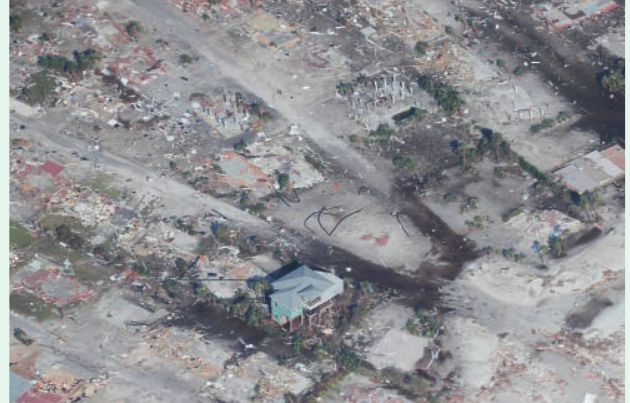
The hurricane caused devastating damage across Bay County, Florida, with destruction on an unprecedented scale:
- More than 45,000 structures were damaged throughout the affected region
- Over 1,500 buildings were completely destroyed
- Two hospitals suffered severe structural damage
- In the town of Mexico Beach specifically, 1,584 of the town's 1,692 buildings were damaged
- More than 800 buildings in Mexico Beach were completely destroyed
Example
Mexico Beach: A Town Nearly Destroyed
Mexico Beach provides a stark example of the hurricane's destructive power. In this small coastal community:
- Total buildings: 1,692
- Buildings damaged: 1,584 (approximately 93% of all structures)
- Buildings completely destroyed: over 800 (nearly 50% of all buildings)
This means almost every single building in the town suffered some level of damage, making it one of the hardest-hit communities in the entire disaster.
Infrastructure damage
Hurricane Michael's extreme winds and storm surge wreaked havoc on infrastructure throughout the affected areas:
- Trees were uprooted across wide areas
- Power lines were brought down throughout the affected region
- Roofs were ripped off buildings and swept into the air
- Homes were ripped open by fallen trees
- Roads became blocked, and some were flooded, turning into rivers
- Flash flooding occurred as storm surge and heavy rainfall combined
Economic impacts
The financial cost of Hurricane Michael was enormous, making it one of the costliest natural disasters in US history:
- Total damage from the hurricane was estimated at $25 billion
- Damage specifically in Florida accounted for $18.4 billion of this total
- Agricultural and forestry losses totalled approximately $3.87 billion, primarily affecting Florida and Georgia
- Insurance companies faced claims of at least $6.23 billion related to the hurricane
Note
The $25 billion total damage figure represents both direct physical damage to structures and infrastructure, as well as indirect economic losses from business interruption, agricultural losses, and other storm-related impacts.
Power outages
At their greatest extent, power cuts affected nearly 400,000 electricity customers in Florida, representing approximately four per cent of the entire state's population. These widespread outages compounded the crisis by disrupting communications, medical services, and recovery efforts.
Responses to the hurricane
Before the storm (7-9 October)
State and federal authorities took significant action in the days leading up to Hurricane Michael's landfall, implementing comprehensive preparedness measures to protect residents and minimize casualties.
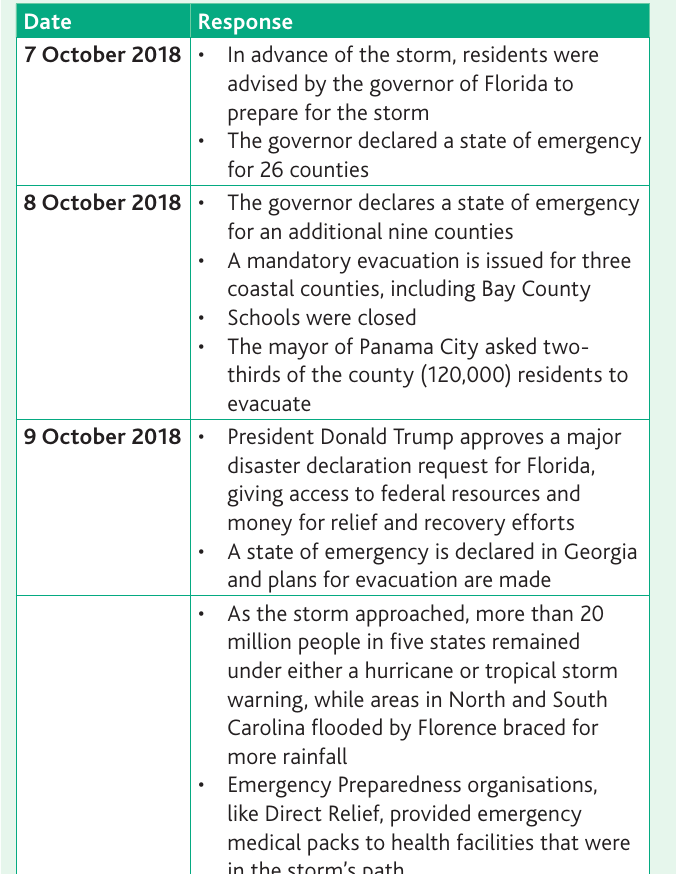
7 October 2018:
- In advance of the approaching storm, residents received advice from the Governor of Florida to prepare
- The Governor declared a state of emergency for 26 counties
8 October 2018:
- The Governor extended the state of emergency to an additional nine counties
- Authorities issued a mandatory evacuation order for three coastal counties, including Bay County
- Schools were closed across the affected area
- The Mayor of Panama City urged two-thirds of the county's residents (approximately 120,000 people) to evacuate
9 October 2018:
- President Donald Trump approved a major disaster declaration request for Florida, providing access to federal resources and funding for relief and recovery efforts
- A state of emergency was declared in Georgia, and evacuation plans were established
- As the storm approached, more than 20 million people across five states remained under either a hurricane warning or tropical storm warning
- Areas in North and South Carolina that had flooded due to Hurricane Florence earlier in the year prepared for additional rainfall
- Emergency preparedness organisations, such as Direct Relief, provided emergency medical packs to health facilities located in the storm's projected path
Important
Mandatory Evacuation Orders
A mandatory evacuation is a government order requiring residents to leave an area due to imminent danger. While the term "mandatory" suggests it is legally required, enforcement varies. These orders are issued when authorities determine that staying poses an unacceptable risk to life.
After the storm
Following Hurricane Michael's devastating impact, extensive relief and recovery operations were launched to support affected communities:
-
Bay County, Florida had to borrow more than $250 million to pay for the immediate clean-up work whilst awaiting reimbursement from state and federal government sources
-
1,500 national guard personnel were activated and deployed across the state of Georgia to assist with emergency response operations
-
On 11 October 2018, President Trump declared a major disaster in five counties, enabling residents to receive:
- Grants for house repairs
- Temporary shelter accommodation
- Loans for uninsured property losses
- Business loans for affected companies
- An emergency declaration for Georgia, authorising funding to cover 75 per cent of the cost of emergency protective measures
- Funding for the removal of storm debris
-
The Federal Emergency Management Agency (FEMA) and several private and not-for-profit organisations established the Hurricane Michael Relief Network to provide direct relief to residents affected by the disaster
Note
The speed of the federal response was crucial. By declaring a major disaster just one day after landfall, President Trump enabled immediate access to federal funding and resources, allowing recovery efforts to begin without delay while communities were still in crisis mode.
Remember!
Summary
Key Points to Remember:
-
Hurricane Michael was exceptionally powerful - one of only four category 5 hurricanes to make landfall in the USA, with wind speeds exceeding 250 km/h.
-
The death toll reached 59 people - 16 died directly from the storm's winds, storm surge, and flooding, whilst 43 died indirectly from accidents during clean-up operations and storm-related traffic incidents.
-
Mexico Beach suffered catastrophic damage - in this small coastal town of 1,000 people, 1,584 of the 1,692 buildings (93%) were damaged, with over 800 completely destroyed.
-
The economic cost was enormous - total damage reached $25 billion, with $18.4 billion occurring in Florida alone, plus $3.87 billion in agricultural and forestry losses.
-
Response efforts were rapid and extensive - authorities declared states of emergency, evacuated 120,000 people, and after the storm, deployed 1,500 national guard personnel and established federal relief programmes through FEMA to support recovery.