Case Study: Lombok, Indonesia (2018) (AQA A-Level Geography): Revision Notes
📚Revision Notes
Case Study: Lombok, Indonesia (2018)
Location and tectonic setting
Lombok is a small island located in Indonesia, forming part of the Lesser Sunda Islands chain. This chain includes well-known islands such as Bali (to the west) and Sumbawa (to the east). The island sits in one of the most tectonically active regions on Earth, making it particularly vulnerable to seismic hazards.
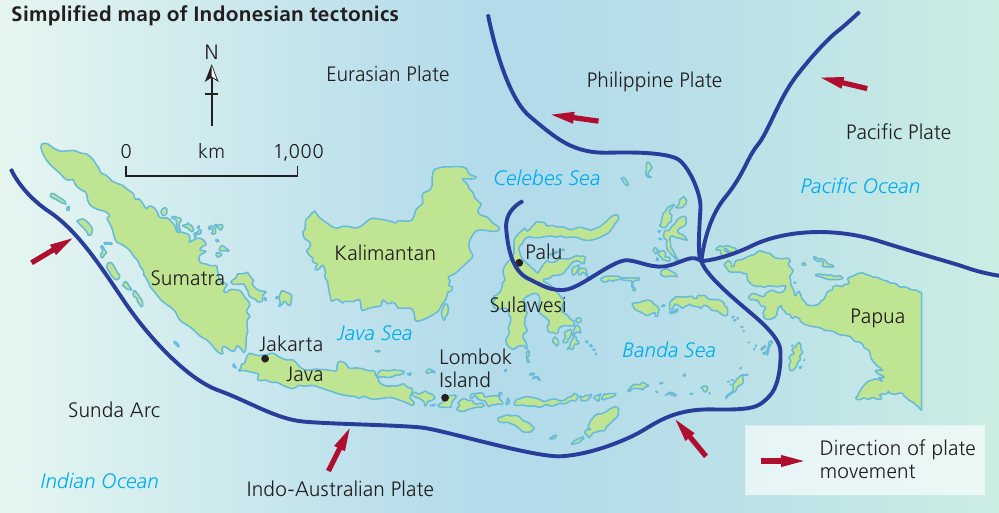
Indonesia's location is complex from a tectonic perspective. The country sits at the convergence point of several major tectonic plates. The Indo-Australian Plate is moving northward and colliding with the south-easterly moving Eurasian Plate. This collision occurs at a rate of approximately 6 cm per year. Additionally, the Philippine and Pacific plates are moving westward, adding further tectonic complexity to the region.
Important
Subduction Zone
A subduction zone is a destructive plate boundary where one tectonic plate is forced beneath another. As the descending plate sinks into the mantle, it creates intense geological activity including earthquakes and volcanic eruptions.
The Sunda Arc subduction zone
The Sunda Arc represents a crucial geological feature in understanding Lombok's earthquake risk. This subduction zone extends from the northern tip of Sumatra, continuing southward past Lombok and beyond. Here, the Indo-Australian Plate is being forced beneath the Eurasian Plate, creating a deep submarine trench that runs parallel to the Indonesian coastline.
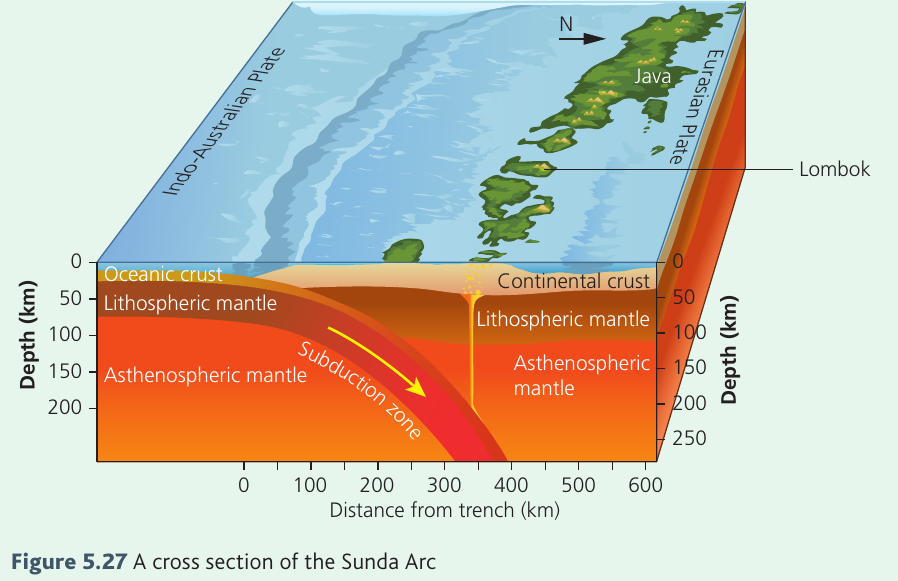
This subduction process has several important consequences for the region:
Note
Consequences of the Sunda Arc Subduction:
- Most of Indonesia's numerous earthquakes occur along this subduction boundary
- The islands of the Lesser Sunda chain, including Lombok, are volcanic in origin
- Many active volcanoes continue to exist along the Sunda Arc
- The subduction zone creates a typical island arc structure
Geological evidence suggests that major earthquakes along the Sunda Arc subduction zone follow a cyclical pattern, occurring approximately once every 200 years. With the last major event being around 200 years ago, scientists warn that a powerful earthquake of magnitude 8.5 to 9.0 could potentially occur by 2040.
Important
Future Seismic Risk
Based on the 200-year earthquake cycle and historical data, the region is approaching a period of elevated risk. Scientists are closely monitoring this subduction zone as the predicted timeframe for the next major event approaches.
The 2018 Lombok earthquakes
The term "Lombok earthquake" actually refers to a sequence of multiple seismic events rather than a single earthquake. These events occurred between 29 July and 19 August 2018, creating a prolonged period of danger and disruption for the island's inhabitants.
The sequence began on 29 July 2018 when the Indonesian Meteorological, Climatological and Geophysical Agency (BMKG) recorded an earthquake measuring 6.4 Mw (moment magnitude). This initial event was the first in a series of shallow earthquakes, followed by over 1,000 smaller aftershocks that continued to shake the region.
Example
Timeline of Major Seismic Events:
29 July 2018: Initial earthquake of 6.4 Mw strikes, triggering the sequence
5 August 2018: Most powerful earthquake measuring 7.0 Mw causes the most significant damage
9 August 2018: Further earthquake of 5.9 Mw continues the crisis
18 August 2018: Another major event of 6.4 Mw prolongs the emergency
19 August 2018: Final major aftershock hits the already devastated area
Throughout this period, over 1,000 smaller aftershocks continued to shake the region, hampering relief efforts and preventing residents from returning to their homes.
Impacts of the earthquakes
The Indonesian National Board for Disaster Management (BNPB) compiled comprehensive data on the impacts of these earthquakes. The human and economic toll was substantial:
Note
Human Impacts:
- 564 people died as a direct result of the earthquakes
- 1,584 individuals suffered injuries requiring medical attention
- 445,343 people required temporary accommodation in makeshift shelters
- 432,015 persons were displaced from their homes, with 2,700 displacement sites established across the island
Note
Infrastructure and Economic Impacts:
- 129,715 houses sustained damage ranging from minor to complete destruction
- 458 schools were damaged, disrupting education for thousands of children
- The total estimated cost of damage reached approximately $600 million
This substantial economic impact affected both public infrastructure and private property. The damage to homes was particularly significant, as many buildings in Lombok were not constructed to withstand major seismic activity.
Important
Common Vulnerability
A critical factor in the high level of damage was that many buildings in Lombok were not constructed to earthquake-resistant standards. This highlights the importance of proper building codes and construction practices in seismically active regions.
Response to the earthquakes
The response to the Lombok earthquakes demonstrates how disaster management unfolds in phases, from immediate emergency action through to longer-term recovery. The emergency plan was continuously updated as the situation evolved.
Example
Disaster Response Timeline:
Immediate Response (29 July 2018):
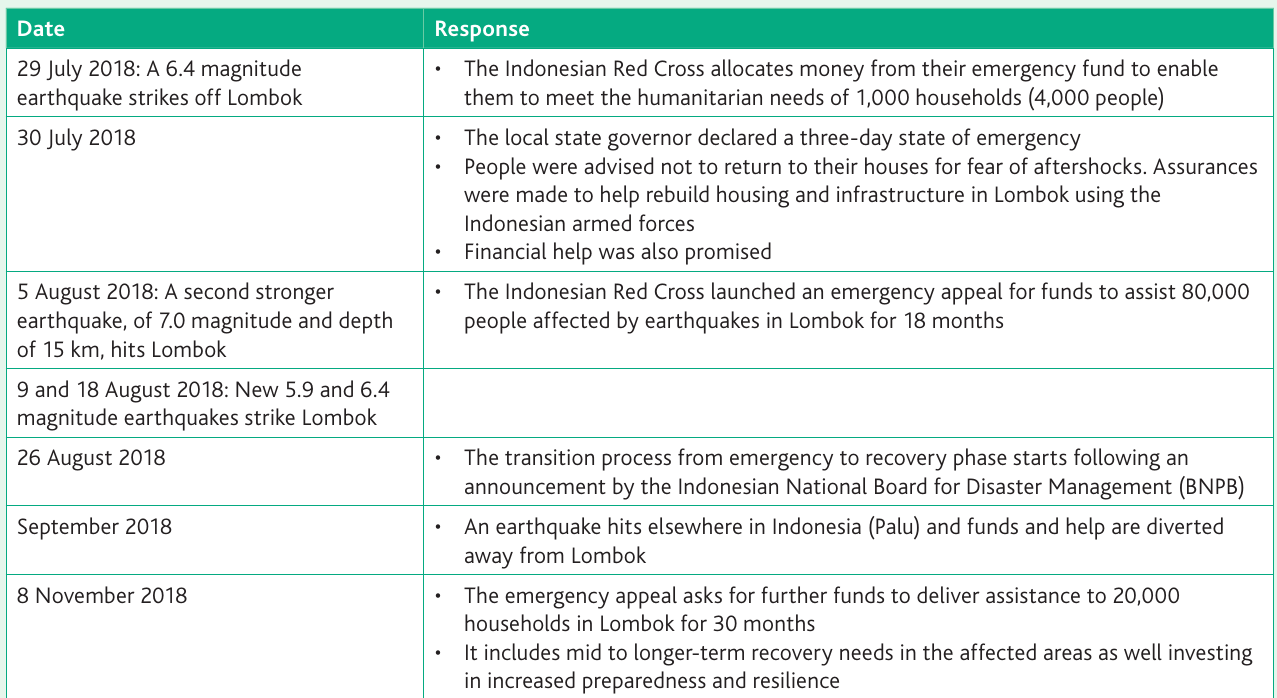
Following the initial 6.4 magnitude earthquake, the Indonesian Red Cross took swift action. They allocated funds from their emergency reserves to address the immediate humanitarian needs of approximately 1,000 households (around 4,000 people). This rapid response helped provide essential supplies and temporary shelter.
State of Emergency (30 July 2018):
The local state governor declared a three-day state of emergency. During this period, authorities advised residents not to return to their homes due to the high risk of aftershocks. The government made assurances that they would help rebuild housing and infrastructure, with support from the Indonesian armed forces. Financial assistance was promised to affected families.
Escalation of Response (5 August 2018):
When the more powerful 7.0 magnitude earthquake struck, the Indonesian Red Cross launched a major emergency appeal. This appeal sought funds to assist 80,000 people affected by the earthquakes, with support planned to extend over 18 months. The scale of this appeal reflected the magnitude of the disaster.
Recovery Transition (26 August 2018):
The BNPB announced the beginning of a transition from emergency response to the recovery phase. This shift recognised that immediate life-saving operations were giving way to longer-term reconstruction and rehabilitation needs.
Resource Diversion (September 2018):
In September 2018, another major earthquake struck Palu in Sulawesi, Indonesia. This created a challenging situation where funds and relief resources needed to be diverted to assist the new disaster area whilst Lombok still required ongoing support.
Long-term Recovery (8 November 2018):
By November, the emergency appeal was expanded to request further funds to deliver assistance to 20,000 households in Lombok over a 30-month period. Importantly, this appeal recognised that medium to long-term recovery needs remained, including rebuilding homes, restoring livelihoods, and investing in increased preparedness and resilience for future earthquakes.
Funding and Assistance:
The majority of the $600 million damage cost was covered by the Indonesian government alongside Indonesian non-governmental organisations (NGOs). International support included:
- A hospital ship was dispatched to provide medical care
- Ferry services were made free to help people evacuate or access assistance
- The postal service coordinated the movement of large quantities of aid supplies
Note
Multi-phase Response Strategy
The Lombok earthquake response demonstrates the importance of flexible disaster management that evolves through distinct phases: immediate emergency relief, short-term recovery, and long-term resilience building. Each phase requires different resources, strategies, and coordination approaches.
Remember!
Summary
Key Points to Remember:
-
Lombok sits on the Sunda Arc subduction zone where the Indo-Australian Plate subducts beneath the Eurasian Plate at approximately 6 cm per year, creating significant seismic risk.
-
The 2018 earthquakes were actually a series of events between July and August, with the main shock measuring 7.0 Mw on 5 August, followed by numerous aftershocks.
-
The impacts were severe: 564 deaths, 1,584 injuries, nearly 130,000 houses damaged, over 432,000 people displaced, and $600 million in damage costs.
-
The response evolved through distinct phases: immediate emergency action by the Red Cross, declaration of a state of emergency, major humanitarian appeals, and eventual transition to long-term recovery and resilience building.
-
Geological evidence suggests major earthquakes occur approximately every 200 years along the Sunda Arc, meaning another large event (magnitude 8.5-9.0) could potentially occur by 2040.