Hazard in a Geographical Context (AQA A-Level Geography): Revision Notes
📚Revision Notes
Hazard in a Geographical Context
Introduction
Natural hazards are environmental events that pose significant threats to human life, property and activities. Understanding hazards in their geographical context means examining not only the physical events themselves, but also how location, human perception and vulnerability shape the risk that people face. This geographical approach helps explain why similar hazards can have vastly different impacts in different places.
Note
The geographical perspective on hazards recognises that the impact of natural events depends not just on their physical characteristics, but on the complex interactions between the environment, human settlements, and social factors in specific locations.
What is a natural hazard?
Important
A natural hazard is a perceived event that threatens both life and property. These events occur in the physical environment of the atmosphere, lithosphere and hydrosphere.
Natural hazards frequently lead to disasters that result in loss of life and damage to the built environment. They create severe disruption to human activities across communities and regions. Common examples of natural hazards include:
- Volcanic activity (eruptions, lava flows, ash clouds)
- Seismic events (earthquakes and associated ground shaking)
- Tropical storms (hurricanes, typhoons and cyclones)
All of these hazards have the potential to cause significant disruption to human systems. The impacts can include death and injury, destruction of property, damage to communication networks and the disruption of economic activities that communities depend upon.
The risk posed by natural hazards increases considerably when we build settlements in vulnerable locations. For example, constructing shanty towns on unstable tropical slopes, developing communities in volcanic zones, building near active geological faults, or establishing coastal settlements susceptible to hurricanes and tsunamis all amplify the potential danger. This increased risk is often compounded when communities fail to recognise the hazard exists or do not take appropriate action to protect themselves.
Characteristics of natural hazards
Natural hazards share several common characteristics that help us understand their impacts on people and places:
-
Clear origins and distinctive effects: The sources of hazards are identifiable and their impacts are distinctive. For example, earthquakes cause buildings to collapse through ground shaking, creating a recognisable pattern of destruction.
-
Limited warning time: Most natural hazards provide only a short warning period before the event occurs. Some hazards, such as earthquakes, may give virtually no advance warning at all, making preparation extremely difficult.
-
Involuntary exposure to risk: Exposure to hazard risk is often involuntary, particularly for populations in less developed countries. In wealthier nations, people living in hazardous areas tend to be well aware of the risks. They often deliberately choose to minimise or even ignore these risks when making decisions about where to live.
-
Immediate losses: The majority of losses to life and property damage occur shortly after the hazard event strikes. However, the effects of natural hazards can persist in communities for extended periods after the initial event. These longer-term impacts include disease outbreaks, disruption to communication systems and damage to economic activities.
-
Scale requires emergency response: The scale and intensity of natural hazard events demand an emergency response from authorities and aid organisations to help affected communities cope with the immediate aftermath.
Note
These shared characteristics help geographers and emergency planners understand what to expect when hazards strike, though the specific impacts vary greatly depending on location, preparedness, and the vulnerability of affected communities.
Risk and vulnerability
Understanding risk
Risk refers to the exposure of people to a hazardous event that presents a potential threat to themselves, their possessions and the built environment they inhabit. An important geographical question emerges here: why do people consciously choose to put themselves at risk from natural hazards?
Several factors explain why people continue to live in hazardous areas:
-
Unpredictability of hazard events: We cannot accurately predict the frequency, magnitude or scale of future natural hazard events. This uncertainty makes it difficult for people to assess the true level of danger they face.
-
Lack of alternatives: Social, political, economic and cultural factors often prevent people from simply leaving hazardous areas. They cannot easily uproot themselves from one place and move to another, as doing so would mean abandoning their homes, land and employment opportunities.
-
Changing levels of risk: Places that were once relatively safe may become more hazardous over time. For instance, deforestation in mountainous areas could increase the risk of flooding from torrential rain during tropical storms. There may also be heightened risk from landslides in deforested regions.
-
Cost-benefit considerations: Many hazardous areas offer significant advantages that, in people's minds, outweigh the risks they face. Californian cities, for example, experience high earthquake risk, yet people continue to live there because they perceive the many benefits of living in these locations as greater than the potential danger.
-
Perception of risk: How individuals and communities perceive the threat of a hazard event ultimately shapes their decisions and the actions they expect from governments and organisations. Perception plays a crucial role in determining whether people take protective measures.
Example
Real-world Application: Living in Earthquake Zones
Californian cities like San Francisco and Los Angeles sit along major fault lines, exposing millions of people to earthquake risk. Despite this known danger, these cities continue to grow because residents perceive the benefits as outweighing the risks:
- Economic opportunities in thriving tech and entertainment industries
- Attractive climate and lifestyle
- Well-developed infrastructure and services
- Strong building codes that reduce (but don't eliminate) risk
This demonstrates how cost-benefit analysis influences people's decisions to remain in hazardous locations.
The concept of vulnerability
Vulnerability describes the potential for loss when a hazard strikes. Since losses vary geographically, over time and among different social groups, vulnerability is not uniform across all people and places. It changes over both time and space, creating a complex pattern of risk.
Researchers have developed models to understand the various factors that link risk and vulnerability. These models help explain why some communities suffer greater impacts than others when faced with similar hazards.
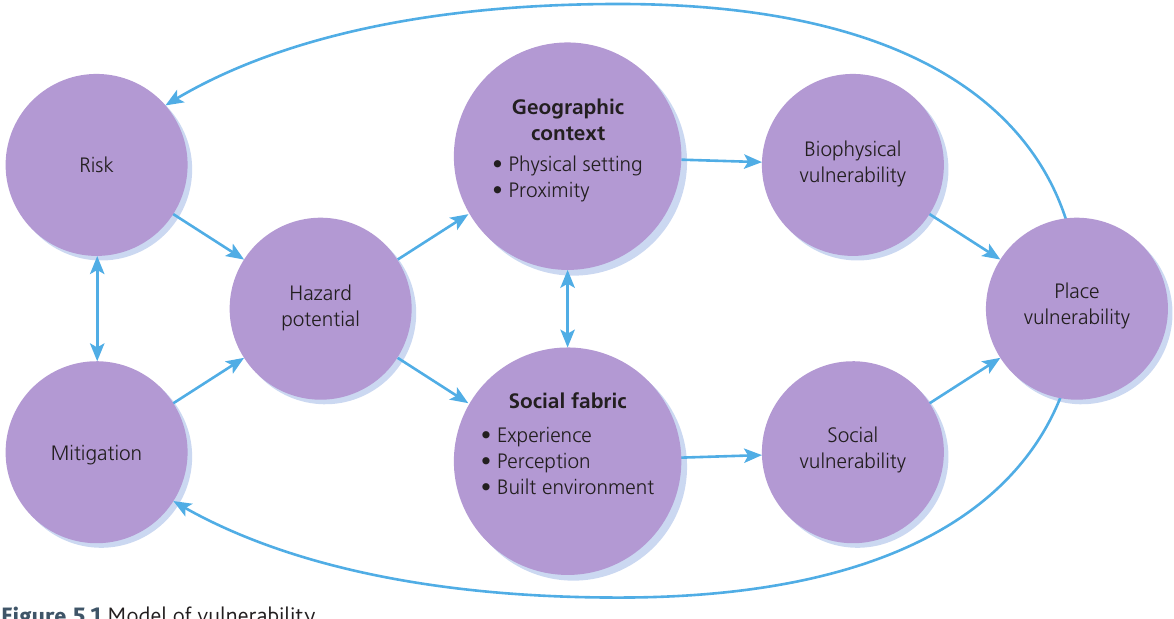
The vulnerability model demonstrates how different elements interact to create overall vulnerability in a place. The model shows that risk is connected to hazard potential and mitigation efforts. These factors operate within a geographic context (determined by physical setting and proximity to hazards) and a social fabric (shaped by experience, perception and the built environment).
Note
The cyclical nature of the vulnerability model is particularly important. It shows that vulnerability is not static—changes in one component affect all others. For example, improved mitigation measures reduce vulnerability, which can influence how people perceive risk, which in turn affects future decisions about living in hazardous areas.
Together, these elements influence three types of vulnerability:
-
Biophysical vulnerability: This relates to the physical characteristics of a location and how exposed it is to natural hazards based on its geographical features.
-
Social vulnerability: This concerns how different social groups within a community are affected by hazards. Factors such as age, income, education and social networks all influence how vulnerable different people are.
-
Place vulnerability: This represents the overall vulnerability of a specific location, combining both the biophysical and social dimensions of risk.
The model is cyclical, showing that vulnerability feeds back into risk levels, which in turn influences mitigation strategies and future hazard potential. Understanding these connections helps explain why vulnerability is not simply about the physical hazard itself, but involves complex interactions between environment, society and human decision-making.
Key concepts in hazard geography
Adaptation
Important
Adaptation refers to the attempts by people or communities to live with hazard events. By adjusting their living conditions, people are able to reduce their levels of vulnerability.
Adaptation involves making changes that allow communities to cope better with hazardous conditions. For example, people might continue to reside in sites that are vulnerable to storm surges but adapt by staying within the same area rather than relocating entirely. This approach recognises that moving away is not always feasible or desirable, so communities develop strategies to live more safely with the hazards they face.
Examples of adaptation strategies include building homes on stilts in flood-prone areas, constructing earthquake-resistant buildings, developing early warning systems, or creating community evacuation plans. These measures acknowledge the presence of hazards whilst taking practical steps to reduce their potential impact.
Fatalism
Important
Fatalism is a view of hazard events that suggests people cannot influence or shape the outcome, therefore nothing can be done to mitigate against it.
People with a fatalistic attitude may describe hazard events as "God's will" or simply accept them as inevitable. This perspective means that individuals with fatalistic views are likely to take limited or no preventative measures against hazards. They may see attempts to prepare for or prevent disaster impacts as pointless, believing the outcome is predetermined regardless of human action.
Fatalism can be influenced by cultural beliefs, religious views, repeated exposure to hazards, or a sense of powerlessness in the face of overwhelming natural forces. Understanding fatalistic attitudes is important for disaster management, as it affects how communities respond to warnings and preparedness initiatives.
Perception
Important
Perception is the way in which an individual or a group views the threat of a hazard event. This perception will ultimately determine the course of action taken by individuals or the response they expect from governments and other organisations.
Perception is crucial because it shapes behaviour and decision-making around hazards. Different people may perceive the same hazard very differently based on their experiences, cultural background, education and access to information. These varying perceptions explain why some communities take extensive precautions whilst others appear to ignore obvious dangers. Understanding perception helps geographers explain the range of human responses to natural hazards.
Factors influencing perception include:
- Previous experience with hazard events
- Media coverage and information availability
- Socioeconomic status and resources
- Trust in authorities and institutions
- Cultural and religious beliefs about nature and risk
Note
The three concepts of adaptation, fatalism, and perception are interconnected. Someone's perception of a hazard influences whether they adopt a fatalistic view or pursue adaptation strategies. Similarly, successful adaptation can change perception, making people feel more capable of managing hazard risks.
Remember!
Summary
Key Points to Remember:
-
Natural hazards are perceived events that threaten both life and property, including volcanic activity, earthquakes and tropical storms.
-
People continue to live in hazardous areas due to unpredictability, lack of alternatives, changing risk levels, cost-benefit considerations and their perception of the threat.
-
Vulnerability is the potential for loss and varies geographically, over time and among different social groups.
-
The vulnerability model shows how risk, hazard potential, mitigation, geographic context and social fabric interact to create biophysical, social and place vulnerability.
-
Key concepts include adaptation (adjusting to live with hazards), fatalism (belief that outcomes cannot be changed) and perception (how people view hazard threats).