Plate Margins (AQA A-Level Geography): Revision Notes
📚Revision Notes
Plate margins
Tectonic plates meet and interact at boundaries called plate margins. These margins are critical zones where most volcanic eruptions and earthquakes occur. Understanding how plates interact at these boundaries helps explain why major natural hazards happen in specific locations around the world.
Note
There are three main types of plate margin, classified by the direction of plate movement:
- Constructive (divergent) plate margin – plates move apart
- Destructive (convergent) plate margin – plates move together
- Conservative (passive) plate margin – plates slide past each other
Constructive (divergent) plate margins
At constructive margins, tectonic plates pull away from each other. As they separate, new lithosphere forms in the gap between them. This process happens both under the oceans and within continents.
Ocean ridge system
The most extensive example of constructive plate margins occurs beneath the world's oceans. The ocean ridge system forms an underwater mountain range that stretches for nearly 65,000 kilometres around the globe. Over 90% of this mountain range sits at an average depth of 2,500 metres below sea level.
Different sections of this system have different names depending on their location:
- Mid-Atlantic Ridge (MAR)
- East-Pacific Rise
- Juan de Fuca Ridge
- Galapagos Rise
The Mid-Atlantic Ridge rises approximately 3 kilometres above the ocean floor and measures between 1,000 and 1,500 kilometres in width. Along its length, numerous transform faults cut across the ridge at right angles.
Example
How New Oceanic Crust Forms at Mid-Ocean Ridges
Step 1: Plates pull apart at the ocean ridge, creating a gap in the crust
Step 2: Hot magma wells up from the mantle below to fill the gap
Step 3: The magma cools and solidifies, forming new oceanic crust
Step 4: The newly formed rock is hot and less dense, causing it to sit higher on the ridge
Step 5: As the rock ages and moves away from the ridge, it cools and becomes denser
Step 6: Gravity pulls this denser lithosphere down the sloping asthenosphere (gravitational sliding)
The repeated pulling apart of newly formed crust causes shallow earthquakes along the ridge. Some scientists prefer the term gravitational sliding to describe this mechanism of plate movement.
Important
At destructive (subduction) boundaries, older and colder oceanic plates are denser than the underlying mantle. As the subducting plate sinks into the mantle due to gravity, it pulls the entire oceanic plate down with it. This downward force is called slab pull and is considered by many scientists to be a major driving force of plate motion.
Rift valleys
Within continents, constructive margins create features called rift valleys. The Great Rift Valley in East Africa provides an excellent example – it measures up to 120 kilometres wide and 1,500 metres deep.
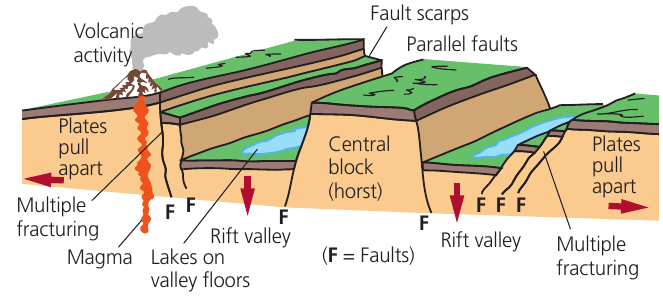
Rift valleys form when rising magma causes a region to be uplifted. This uplift creates weaknesses in the crust through reduced rock viscosity. As basaltic magma emerges and floods the area, there is a partial collapse of the crust, forming a deep, steep-sided valley. Lakes often form on the floors of these valleys.
Note
The sides of a rift valley slowly move apart over time. Scientists believe that eventually sea water will flood into the valley, creating a new ocean that will separate Africa into two parts. Where magma reaches the surface, volcanoes can develop into islands, as seen in Iceland.
Destructive (convergent) plate margins
Destructive margins occur where tectonic plates move towards each other and collide. The geological processes and landforms that develop depend on the types of crust involved in the collision.
Oceanic/continental convergence
When an oceanic plate meets a continental plate, the denser oceanic crust is forced beneath the lighter continental crust. This process is called subduction.
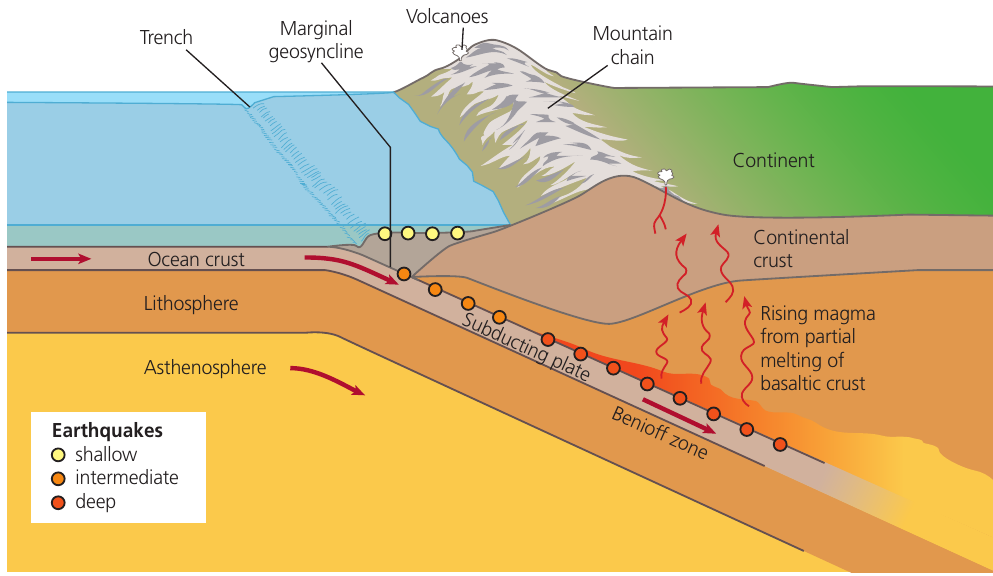
Key features of oceanic/continental subduction:
-
Ocean trench – The downward bending of the oceanic plate creates a deep-sea trench parallel to the plate boundary. The Challenger Deep in the Marianas Trench is the deepest part of the world's oceans at just over 10,900 metres.
-
Earthquakes – As the oceanic plate descends, friction and stress cause earthquakes. These occur at shallow, intermediate and deep levels along the Benioff zone – the inclined plane marking the descending plate.
-
Volcanic mountain chain – Sediments on the edge of the continental plate are deformed by folding and faulting, then uplifted to form mountains. The partial melting of the descending basaltic crust produces magma that rises through the continental crust, creating a chain of volcanic mountains parallel to the coast.
-
Young fold mountains – These mountains, such as the Andes, are parallel chains of high volcanic peaks with an inter-montane plateau (high flat area) between them.
Note
The combination of subduction, volcanic activity, and mountain building at oceanic/continental convergence zones creates some of the most dynamic and hazardous regions on Earth. The Andes mountain range along South America's western coast perfectly demonstrates all these processes working together.
Ocean/ocean convergence
Where two oceanic plates converge, the denser of the two plates subducts beneath the less dense plate. This creates a line of volcanic islands known as an island arc.
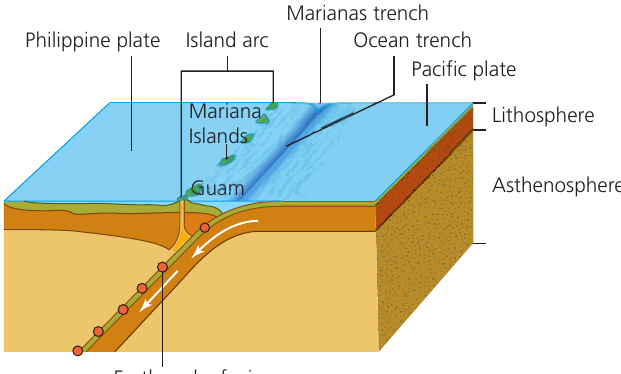
On the western side of the Pacific Ocean, the Pacific plate is being subducted beneath the smaller Philippines plate. This has formed the Mariana Islands, including Guam. Magma upwelling from the Benioff zone creates these volcanic islands. The Mariana Trench marks where the Pacific plate bends downwards into the mantle.
Continental/continental convergence (collision boundary)
When two continental plates of similar low density collide, neither can be subducted into the mantle. Instead, the collision causes both plates to crumple and buckle upwards.
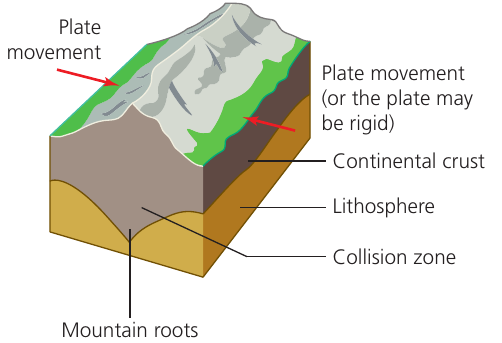
Sediments that accumulated between the converging plates are forced upwards and form enormous fold mountain ranges. The Himalayas formed where the Indo-Australian plate continues to push northwards into the Eurasian plate. These mountains have deep roots extending into the crust below.
Important
There is no volcanic activity at continental collision zones, but the immense stresses generated cause shallow-focus earthquakes as the plates continue to push against each other. These earthquakes can be devastating when they strike populated areas.
Conservative (passive) plate margins
At conservative margins, two plates slide horizontally past one another, parallel to the plate boundary. There is no subduction and no volcanic activity because the plates are moving alongside each other rather than towards or away from each other.
Important
A conservative plate margin is where two plates slide past each other horizontally. The movement creates enormous stress and friction between the plates, particularly when sections of the boundary become locked together.
The most well-known example is the San Andreas Fault system in California. Here, the Pacific plate (moving at 5-9 cm per year) slides past the North American plate (moving at 2-3 cm per year) in the same general direction but at different speeds.
Characteristics of conservative margins:
- Transform faults develop running at right angles to the main fault line
- Sections of the fault become stuck as plates try to slide past each other
- Stress builds up over time in the locked sections
- When the stress is released, sudden plate movements trigger earthquakes
- These earthquakes can range from frequent moderate events to infrequent but very severe ones
Note
Areas of frequent moderate earthquake activity exist around San Francisco and Los Angeles, while areas of severe but less frequent activity occur at the ends of the fault system. This pattern reflects how stress accumulates and releases differently along various sections of the fault.
Mantle (magma) plumes
In the 1970s, scientists developed a theory to explain volcanic activity occurring far from plate boundaries. This theory proposes that localised heating at the core/mantle boundary creates a plume of magma. This hot magma rises through the mantle and penetrates into the plate above, creating what is known as a hot spot.
Where lava breaks through to the surface, active volcanoes form above the hot spot. As tectonic plates continue moving over the relatively stationary hot spot, they carry these volcanoes away from the magma source. The volcanoes then cool, become dormant, and eventually subside. Over millions of years, this process creates a chain of islands, atolls and seamounts.
Example
The Hawaiian Island Chain: Hot Spot Volcanism in Action
The Hawaiian hot spot provides a classic example of this process:
- Duration: Active for approximately 70 million years
- Extent: Created a 6,000 kilometre long chain of volcanic islands
- Location: Stretches across the north-west Pacific Ocean
How the chain formed:
Step 1: The Pacific plate moves north-westward over a stationary hot spot
Step 2: Active volcanoes form directly above the hot spot
Step 3: As the plate continues moving, it carries these volcanoes away from the magma source
Step 4: The volcanoes cool, become dormant, and eventually subside
Step 5: New volcanoes form above the hot spot, continuing the chain
Age pattern: The youngest and most active volcanoes sit directly above the hot spot, whilst progressively older features extend northward. The Loihi underwater volcano, south-east of Hawaii, represents the newest volcanic feature and will eventually form another island in the chain.
Scientists use hot spot tracks to understand how tectonic plates have moved over geological time. The age of volcanic rocks increases progressively along the chain, moving away from the currently active volcano.
Note
Limitations of the Theory
Whilst the hot spot theory successfully explains the relationship between volcano age and distance from plate margins for some volcanic chains, it cannot explain all volcanic activity. Scientists continue to debate whether hot spots remain truly fixed in position or whether other, yet unknown, processes contribute to intraplate volcanism.
Summary
Key Points to Remember:
-
Three types of plate margins: Constructive (divergent), destructive (convergent), and conservative (passive) margins explain where tectonic hazards occur.
-
Constructive margins create new crust: Ocean ridges and rift valleys form where plates pull apart, with gentle volcanic activity and shallow earthquakes.
-
Destructive margins destroy crust: Subduction at ocean/continent boundaries creates deep trenches, volcanic mountain chains, and earthquakes. Continental collisions form huge fold mountains like the Himalayas.
-
Conservative margins cause earthquakes: Plates sliding past each other create friction and stress, resulting in earthquakes but no volcanic activity.
-
Hot spots explain intraplate volcanoes: Mantle plumes rising from the core/mantle boundary create volcanic island chains like Hawaii as plates move over stationary hot spots.