Risk, Vulnerability and Perception of Natural Hazards (AQA A-Level Geography): Revision Notes
📚Revision Notes
Risk, Vulnerability and Perception of Natural Hazards
Understanding risk and vulnerability
Risk refers to situations where individuals and communities face potential danger from hazardous events. This includes threats to their lives, possessions, and the environments where they live. Many people deliberately choose to live in dangerous areas, and understanding why they make this choice is crucial.
Important
Natural hazards – Events which are perceived to be a threat to people and the built and natural environments. They occur in the physical environments of the atmosphere, lithosphere and the hydrosphere.
Why do people live in hazardous areas?
There are several reasons why communities remain in areas prone to natural hazards:
-
Hazard events are unpredictable: It's impossible to accurately forecast when, where, or how severe a natural hazard event will be. This uncertainty means people may underestimate the actual danger.
-
Lack of alternatives: Social, political, economic and cultural factors can trap people in hazardous locations. Moving elsewhere might mean losing homes, jobs, and community ties, making relocation impossible for many.
-
Changing risk levels: Areas that were once relatively safe can become more dangerous over time. For instance, deforestation in one region can lead to increased flooding from heavy tropical rain. Similarly, cleared hillsides become more susceptible to landslides.
-
Cost-benefit analysis: Many hazardous locations offer significant advantages that people believe outweigh the risks. Californian cities face serious earthquake threats, yet people continue living there because they value the benefits – employment opportunities, climate, lifestyle – more than they fear the potential danger.
The model of vulnerability
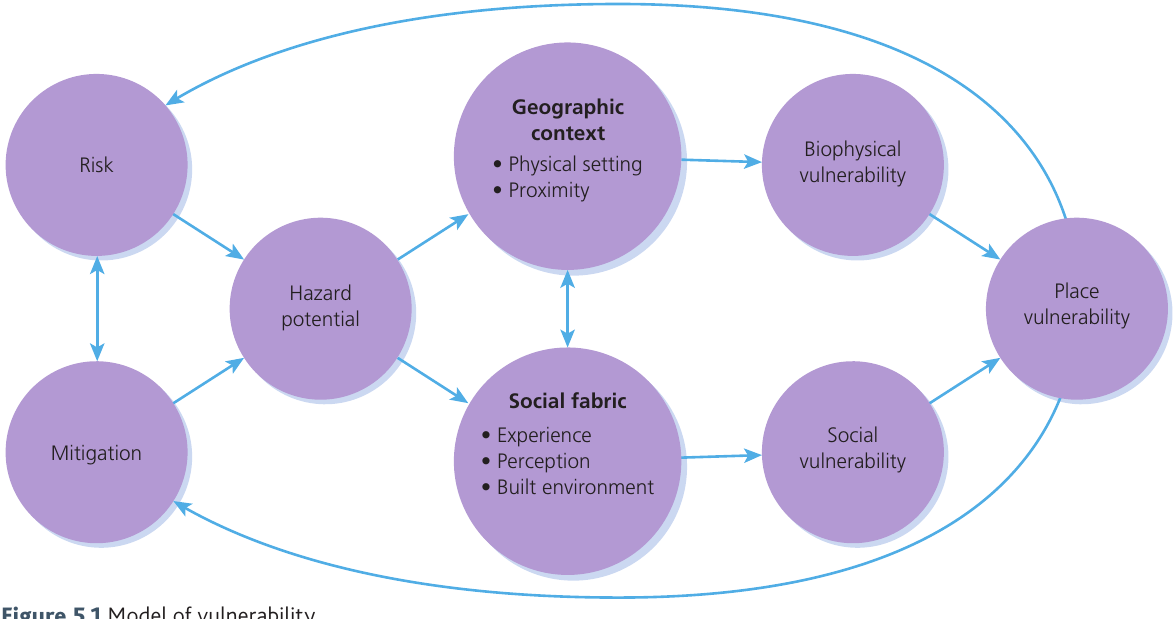
Vulnerability describes the potential for loss when facing physical hazards. Since losses differ geographically, change over time, and vary among different social groups, vulnerability is not constant. Researchers have identified several factors that connect risk and vulnerability, creating the model shown below.
Note
The model illustrates how different elements interact in a continuous cycle:
- Risk connects to both hazard potential and mitigation efforts
- Geographic context includes the physical setting and proximity to hazards, leading to biophysical vulnerability
- Social fabric encompasses people's experience, perception, and the built environment, contributing to social vulnerability
- Both biophysical and social factors combine to create place vulnerability
- All these elements feed back into each other, creating a dynamic system where changes in one area affect all others
Types of vulnerability
Understanding the three types of vulnerability helps explain why some people and places suffer more than others:
Biophysical vulnerability relates to the physical exposure to hazards based on location. People living on steep slopes face landslide risks, whilst those in low-lying coastal areas are vulnerable to storm surges and tsunamis.
Social vulnerability considers economic and social factors that affect people's ability to cope. This includes wealth, education level, access to resources, and community support networks.
Place vulnerability combines both biophysical and social elements for specific locations. It recognises that vulnerability results from both where people live and their social circumstances.
Note
These three types of vulnerability don't exist in isolation. They interact and amplify each other. For example, a community living on a floodplain (biophysical) with limited economic resources (social) faces compounded vulnerability in that specific location (place).
How wealth affects vulnerability
A natural hazard event of similar magnitude can have vastly different impacts in different parts of the world. The level of wealth and available technology significantly influences how well people can protect themselves.
Wealthier individuals and nations can:
- Construct sea defences against flooding
- Build earthquake-resistant structures
- Provide better emergency services
- Increase public awareness through education
- Afford insurance protection
In contrast, as urban areas in poorer countries expand, more people are forced into hazardous locations such as:
- Very steep hillsides prone to landslides
- Floodplains in low-lying areas
- Regions vulnerable to tropical storms and tsunamis
These populations face greater vulnerability because they lack the resources for adequate protection or preparedness.
The perception of natural hazards
How people respond to hazard threats varies considerably because individuals and groups process information about risks differently. Perception shapes how people react and what responses they expect from governments and organisations.
Important
Perception – This is the way in which an individual or a group views the threat of a hazard event. This will ultimately determine the course of action taken by individuals or the response they expect from governments and other organisations.
What affects perception?
Many factors influence how people perceive natural hazards:
- Socio-economic status
- Level of education
- Occupation and employment status
- Religion and cultural or ethnic background
- Family and marital status
- Past experience with hazards
- Personal values, personality and expectations
Note
These factors don't work independently. Someone's perception is shaped by the complex interaction of all these elements. For example, a wealthy, well-educated individual with no past experience of hazards might perceive risk very differently from someone who has lived through multiple disasters but lacks resources to relocate.
Differences based on economic development
There are often significant differences in hazard perception between people in wealthier and poorer regions.
In wealthier areas, there tends to be greater confidence in disaster preparedness. People believe that better preparation increases their ability to withstand hazards and potentially prevent disasters entirely. This confidence stems from:
- Government and community action
- Access to capital for technological solutions
- Better infrastructure and emergency services
In poorer regions, feelings of helplessness intensify as poverty levels increase. People experience greater deprivation and have fewer resources to cope. This creates a cycle where:
- Natural hazards are seen as unavoidable aspects of life
- Events are viewed as inevitable, like other conditions of poverty
- Disadvantaged groups (even in wealthier countries) share similar fatalistic views
Three types of perception
People perceive natural hazards in three main ways:
Important
Fatalism – A view of a hazard event that suggests that people cannot influence or shape the outcome, therefore nothing can be done to mitigate against it. People with such an attitude take limited or no preventative measures. In some parts of the world, the outcome of a hazard event can be said to be 'God's will'.
Fatalism (acceptance): Some communities view hazards as natural events beyond human control. These are seen as part of living in an area, and communities would never consider them serious enough to warrant leaving. The outcome is often attributed to divine will or fate. People with this perspective take direct action focused on safety concerns. Losses are accepted as inevitable, and residents remain in their locations.
Important
Adaptation – In the context of hazards, adaptation is the attempts by people or communities to live with hazard events. By adjusting their living conditions, people are able to reduce their levels of vulnerability. For example, they may avoid building on sites that are vulnerable to storm surges but stay within the same area.
Adaptation: People recognise that they can prepare for hazards and potentially survive events through prediction, prevention, and protection. The specific strategies depend upon available economic and technological resources. This approach involves adjusting living conditions to reduce vulnerability whilst remaining in the area.
Fear: Sometimes the perception of hazard danger becomes so overwhelming that people feel unable to continue living in the area. They move away to regions they believe will remain unaffected by the hazard. This represents the most extreme response to hazard perception.
Example
Example: Different Perceptions of Earthquake Risk
Consider three families living in the same earthquake-prone region:
Family A (Fatalism): They have lived in the area for generations and view earthquakes as part of life. They believe "if it's our time, it's our time" and take minimal precautions. After each earthquake, they rebuild and continue their lives without significant changes.
Family B (Adaptation): They retrofit their home with earthquake-resistant features, maintain an emergency kit, participate in community drills, and have insurance. They choose to stay because of employment and family ties but actively work to reduce their vulnerability.
Family C (Fear): After experiencing a major earthquake, they become increasingly anxious about future events. Despite the economic cost, they decide to relocate to a region with lower seismic activity, prioritising peace of mind over other considerations.
Each family faces the same hazard but responds completely differently based on their perception.
Summary
Key Points to Remember:
-
Risk involves conscious choice – People deliberately live in hazardous areas for various reasons including unpredictability of events, lack of alternatives, changing risk levels, and perceived benefits that outweigh dangers.
-
Vulnerability has three dimensions – Biophysical vulnerability (physical exposure), social vulnerability (economic and social factors), and place vulnerability (combination of both) all interact to determine overall risk levels.
-
Wealth creates protection – Wealthier people and nations can better protect themselves through technology, infrastructure, education and emergency services, whilst poorer populations face greater vulnerability.
-
Perception shapes response – How people view hazards (fatalism, adaptation, or fear) determines their actions and expectations, with significant differences between wealthier and poorer regions.
-
Multiple factors influence perception – Socio-economic status, education, occupation, religion, family situation, past experience, and personal values all shape how individuals perceive natural hazard risks.