Volcanic Hazards (AQA A-Level Geography): Revision Notes
📚Revision Notes
Volcanic hazards
Understanding volcanic hazards
Volcanic hazards are the dangerous effects produced by volcanic activity that can threaten human life, property, and the environment. These hazards occur when volcanic processes interact with people and the built environment.
Note
While there are approximately 300 volcanoes on the Kamchatka peninsula in Russia, they are not widely considered hazardous because very few people live in that remote area. This illustrates an important principle: the key factor is not just volcanic activity itself, but whether that activity impacts human populations.
Key terminology
Understanding volcanic hazards requires familiarity with specific technical terms. The following definitions cover the essential vocabulary you'll encounter when studying volcanic activity and its effects.
Volcanic materials and ejecta:
Ash – Fine particles of rock produced when volcanoes erupt explosively. These dust-sized fragments can be carried by winds for long distances from the eruption site.
Tephra – Any type of rock fragment forcibly ejected from a volcano during an eruption.
Volcanic bombs – Rocks larger than 5 mm in diameter thrown into the air by a volcanic eruption.
Magma – Molten rock located beneath the Earth's surface.
Important
Pyroclastic flow – A high-density mass of gases, hot ash, and larger volcanic material that flows rapidly down the sides of a volcano. These are among the most dangerous volcanic hazards due to their extreme heat and speed.
Volcano types and features:
Composite volcano – A large, steep-sided, symmetrical cone-shaped volcano built up from alternating layers of lava flows, volcanic ash, cinders, blocks, and bombs.
Hazardous flows and secondary effects:
Important
Lahars – Mudflows made up of pyroclastic material mixed with water that flow down from a volcano, typically following river valleys. These can occur during or after an eruption and travel at high speeds.
Tsunamis – Giant sea waves generated by shallow-focus underwater earthquakes, violent volcanic eruptions, or underwater debris slides and landslides.
Measurement systems:
Volcanic Explosivity Index (VEI) – A scale used to measure the explosiveness of volcanic eruptions, ranging from 0 to 8.
Nature and distribution of volcanic activity
Plate tectonic settings
Most volcanic activity is connected to plate tectonic processes and occurs mainly along plate margins. Understanding where volcanoes form helps us predict potential hazard zones.
Volcanic activity occurs at three main locations: constructive plate margins, subduction zones, and hot spots.
1. Constructive plate margins
At these boundaries, tectonic plates move apart and magma forces its way to the surface. Key characteristics include:
- Oceanic ridges where lava builds up to the ocean surface
- Volcanic islands can form, such as Iceland
- Volcanoes also develop within continental rift valleys
- The Great Rift Valley in east Africa has created many volcanoes, including Kilimanjaro
- These volcanoes have fairly gentle slopes due to low viscosity basaltic lava
- Eruptions are frequent but relatively gentle (effusive)
Note
The relatively gentle nature of eruptions at constructive margins makes them less hazardous compared to subduction zone volcanoes, though they still pose risks to nearby populations and can disrupt air travel with ash clouds.
2. Subduction zones
These zones form the 'ring of fire' surrounding the Pacific Ocean. The process works as follows:
- Tectonic plates converge and the denser oceanic plate descends beneath the other
- The deeper the oceanic plate goes, the hotter the surroundings become
- Heat generated from friction begins to melt the oceanic plate into magma
- This forms part of the subduction zone known as the Benioff zone
- Molten magma, being less dense than surrounding material, begins to exploit weaknesses in the crust
- Magma rises as columns and collects in huge sub-surface reservoirs called plutons
- Eventually, some magma reaches the surface and forms volcanoes
- Andesitic lava (more viscous than basaltic) creates complex, composite, and explosive volcanoes
- If eruptions occur offshore, a line of volcanic islands called an island arc can form
Important
The 'ring of fire' accounts for approximately 75% of the world's active and dormant volcanoes and is responsible for about 90% of the world's earthquakes. This makes it the most geologically active region on Earth.
3. Hot spots
These are locations away from plate boundaries where volcanic activity occurs:
- The Hawaiian Islands in the north Pacific Ocean exemplify shield volcanoes located over a hot spot
- Hot spots are thought to be fairly stationary whilst tectonic plates continue to move
- As a plate moves away from the hot spot, it takes with it the volcanoes that have formed
- These volcanoes cool and subside over millions of years
- A chain of islands, atolls, and seamounts (hotspot tracks) forms progressively
- The youngest and most active volcanoes are found directly over the plume
- The Hawaiian hot spot has been active for around 70 million years
- It has created a 6,000 kilometre long chain of volcanic islands
- The Loihi Seamount is a submarine volcano south-east of Hawaii that will eventually form a new island
- Two of the world's most active volcanoes, Kilauea and Mauna Loa, are found on Hawaii
- Mauna Loa last erupted in 1984, whilst Kilauea's last eruption lasted from 1983-2018
Example
Worked Example: The Hawaiian Hot Spot Track
The Hawaiian island chain demonstrates how hot spots create a progressive sequence of volcanic islands:
- Oldest islands (northwest): Kauai and Niihau are heavily eroded, no longer volcanically active
- Middle islands: Oahu and Molokai show moderate erosion with extinct volcanoes
- Youngest island (southeast): Hawaii (the Big Island) sits directly over the hot spot with active volcanoes Kilauea and Mauna Loa
- Future island: Loihi Seamount is currently forming underwater and will eventually break the surface
This pattern shows the Pacific Plate moving northwest at approximately 7-9 cm per year over the stationary hot spot.
Variation in volcanic activity
Volcanic eruptions show enormous variation. The type of volcanic activity and associated hazards depend upon the nature of the lava, which in turn depends upon the location of the volcano relative to tectonic plate margins.
Lava viscosity and eruption type:
- If lava is not viscous (thin fluid), gases can escape easily
- If lava is highly viscous (thick and pasty), gases cannot move freely
- Gas pressure builds up tremendously within the volcano
- This results in explosive eruptions that blow volcanic ash and dust high into the atmosphere
- These eruptions reduce incoming solar radiation and can cause short-term global climate change
Important
The relationship between lava viscosity and eruption type is critical for hazard assessment:
- Low viscosity (basaltic) lava → Effusive eruptions → Lower immediate danger
- High viscosity (andesitic/rhyolitic) lava → Explosive eruptions → Extreme danger
The main method of measurement for magnitude has been the Volcanic Explosivity Index (VEI), a logarithmic scale running from 0 to 8.
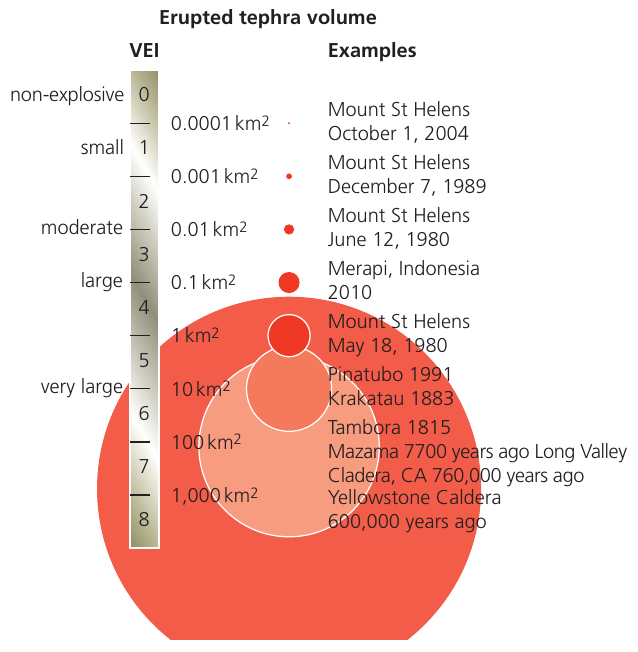
The VEI scale categorises eruptions based on erupted tephra volume:
- 0 = non-explosive (0.0001 km²)
- 1 = small (0.001 km²) - Example: Mount St Helens, October 2004
- 2 = moderate (0.01 km²) - Example: Mount St Helens, December 1989 and June 1980
- 3 = large (0.1 km²) - Example: Merapi, Indonesia 2010
- 4 = very large (1 km²) - Example: Mount St Helens, May 1980
- 5 = very large (10 km²) - Examples: Pinatubo 1991, Krakatau 1883
- 6 = very large (100 km²) - Example: Tambora 1815
- 7 = very large (1,000 km²) - Examples: Mazama 7,700 years ago, Long Valley Caldera 760,000 years ago
- 8 = very large (1,000 km²) - Examples: Yellowstone Caldera 600,000 years ago
Note
The VEI scale is logarithmic, meaning each step up represents approximately 10 times more material ejected. A VEI 5 eruption ejects 10 times more tephra than a VEI 4, and 100 times more than a VEI 3.
Magnitude and frequency of volcanic events
Like all natural phenomena, volcanic events only become hazardous when they impact people and the built environment. Hazards can include:
- Killing and injuring people
- Burying and destroying buildings and infrastructure
- Bringing agricultural and other economic activities to a halt
Note
The concept of a volcanic "hazard" versus volcanic "activity" is crucial: a remote volcano may be highly active but pose little hazard if no one lives nearby. Conversely, even a relatively small eruption near a densely populated area can be catastrophic.
The frequency of eruption for any volcano can be interpreted by volcanologists using:
- Its previous history of activity
- Deposits associated with the volcano itself
- Deposits within the wider region
This historical analysis helps predict future volcanic behaviour and assess risk to nearby populations.
The impacts of volcanic activity
A volcanic event can produce a variety of effects. The impact can range from the area immediately surrounding the volcano to global-scale atmospheric and climatic changes. Understanding these impacts is essential for hazard management and disaster preparedness.
Note
Range of volcanic impacts:
Volcanic events create both immediate local effects (such as pyroclastic flows, lava flows, and lahars) and longer-term regional to global effects (including ash clouds disrupting air travel, crop failures from ash fall, and climate cooling from stratospheric aerosols). The 1815 eruption of Tambora, for example, caused the "Year Without a Summer" in 1816, leading to widespread crop failures and famine across Europe and North America.
Remember!
Summary
Key Points to Remember:
-
Volcanic activity occurs at three main locations: constructive plate margins (where plates move apart), subduction zones (where plates converge), and hot spots (stationary plumes beneath moving plates).
-
The Volcanic Explosivity Index (VEI) is a logarithmic scale from 0 to 8 that measures eruption magnitude based on the volume of tephra ejected. Each increase represents approximately 10 times more material ejected.
-
Lava viscosity determines eruption type: low viscosity basaltic lava produces effusive (gentle) eruptions, whilst high viscosity andesitic lava produces explosive eruptions due to trapped gases building pressure.
-
Volcanic hazards only become dangerous when they impact people – the presence of 300 volcanoes on the Kamchatka peninsula poses little threat because few people live there.
-
Historical eruption patterns help predict future activity – volcanologists study deposits and previous eruption history to interpret the frequency and likely magnitude of future volcanic events.