Characteristic Desert Landscapes Through Time (AQA A-Level Geography): Revision Notes
📚Revision Notes
Characteristic Desert Landscapes Through Time
Introduction to desert landscape diversity
Sand is often the first thing that comes to mind when picturing desert landscapes. However, hot desert environments contain some of the most spectacular and varied landscapes on Earth. These range from seemingly endless flat plains to enormous fields of sand dunes the size of mountain ranges. Some hot deserts feature remarkable geological formations that attract millions of tourists each year, including famous landmarks like Uluru in central Australia and the Grand Canyon in southwestern USA.
Note
What makes a desert landscape distinctive from other environments is the lack of vegetation. With little plant cover, the underlying rock structure and geological features are clearly visible. This exposure allows the unique geomorphological features of deserts to stand out dramatically in the landscape.
What makes each desert landscape unique
No two hot desert landscapes are exactly the same. This diversity exists because each location has experienced a distinctive combination of geological processes, time periods, and landform features. Every hot desert landscape develops through the processes discussed earlier in this chapter and consists of unique assemblages of the landforms already covered.
The fascinating variety of hot desert landscapes results from several key factors relating to time, process and landform.
Factors influencing landscape formation
The role of weathering and temperature
How quickly and in what way rocks break down varies considerably between different desert regions. The speed of weathering depends on:
- The type of rock present in the area
- Rapid heating and cooling cycles affecting different minerals within rocks
- The extent of daily temperature fluctuations
Rocks break down much more quickly in areas with greater diurnal temperature ranges. Some deserts experience extreme temperature swings on a daily basis, whilst others have more moderate day-night temperature differences.
The influence of moisture
Important
The amount and availability of water in different locations significantly affects landscape formation. Water can speed up weathering processes, including the growth of salt crystals and frost shattering, especially when temperatures fluctuate rapidly.
Where moisture is present, hot deserts are more likely to develop landscapes with biological and organic features. These range from simple organisms like lichens and bacteria through to grasses and cacti. The presence or absence of water creates fundamentally different landscape types.
The dimension of time
The speed at which both erosional and depositional processes shape the desert landscape heavily depends on time factors:
- Some deserts regularly have moisture present
- Others only experience occasional seasonal rainfall
- Some remain completely arid for years at a time
The rate of landscape formation varies enormously depending on these temporal patterns of water and wind activity. Wind and flowing water may be constant forces, or seasonal, or sporadic, depending on the climate regime.
Desert landscapes through geological time
Water and wind not only shape the present-day desert landscape, they may also have played a fundamental role in the geological history of the area. Looking at desert landscapes through time reveals fascinating evidence of changing environmental conditions.
Evidence of wetter periods in the past
Some landscapes contain features that record a much wetter past:
- Ancient river systems that once flowed through areas now almost completely arid
- The presence of inselbergs (isolated rock hills)
Important
Inselbergs are resistant rock formations that were once buried beneath the surface. They have since been exposed by the removal of surrounding softer rock. These features suggest that desert environments experienced wetter periods (called pluvials) in the past when conditions were more humid than today.
Recent landscape features
Some desert landscapes are dominated by relatively recent features that have developed over hundreds to a few thousand years:
- Alluvial fans at the mouths of wadis
- Bajadas (merged alluvial fans)
- Recently formed sand dunes
These features show evidence of ongoing or recent geological activity.
Ancient landscape features
Other desert landscapes are truly ancient:
- The great 'shield deserts' of central Australia are dominated by vast, almost featureless plains
- These ancient surfaces have rare outcrops of resistant rock, like Uluru
- These landscapes formed millions of years ago
Note
Wind and water have been slowly wearing away these ancient surfaces since the break-up of super-continents like Gondwana between 100 and 200 million years ago. In reality, no two deserts are exactly alike due to their unique geological histories.
Badlands
Water action can create one of the most distinctive features of semi-arid regions: badlands.
Important
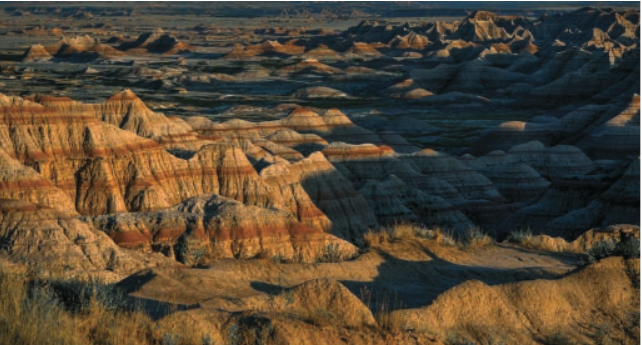
Badlands are dramatic erosional landscapes formed in areas with relatively soft, less-resistant geology where run-off from heavy but sporadic rainfall moulds a distinctive terrain. Vegetation cover cannot establish due to the aridity, leaving little to hold the regolith and bedrock together. This allows flowing water to create dramatic erosional and depositional landforms.
Key characteristics of badlands
Badlands display a range of distinctive features:
- Wadis of all shapes and sizes with steep sides and debris-covered bottoms
- Unstable slopes that regularly collapse as gullies erode headward into hillsides
- Regular mass movement as slope failure and slumping are common
- Alluvial fans and bajadas form as the many wadis and small gullies emerge onto lowland areas
- Pipes develop as water carves out surface cracks, which then erode into larger caves as surface water flows into them
- Natural arches form as caves erode further over time, aided by weathering processes
Example
Real-World Example: Badlands Tourism
Due to their striking landscapes and often inaccessible locations, many badlands (especially in the USA) have become popular with adventure tourists. They remain undeveloped due to the lack of options for other viable economic activity.
The unique landscape of the badlands of southern Tunisia near Matmata has been popular with film-makers for some time, keeping the location popular with tourists today.
Examples of major world deserts
This section demonstrates just how unique all hot desert landscapes are. Different factors combine to create different assemblages of landforms and features, giving each desert its own characteristic appearance. Unlike badlands, not all assemblages of landforms create a named landscape type.
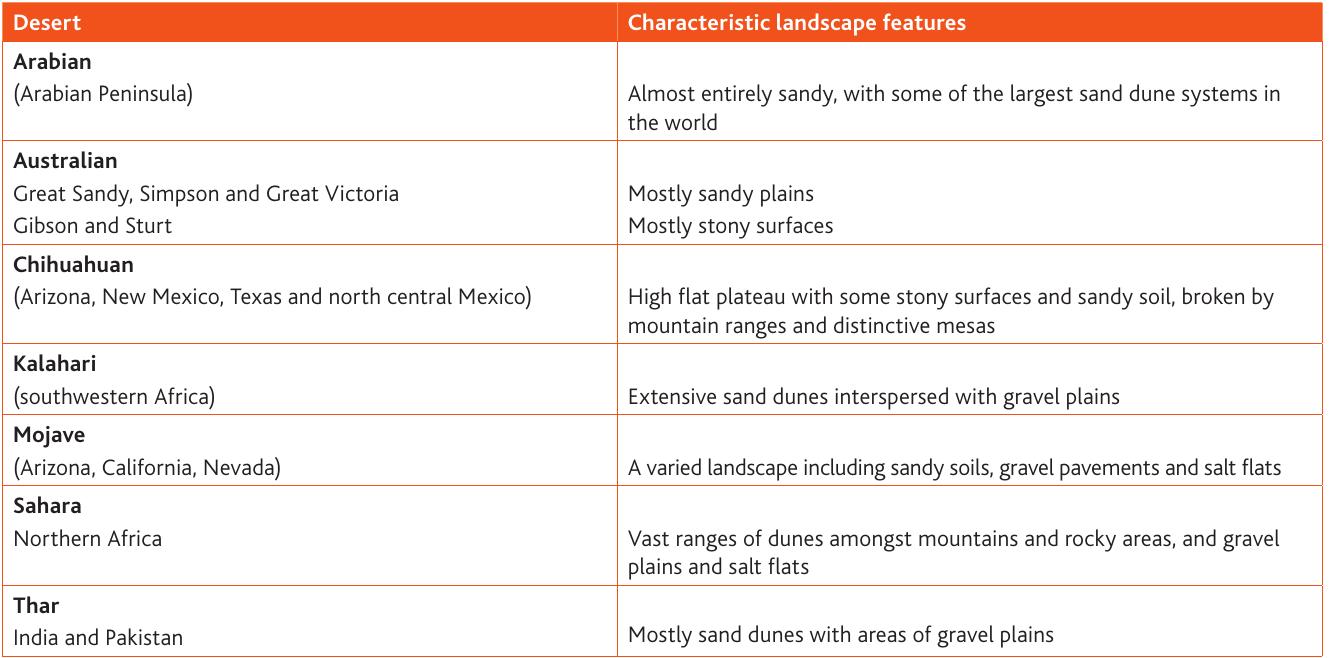
The table shows the dominant features of some of the world's most well-known hot deserts:
- Arabian Desert (Arabian Peninsula) features almost entirely sandy terrain with some of the largest sand dune systems in the world
- Australian deserts (Great Sandy, Simpson, Great Victoria, Gibson and Sturt) display mostly sandy plains or mostly stony surfaces depending on location
- Chihuahuan Desert (Arizona, New Mexico, Texas and Mexico) consists of high flat plateaux with some stony surfaces and sandy soil, broken by mountain ranges and distinctive mesas
- Kalahari Desert (southwestern Africa) contains extensive sand dunes interspersed with gravel plains
- Mojave Desert (Arizona, California, Nevada) shows varied landscape features including sandy soils, gravel pavements and salt flats
- Sahara Desert (Northern Africa) displays vast ranges of dunes amongst mountains and rocky areas, plus gravel plains and salt flats
- Thar Desert (India and Pakistan) features mostly sand dunes with areas of gravel plains
Summary
Key Points to Remember:
- Desert landscapes are incredibly diverse, shaped by unique combinations of weathering processes, moisture availability, and time
- Three key factors influence landscape formation: speed of weathering (temperature), presence of moisture, and timescales of processes
- Desert landscapes reveal evidence of different time periods: wetter pasts (inselbergs), recent features (alluvial fans), and ancient surfaces (shield deserts)
- Badlands are distinctive semi-arid features created by water erosion, characterised by wadis, unstable slopes, pipes, caves and natural arches
- Major world deserts vary significantly in their characteristic features, from the sandy Arabian Desert to the rocky and mountainous Sahara to the mixed terrain of the Mojave