Climate Change and Local Populations (AQA A-Level Geography): Revision Notes
📚Revision Notes
Climate Change and local populations
Introduction
Desert environments face increasing threats from both climate change and human activities. Understanding how these factors interact and affect local populations is crucial for developing effective management strategies. This note explores the risks of desertification, its impacts, and potential future scenarios for communities living in and around hot deserts.
Note
This document examines the complex interplay between environmental degradation, climate change, and human populations in desert regions, with a focus on understanding both current impacts and future scenarios for affected communities.
Areas at risk of desertification
Global distribution
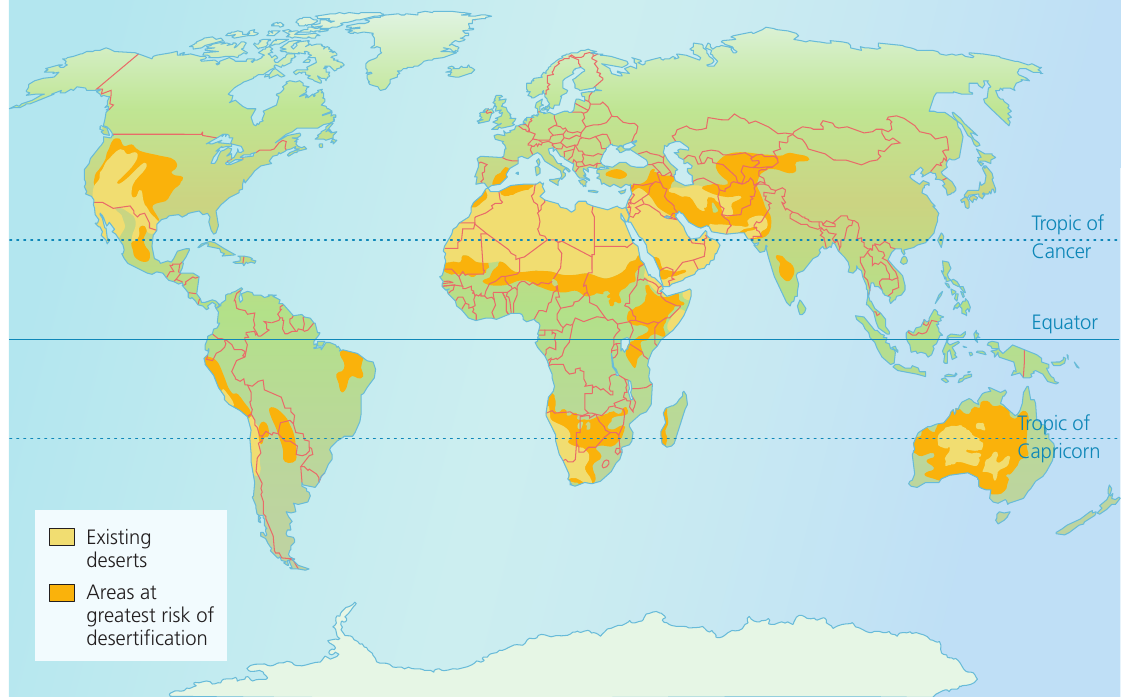
Desertification affects large areas of the planet. The regions most at risk include:
- North Africa (particularly the Sahel region south of the Sahara)
- Middle East and Central Asia
- Southwestern United States and northern Mexico
- Parts of South America (including areas of Argentina and Chile)
- Southern Africa
- Australia
Scale of the problem
Note
The Global Impact of Desertification
The statistics paint a concerning picture of desertification's worldwide reach:
- Approximately 25% of the Earth's surface (3.6 billion hectares) is currently experiencing desertification
- Around one billion people across 100 countries face risks from desertification
- Roughly 12 million hectares of land are lost to desertification each year
These figures demonstrate that desertification is not a localized problem but a global environmental crisis affecting substantial portions of our planet and its population.
Important: Desertification is the process through which productive land gradually transforms into desert, resulting in reduced biological productivity and land degradation.
Causes of desertification
Human populations place considerable stress on desert margins through several interconnected processes. Each of these factors contributes to a cycle of environmental degradation that accelerates the transformation of productive land into desert.
Agricultural intensification
The pressure to feed growing populations leads to unsustainable farming practices:
- Growing communities require more food production
- This leads to over-cultivation of marginal lands
- Soil nutrients become depleted
- Land loses its productive capacity
Overgrazing and deforestation
Livestock management practices often exceed environmental limits:
- Livestock numbers exceed the land's carrying capacity
- Vegetation is removed faster than it can regenerate
- Without plant cover, soil becomes vulnerable to erosion
- Wind and rain easily remove exposed topsoil
Fuelwood demand
Energy needs drive vegetation removal across desert margins:
- Many communities rely on wood for cooking and heating
- The demand for fuelwood is often underestimated
- Removal of woody vegetation destabilises the landscape
Important
All these factors contribute to land degradation - the deterioration of productive land - which ultimately leads to desertification. These processes are interconnected and mutually reinforcing, meaning that addressing desertification requires tackling multiple causes simultaneously rather than focusing on individual factors.
Impact of desertification
Desertification creates widespread impacts that vary between locations but generally affect three interconnected areas: ecosystems, human populations, and physical landscapes. The consequences extend far beyond simple environmental change, affecting every aspect of life in affected regions.
Impacts on ecosystems
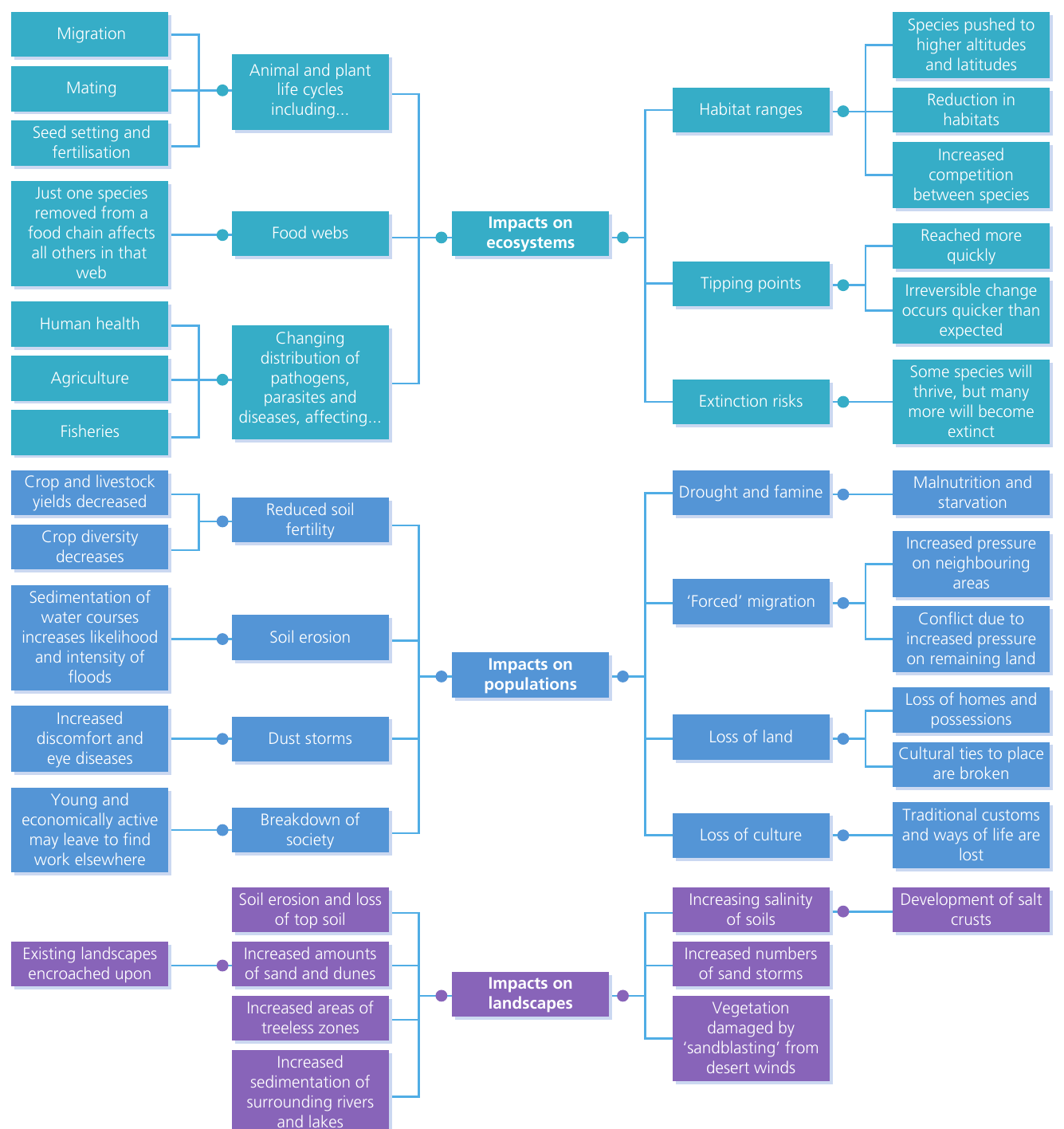
Desertification disrupts natural systems in multiple ways:
- Life cycles disrupted: Animal and plant breeding, migration, and seed dispersal patterns are altered
- Food webs collapse: Removing even one species can destabilise entire ecological communities
- Habitat changes: Species are pushed to higher altitudes or latitudes, increasing competition between species
- Tipping points reached: Ecosystems may change irreversibly, faster than predicted
- Extinction risks increase: Some species adapt and survive, but many become extinct
- Disease patterns shift: Changing conditions alter the distribution of pathogens and parasites
Impacts on populations
Local communities experience severe consequences that threaten both survival and cultural continuity:
- Drought and famine: Reduced rainfall and crop failures lead to malnutrition and starvation
- Forced migration: People must leave their homes to find water, food, and work
- Loss of land: Productive farmland becomes unusable, threatening livelihoods
- Cultural disruption: Traditional customs and ways of life are broken as communities disperse
- Social breakdown: Young and economically active members may migrate, leaving vulnerable people behind
Note
The human impacts of desertification extend beyond immediate survival needs. Communities lose not only their land and livelihoods but also their cultural heritage, social structures, and sense of place. This makes desertification a crisis that affects human dignity and identity as much as physical survival.
Impacts on landscapes
The physical environment undergoes dramatic changes:
- Soil erosion accelerates: Top soil is lost through wind and water erosion
- Salinisation occurs: Soils become increasingly salty, making them unsuitable for crops
- Sand storms intensify: More frequent and severe dust storms damage property and health
- Vegetation damage: Plants are destroyed by sandblasting from desert winds
- Treeless zones expand: Areas without vegetation grow larger
- Sedimentation increases: Rivers and lakes fill with eroded material
Climate change and possible futures
Predicted climate change impacts
Scientific evidence shows the Earth has experienced significant warming over recent decades:
- Average global temperatures rose between and during the twentieth century
- Atmospheric CO₂ concentrations have doubled
- Continued doubling could lead to temperature increases of
The area of degraded land and deserts has grown in recent decades and continues to expand. However, predicting future desertification is complex because it involves multiple interacting factors without simple solutions.
Feedback loops connecting desertification and climate change
Important
Understanding the Interconnected Crisis
Desertification, climate change, and biodiversity loss are interconnected through powerful feedback mechanisms. Rather than being separate problems, these three environmental crises form a self-reinforcing system where each problem intensifies the others.
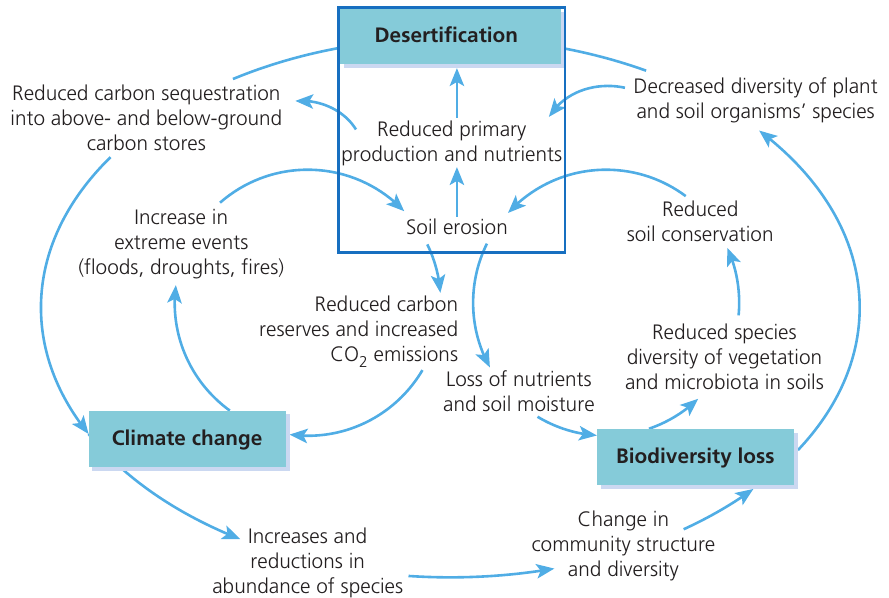
The diagram shows how these three processes reinforce each other through several key pathways:
Desertification leads to climate change through:
- Reduced carbon storage in vegetation and soils
- Soil erosion releasing stored carbon
- Decreased plant productivity
- Increased CO₂ emissions
- More extreme weather events (floods, droughts, fires)
Climate change contributes to biodiversity loss through:
- Changes in species abundance and distribution
- Altered community structures and diversity
- Increased pressure on already stressed ecosystems
Biodiversity loss accelerates desertification through:
- Reduced species diversity in plants and soil organisms
- Decreased soil conservation
- Loss of nutrients and soil moisture
- Further soil erosion
Note
This creates a self-reinforcing cycle where each problem makes the others worse. Breaking this cycle requires interventions that address all three issues simultaneously, as solving only one problem will not stop the overall degradation process.
Alternative possible futures for local populations
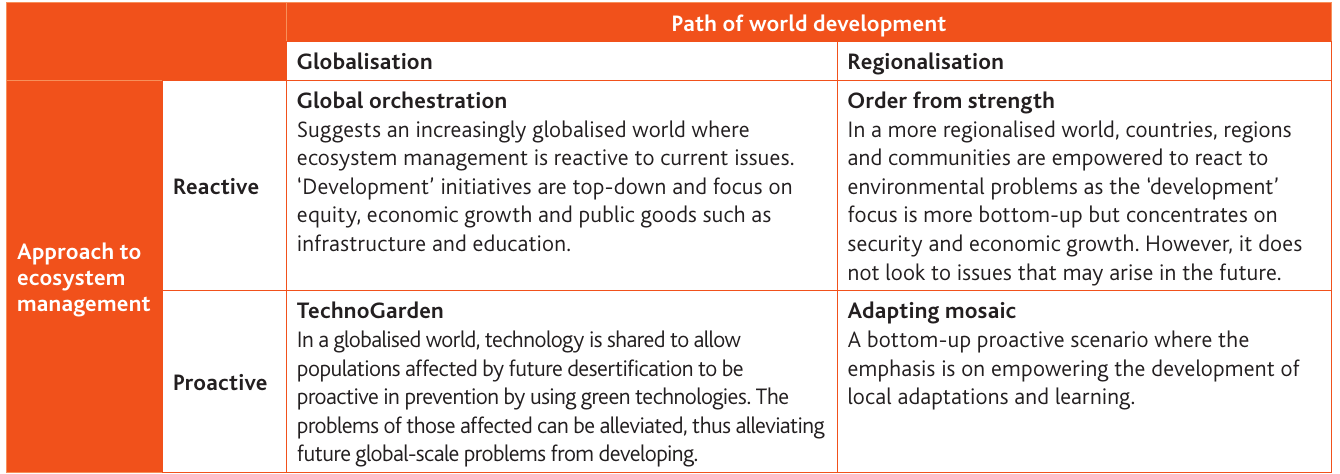
In 2005, the UN's Millennium Ecosystem Assessment outlined four potential scenarios for how the world might address desertification. These scenarios provide a framework for understanding different approaches to managing this global challenge.
These scenarios differ based on two key dimensions:
- Scale of action: Globalisation versus regionalisation
- Timing of response: Reactive (responding to existing problems) versus proactive (anticipating and preventing future problems)
The four scenarios explained
Global orchestration (Reactive + Globalisation)
- Focuses on top-down development approaches
- Prioritises economic growth and public services
- Addresses current environmental issues as they arise
- Emphasises global cooperation and trade
Order from strength (Reactive + Regionalisation)
- Emphasises regional and national security
- Takes a bottom-up approach to development
- Responds to problems after they emerge
- May not adequately prepare for future challenges
TechnoGarden (Proactive + Globalisation)
- Uses green technologies and innovation
- Shares technology globally to prevent desertification
- Takes preventive action before problems develop
- Focuses on sustainable solutions
Adapting mosaic (Proactive + Regionalisation)
- Empowers local communities and adaptations
- Emphasises learning and local knowledge
- Takes preventive action at community level
- Values diverse, context-specific solutions
Note
Comparing Approaches
Research suggests that proactive approaches are likely to be more effective than reactive responses in managing desertification. Similarly, solutions that balance global resources with local knowledge tend to achieve better outcomes than purely global or purely regional approaches.
Key points about future desertification
Several important factors will shape future desertification trends, each presenting both challenges and opportunities for intervention.
Poverty and land use
- Reducing poverty in at-risk areas is crucial for relieving pressure on the land
- However, population growth and increased food demand will expand cultivated land
- This inevitably leads to deforestation and land degradation
Climate uncertainty
- Climate change and desertification are linked, but the exact nature of their interaction remains uncertain
- Future mitigation strategies for both problems are still being developed
- Hot deserts and their margins will likely experience more extreme weather events
Effectiveness of approaches
Important
Keys to Successful Intervention
- Proactive approaches are likely to be more effective than reactive responses
- Solutions must address both environmental and economic problems
- Local knowledge and priorities should inform future plans
Waiting for problems to develop before responding typically results in higher costs and less effective outcomes than anticipating and preventing issues.
Development pathways
The global consensus suggests:
- Desertified land will probably continue to increase
- Many affected countries are least developed countries with low scores on the Human Development Index (HDI)
- These nations face the most severe population pressures
- Solutions are more likely to come from grassroots efforts by local at-risk populations rather than global initiatives
Critical considerations
Note
Factors Determining Success
Several key factors will determine whether efforts to combat desertification succeed:
-
Local involvement: Incorporating local knowledge and priorities into plans makes inappropriate "solutions" less likely
-
Adaptation support: Helping communities adapt to current and future pressures reduces vulnerability and builds resilience
-
Irrigation concerns: Extending intensive irrigation systems will worsen desertification
-
Ecosystem pressures: Current problems from climate change, overgrazing, and over-cultivation will intensify without proactive intervention
-
Globalisation impacts: Increased globalisation could be positive (more cooperation and resource sharing) or negative (reduced focus on environmental issues, less technology exchange)
-
Property rights: Protecting local property rights and integrating environmental concerns into governance at all levels is essential
Remember!
Summary
Key Takeaways: Climate Change and Desertification
-
Approximately 25% of Earth's surface is currently desertified, affecting one billion people across 100 countries and resulting in 12 million hectares of annual land loss.
-
Desertification creates interconnected impacts on ecosystems (habitat loss, extinction), populations (drought, famine, migration), and landscapes (soil erosion, increased sand storms).
-
Powerful feedback loops connect desertification, climate change, and biodiversity loss, where each problem intensifies the others through processes like reduced carbon storage, soil erosion, and species loss.
-
Four possible future scenarios combine globalisation or regionalisation with reactive or proactive approaches, ranging from technology-focused solutions to community-based adaptations.
-
Effective solutions require local involvement, proactive rather than reactive strategies, poverty reduction, and integration of environmental concerns into all levels of governance and planning.