Desertification (AQA A-Level Geography): Revision Notes
📚Revision Notes
Desertification
What is desertification?
Desertification represents a significant environmental challenge facing many regions of the world. It is more complex than simply the expansion of existing deserts onto neighbouring land.
Important: Desertification – The persistent degradation of dryland ecosystems by human activities and by climate change.
This UNESCO definition highlights two critical aspects:
- The process is ongoing and long-term (persistent)
- It results from both human actions and natural climate variations
Note
Desertification can be understood as an open system with inputs, processes, and outputs. It also demonstrates positive feedback, where the degradation process reinforces itself, making the situation progressively worse.
Historical changes in desert extent
Understanding how desert distribution has changed over time helps us appreciate that desertification is a dynamic process influenced by long-term climate variations.
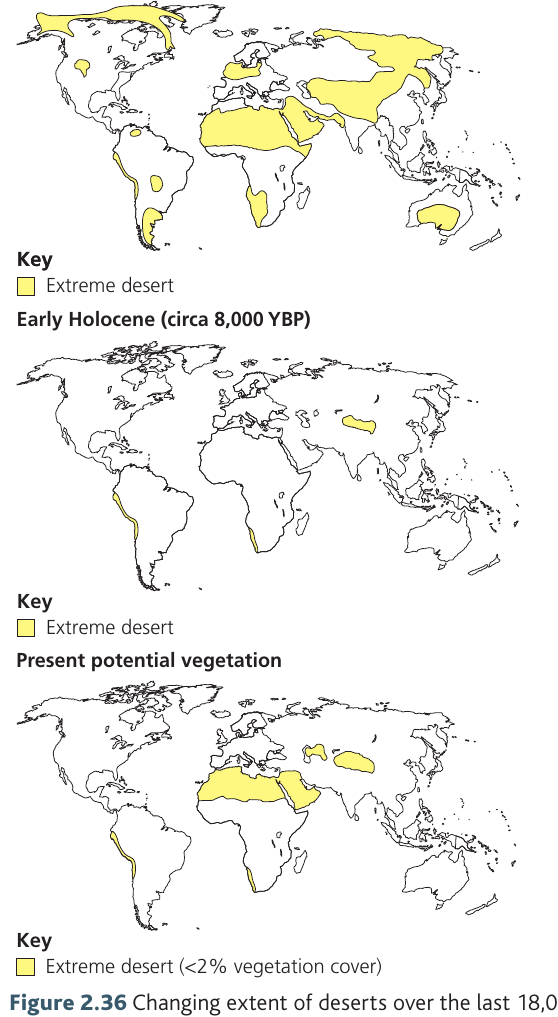
The last 18,000 years
During the Earth's climatic history, the planet has experienced alternating glacial periods (ice ages) and warmer interglacial periods. These shifts have significantly affected desert environments.
During the last glacial maximum (approximately 18,000 years ago):
- Arid areas covered a much larger portion of the Earth's surface
- Global temperatures were roughly 12°C lower than today
- However, most of these areas were not hot deserts due to the cooler conditions
During the Early Holocene period (approximately 8,000 years ago):
- Often called the 'Holocene Climate Optimum'
- Temperatures were warmer and similar to present conditions
- Desert extent was confined to much smaller areas
- Present-day deserts covered considerably less land
Present day:
- Desert areas have expanded significantly compared to the Early Holocene
- Current extreme deserts (with less than 2% vegetation cover) are much more extensive
Important
This historical perspective reveals that desert extent is not fixed but responds to climate variations over thousands of years. Understanding these natural cycles helps distinguish between natural climate variability and human-accelerated desertification.
The causes of desertification
Desertification results from a complex interplay of both natural climate factors and human activities. While there is ongoing scientific debate about the relative importance of each factor, it is clear that recent enhanced climate change combined with direct human activities are accelerating the process.
Climate change factors
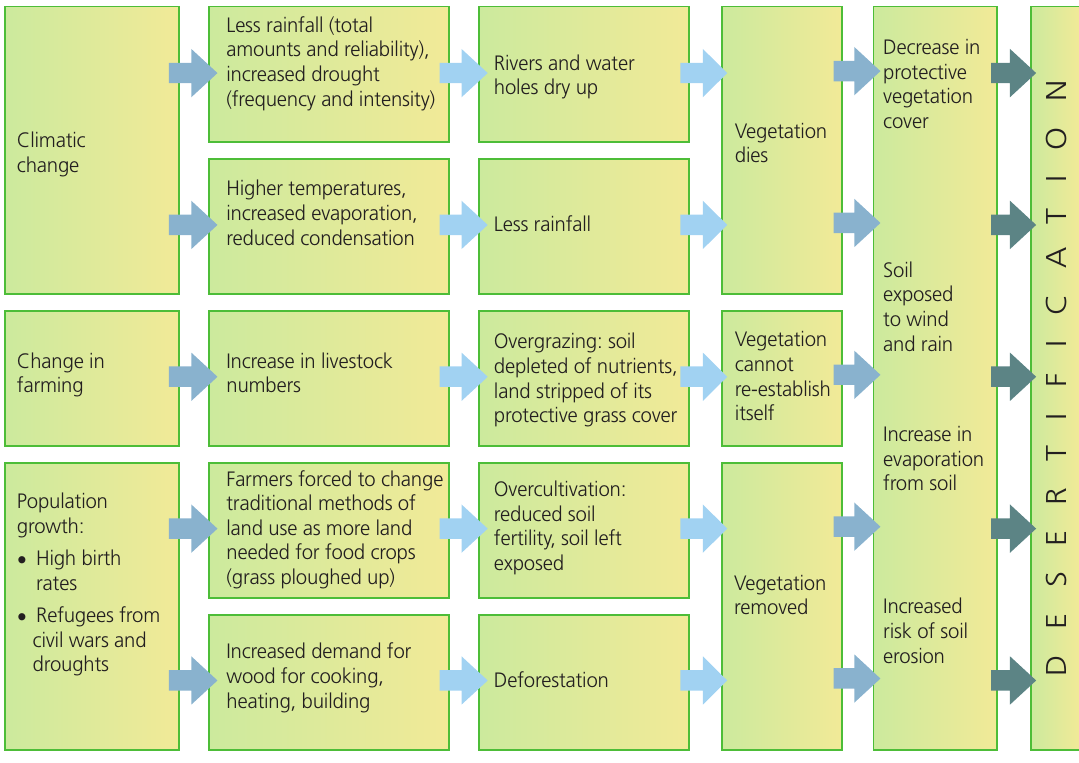
Climate change affects desert margins in several interconnected ways:
Reduced rainfall:
- The Sahel region experienced the greatest loss of rainfall globally during the last 25 years of the twentieth century
- Both the total amount and reliability of rainfall have decreased
- Increased frequency and intensity of drought events
- Rivers and water sources dry up as precipitation declines
Higher temperatures:
- Rising temperatures increase evaporation rates
- This reduces available moisture for vegetation
- In desert areas, local evapotranspiration is often the only water source for precipitation
- A reduced water supply results as the water table falls
Human causes
Historically, populations in hot desert margins remained relatively stable and well-adapted to environmental conditions. However, recent decades have seen significant changes.
Population growth:
Population increase stems from:
- Natural increase as birth rates remain high
- Migration of refugees fleeing civil wars and droughts in neighbouring regions
- Small local populations beginning to move through demographic transition stages
Population pressure on the land:
Growing populations create several pressures:
Intensification of agriculture: Farmers must produce more food from the same land to feed larger local populations.
Overgrazing:
- Livestock numbers increase to meet food demands
- Soil becomes depleted of nutrients
- The protective grass cover is stripped away
- Vegetation cannot re-establish itself
- Exposed soil is vulnerable to wind and rain erosion
Overcultivation:
- Traditional land use methods are abandoned in favour of continuous cultivation
- Grass is ploughed up to create more cropland
- Soil fertility declines as nutrients are not replenished
- Soil is left exposed to erosive forces
- Vegetation is removed and cannot recover
Deforestation:
- Increased demand for fuelwood for cooking, heating, and building
- Trees are removed faster than they can regenerate
- Loss of tree cover exposes soil
- Risk of soil erosion increases dramatically
Important
All these human activities lead to land degradation, where the soil loses its structure, nutrients, and ability to support vegetation, ultimately resulting in desertification. The key process follows this cycle:
Vegetation loss → Soil exposure → Erosion → Further vegetation loss
This creates a positive feedback loop that is extremely difficult to reverse once established.
Areas at risk of desertification
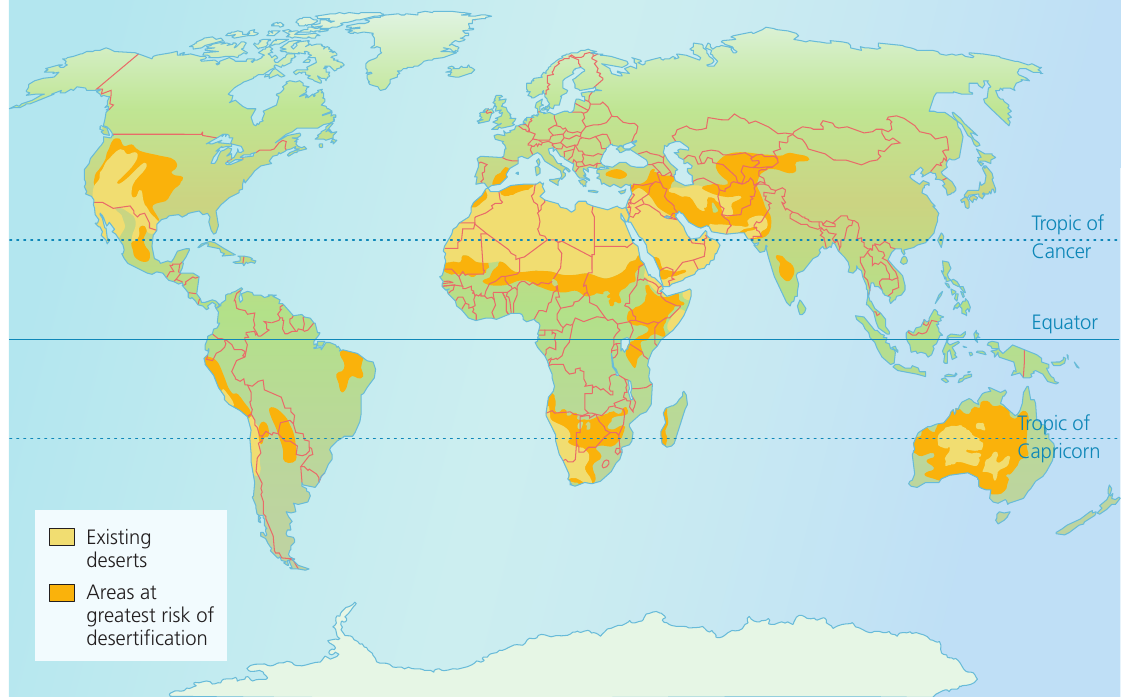
The global extent of desertification is substantial and affects many vulnerable regions.
Current statistics:
- Approximately 25% (one quarter) of the Earth's surface is currently desertified
- This represents around 3.6 billion hectares of land
- About 1 billion people living in some 100 countries face desertification risk
- Roughly 12 million hectares of land are lost to desertification annually
Note
The map shows that areas at greatest risk are typically found on the margins of existing deserts, particularly in:
- The Sahel region (southern edge of the Sahara Desert)
- Sub-Saharan Africa
- Parts of the Middle East and Central Asia
- Interior regions of Australia
- Southwestern United States and northern Mexico
- Parts of South America
Impact of desertification
The consequences of desertification are extensive and affect multiple aspects of the environment and human society.
Ecosystem impacts:
- Loss of biodiversity as species lose their habitats
- Disruption of food chains and ecological relationships
- Reduction in vegetation cover
- Soil degradation and loss of soil structure
- Decreased water retention capacity
Landscape changes:
- Increased soil erosion by wind and water
- Loss of topsoil
- Changes in surface albedo (reflectivity)
- Alteration of local microclimates
- Expansion of barren land
Impacts on human populations:
- Reduced agricultural productivity
- Food insecurity and potential famine
- Loss of livelihoods for farming and pastoral communities
- Forced migration and creation of environmental refugees
- Increased poverty in affected regions
- Social and economic disruption
Climate change and possible futures
The relationship between climate change and desertification is becoming increasingly critical as the Earth experiences unprecedented warming.
Predicted climate changes:
The majority of climate scientists agree that:
- The Earth has experienced significant climate change during the last quarter of the twentieth century and the start of the twenty-first century
- Average global temperatures rose between 0.3°C and 0.6°C during the last century
- Concentrations of atmospheric carbon dioxide (CO₂) have doubled
- With every doubling of CO₂ concentrations, drylands could experience temperature increases of between 2°C and 5°C
Important
Future desertification challenges:
Predicting and addressing future desertification is complex because:
- It is not a problem with a single simple cause
- There is no single simple solution
- Multiple feedback loops are involved
- Desertification and biodiversity loss are linked to climate change through soil erosion
- These connections create reinforcing cycles that amplify the problem
The area of degraded land and deserts has increased substantially in recent decades and continues to expand. This trend is likely to continue and potentially accelerate as climate change intensifies, creating significant challenges for affected regions and their populations.
Remember!
Summary
Key Points to Remember:
-
Desertification is the persistent degradation of dryland ecosystems caused by both human activities and climate change – it's not simply desert expansion.
-
Desert extent has varied dramatically over the past 18,000 years, with much larger arid areas during the last glacial maximum, minimal desert during the Holocene Climate Optimum, and significant expansion in recent times.
-
The main causes are a combination of climate factors (reduced rainfall, higher temperatures) and human activities (overgrazing, overcultivation, deforestation) that together create a cycle of land degradation.
-
Approximately 25% of the Earth's surface is currently desertified, affecting around 1 billion people in 100 countries, with 12 million hectares lost annually.
-
Future climate change is predicted to worsen desertification through feedback loops, with temperature increases of 2-5°C possible in dryland regions, making this a critical environmental challenge requiring urgent attention.