Sediment Sources, Cells and Budgets (AQA A-Level Geography): Revision Notes
📚Revision Notes
Sediment Sources, Cells and Budgets
Introduction
Hot desert landscapes are dominated by loose material known as sediment. This sediment can be transported and deposited within the desert, creating distinctive landforms. Understanding where sediment comes from, how it moves, and where it accumulates is crucial for understanding desert geomorphology.
Note
Deserts function as storage areas for sediment. Much of this material is moved around and redeposited within the desert boundary itself, forming what geographers call a sediment cell. The balance between sediment entering and leaving these systems is known as the sediment budget.
Sources of sediment in hot deserts
Sediment in desert environments originates from several different sources. These inputs of material are essential for understanding how desert landscapes develop and change over time.
Weathering of parent material
One primary source of sediment comes from the breakdown of rocks that lie beneath the desert surface. Through weathering processes, the underlying rock (called parent material) breaks down into smaller fragments. This broken material is known as regolith and provides a local source of sediment that doesn't require transport from elsewhere.
Important
Weathering is the breaking down or decaying of rock material without involving its transport. The resulting material (regolith) becomes available for later erosion and movement.
Fluvial sources
Rivers can bring sediment into desert areas, even though deserts are arid environments. These fluvial (river-related) sediments are transported into the desert from wetter regions beyond the desert margins.
Ephemeral sources
Desert riverbeds are often dry for much of the year. These ephemeral channels only contain water during and immediately after rainfall events. When these channels dry up, sediment is left behind in the riverbed, creating another sediment source within the desert system.
Note
Despite receiving very little annual rainfall, deserts can experience intense storms that deposit significant amounts of sediment through ephemeral channels.
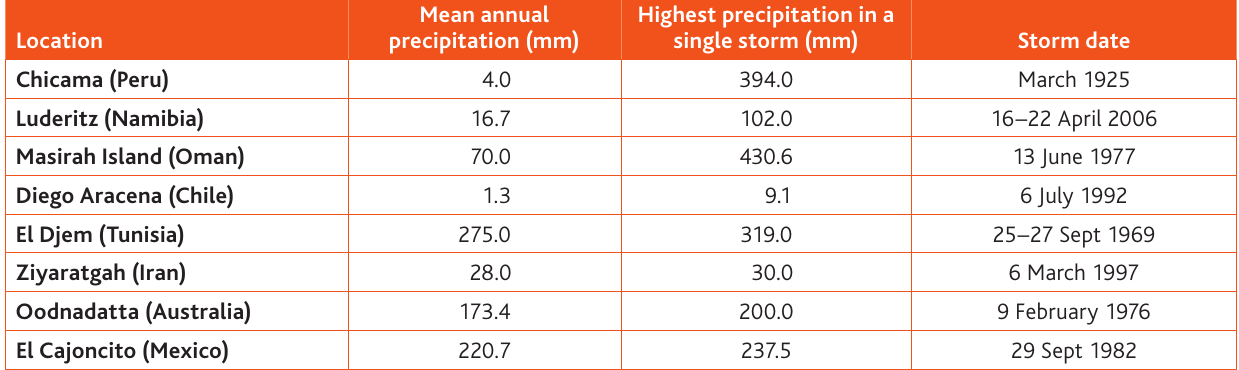
The table above shows how extreme individual storm events can deliver many times more precipitation than the annual average. For example, Chicama in Peru has a mean annual precipitation of just 4.0 mm, yet received 394.0 mm in a single storm in March 1925.
Aeolian sources
Sediment can also originate from beyond the desert margins and be transported in by wind. This aeolian (wind-transported) sediment can travel vast distances before being deposited. When wind deposits sediment, it is often referred to as loess.
Note
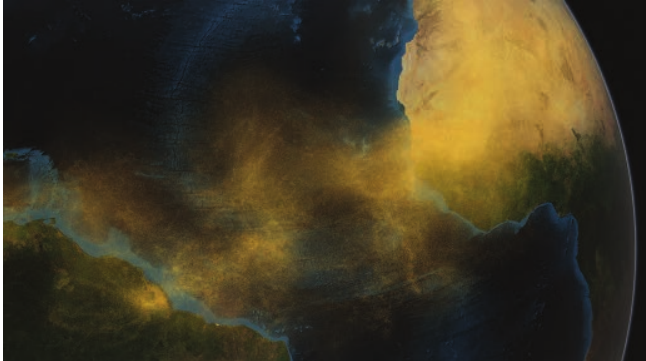
The image above demonstrates how desert sediment can be transported enormous distances. Saharan dust is regularly blown across the Atlantic Ocean - a distance of several thousand miles - reaching as far as the Americas.
Sediment cells in hot deserts
A sediment cell is an area where sediment is stored and much of it is transported and deposited within the desert boundary itself. Think of it as a relatively self-contained system where material circulates internally.
Desert landscapes store large quantities of loose sediment. This stored material can be:
- Picked up by wind and redeposited elsewhere within the desert
- Moved by occasional water flows during rain events
- Left in place for extended periods during stable conditions
Note
The concept of a sediment cell recognises that deserts aren't just areas where sediment passes through - they're active storage zones where material accumulates and is redistributed over time.
Sediment budgets in hot deserts
The sediment budget is the balance between the input and output of sediment in desert systems. Just like a financial budget balances income against spending, a sediment budget compares material entering the system against material leaving it.
Net sediment loss
Areas dominated by erosion experience a net sediment loss. In these locations, erosion removes more material than is added through deposition. The system acts as a source of sediment, with material being carried away by wind or water.
Characteristics of areas with net sediment loss:
- Erosion is the dominant process
- More sediment leaves than arrives
- Often found in exposed, unvegetated areas
- Creates erosional landforms
Net sediment gain
Areas dominated by deposition experience a net sediment gain. Here, deposition adds more material than erosion removes. The system acts as a sink for sediment, with material accumulating over time.
Characteristics of areas with net sediment gain:
- Deposition is the dominant process
- More sediment arrives than leaves
- Creates depositional landforms like dunes
- Material builds up over time
Understanding the balance
The relationship between inputs and outputs determines whether a particular part of the desert landscape is growing (accumulating sediment) or shrinking (losing sediment). This balance isn't static - it can change over time as conditions vary.
Example
Worked Example: Understanding Sediment Budget
Imagine a section of desert dunes:
Scenario 1 - Net Gain:
- Sediment input from wind: 100 tonnes per year
- Sediment loss through erosion: 60 tonnes per year
- Result: +40 tonnes per year (net sediment gain - dunes are growing)
Scenario 2 - Net Loss:
- Sediment input from wind: 50 tonnes per year
- Sediment loss through erosion: 80 tonnes per year
- Result: -30 tonnes per year (net sediment loss - dunes are shrinking)
Scenario 3 - Balance:
- Sediment input: 75 tonnes per year
- Sediment loss: 75 tonnes per year
- Result: Zero net change (system is in equilibrium)
Factors affecting the sediment budget include:
- Wind strength and direction
- Rainfall patterns and intensity
- Vegetation cover (or lack of it)
- Human activities
- Sediment supply from source areas
How sediment moves in deserts
Run-off and overland flow
Rainfall in deserts is often described as 'spotty' - it tends to be very localised and unpredictable in both space and time. When intense storms do occur, they can produce significant amounts of water rapidly.
With limited vegetation cover and baked ground surfaces, this water flows quickly across the surface as overland flow (also called run-off). This rapid surface flow can be a powerful agent of erosion and sediment transport, moving large quantities of material in short periods.
Important
The combination of:
- Bare ground surfaces
- Limited vegetation to slow water flow
- Intense but brief rainfall events
...means that run-off can transport significant volumes of sediment, even in environments where rain is rare.
Wind transport
Wind is also capable of moving sediment across and beyond desert boundaries. Large desert areas can act as significant sediment sources on a global scale, with wind picking up fine particles and transporting them thousands of miles. This aeolian transport connects desert sediment systems to the wider global environment.
Summary
Key Points to Remember:
-
Four main sediment sources: weathering of underlying rocks, rivers (fluvial), dry riverbeds (ephemeral), and wind transport from outside the desert (aeolian/loess)
-
Sediment cells are self-contained systems where deserts store sediment and much of it circulates within the desert boundaries through repeated erosion and deposition
-
Sediment budget is the balance between inputs (sediment arriving) and outputs (sediment leaving) - this determines whether an area experiences net gain or net loss
-
Net sediment loss occurs where erosion dominates, whilst net sediment gain occurs where deposition dominates
-
Despite being arid, deserts can experience extreme rainfall events that move large volumes of sediment through overland flow, whilst wind can transport fine sediment across intercontinental distances