Wind (AQA A-Level Geography): Revision Notes
📚Revision Notes
Wind
Why wind matters in hot deserts
Wind plays a crucial role in shaping hot desert landscapes. It acts as a major driver of change and creates a wide range of landforms through erosion, transportation and deposition processes.
Aeolian processes (wind-driven processes) are particularly common features of hot desert environments for two key reasons:
-
Heated air creates wind - Cloudless skies and high sun angles mean that air at the surface heats up and rises. Cooler air then moves in to replace it, creating winds.
-
Little friction to slow wind down - Many desert regions are relatively barren with few surface features like vegetation or buildings. Without these obstacles, winds can blow unimpeded for considerable distances.
Because wind has energy and is constantly moving, it can erode rock surfaces, transport sediment across vast distances, and deposit material to create new landforms. This makes wind a hugely significant force in hot desert systems.
Note
Wind is particularly effective in deserts compared to other environments because the combination of frequent winds and abundant loose surface material creates ideal conditions for aeolian processes to operate continuously.
Wind erosion in hot deserts
There are two main processes through which wind erodes desert surfaces: abrasion and deflation.
Abrasion
Abrasion is often described as a sandblasting or sandpapering effect. Material carried by the wind strikes exposed rock surfaces and creates a range of erosional features.
The process works like this: as wind blows across the desert, it picks up loose particles. These particles then hit rock surfaces repeatedly, gradually wearing them away. Over time, this creates distinctive erosion patterns and landforms.
Several factors affect how quickly abrasion occurs:
-
Wind characteristics - The direction, frequency and velocity of the wind all influence erosion rates. Stronger, more frequent winds from consistent directions cause faster erosion.
-
Rock type (lithology) - Different rocks erode at different rates. Softer rocks wear away more quickly than harder, more resistant rocks.
-
Particle characteristics - The size and nature of the particles being carried by the wind affects their erosive power.
Deflation
Deflation is the process where wind removes dry, loose sand, silt and clay particles from the surface and carries them away. Importantly, wind only removes the finer material, leaving behind coarser particles.
This selective removal creates a surface covered in a concentration of coarse and fine pebbles. This distinctive surface is known as reg or desert pavement.
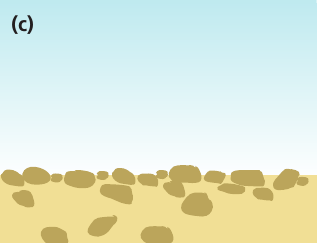
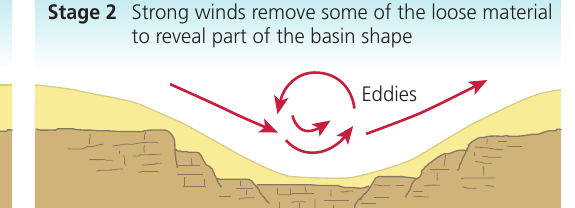
Wind can remove very significant amounts of material through deflation, creating large depressions called deflation hollows. Some of the largest deflation hollows are found in North Africa, where they extend over hundreds of square kilometres.
Example
Case Study: The Qattara Depression
The Qattara Depression in Egypt provides an excellent example of deflation on a massive scale. It is the deepest deflation hollow, reaching 134 metres below sea level at its deepest point and extends over hundreds of square kilometres.
Whilst there is some debate about the exact combination of processes that formed this huge desert depression, wind has undoubtedly played a major role in removing the millions of tonnes of sand and other material that once filled the basin. The depth of deflation hollows is controlled by the level of underlying groundwater.
Wind transportation
Wind is an almost ever-present feature of many hot desert environments. With large amounts of loose surface material available, wind transport is extremely important in shaping the landscape. The transportation of sediment by wind is not only important for erosion processes, but also represents a significant flow of material through desert systems.
Important
The movement of particles by wind depends on several critical factors:
- The wind strength and direction
- The amount of turbulence in the air
- How long the wind blows for
- The relief and surface features of the area
- The amount and nature of any vegetation present
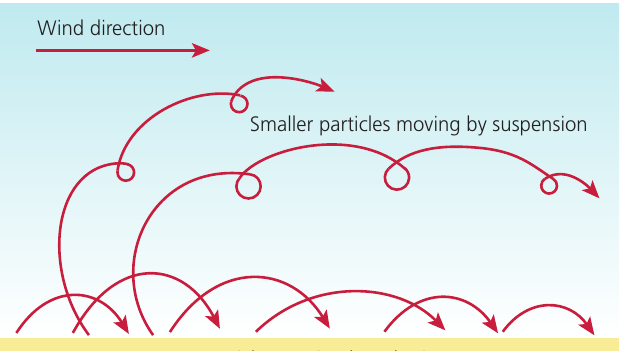
Aeolian processes can transport material in three main ways. The method used depends on the wind strength and the size of the particles being moved.
Suspension
Suspension is where the smallest particles, generally less than 0.2 mm in diameter, are held in the air.
The moving air is able to support the weight of these small particles and carry them indefinitely. They appear as a layer of dust or haze close to the surface.
If winds are strong and persistent enough, clouds of dust can be carried to significant altitudes and transported over hundreds or even thousands of kilometres. With very high velocity winds, vast amounts of silt-sized particles are lifted, creating sand and dust storms. 'Red rain' of Saharan sand has occasionally fallen in the British Isles during particularly strong winds.
Saltation
Saltation is a process where sand-sized particles are transported by bouncing and hopping along the surface.
When turbulence occurs in the wind, particles are lifted by a gust of wind, usually only a few centimetres into the air (but sometimes as high as 2 metres). They are then carried a short distance downwind before dropping back to the surface.
Grains hitting the surface may strike other particles and cause them to jump into the air. They are then caught by the wind themselves and continue the saltation process. Particles are usually transported at one-half to one-third of the speed of the wind.
Surface creep
Surface creep occurs when saltating particles return to the surface and hit larger particles that are too heavy to hop.
These larger particles slowly creep (slide or roll) along the surface. This happens through a combination of the push from the saltating grain hitting them and the general movement of the wind.
It is believed that surface creep accounts for as much as 25% of all grain movement in hot deserts, making it a significant transportation process despite being the slowest method.
Note
The three transportation methods work together as a system. Saltating grains not only move themselves but also trigger surface creep by hitting larger particles, while the finest particles are carried away in suspension. This means wind can transport a wide range of particle sizes simultaneously.
Wind deposition
Deposition occurs when the velocity of the wind decreases to the point where it can no longer transport the grains it is carrying. Wind-deposited materials can often provide clues to the scale and direction of winds in the past. Analysis of huge wind-blown deposits of silt (called loess) on the Loess Plateau in China, and similar but smaller accumulations in Europe and the Americas, has helped researchers map patterns of previous surface winds.
On a more local level, deposition may occur when the wind meets an obstacle and is slowed on the downwind side. This can lead to the formation of sand dunes.
Summary
Key Points to Remember:
-
Wind is a major force in hot deserts because cloudless skies create rising air and barren surfaces provide little friction to slow winds down.
-
Wind erodes through two main processes: abrasion (sandblasting effect) and deflation (removal of fine particles leaving reg behind).
-
Wind transports particles in three ways depending on size: suspension (smallest particles <0.2mm held in air), saltation (sand-sized particles bouncing), and surface creep (largest particles pushed along, accounting for 25% of movement).
-
Deflation can create huge depressions called deflation hollows - the Qattara Depression in Egypt reaches 134 metres below sea level.
-
Wind deposition occurs when wind velocity decreases, creating features like sand dunes and providing evidence of past wind patterns.