Movement of Carbon (AQA A-Level Geography): Revision Notes
📚Revision Notes
Movement of carbon
Carbon constantly moves between different storage locations on Earth through various natural and human-influenced processes. Understanding these movements is essential for comprehending how the carbon cycle functions and how human activities are affecting it.
The carbon cycle overview
Important
Carbon cycle
The carbon cycle describes how carbon moves continuously between different stores on Earth. These stores include the atmosphere, oceans, biosphere (living things), soil and geological formations (rocks and fossil fuels).
The processes that move carbon between these stores are called transfers or fluxes. Think of these as pathways along which carbon travels.
When we analyse carbon stores, we can classify them as either:
- Carbon sinks - stores that absorb more carbon than they release
- Net carbon sources - stores that release more carbon than they absorb
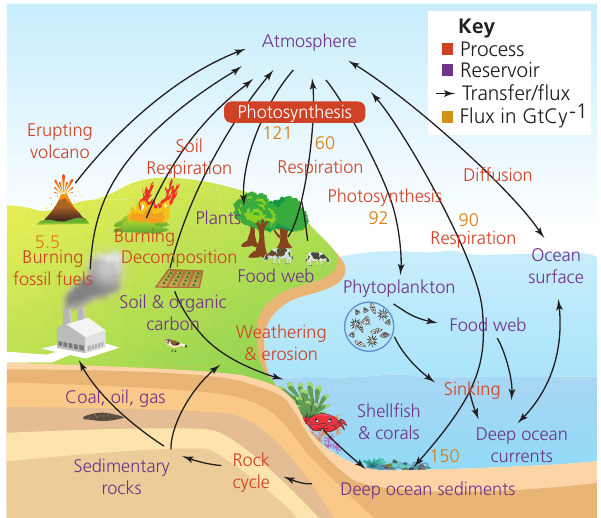
This classification is dynamic and can change over time. For example, a forest might act as a carbon sink whilst it grows, but become a carbon source if it experiences a large fire.
Note
The balance between carbon sinks and sources determines whether atmospheric CO₂ levels rise or fall. Understanding this balance is crucial for predicting future climate change.
The geological component
The geological component represents the slowest part of the carbon cycle, operating over timescales of millions of years. It involves the interaction between carbon and the rock cycle through several key processes.
Chemical weathering
Carbon dioxide in the atmosphere dissolves in water to form a weak acid called carbonic acid:
When this acidic water (rain) reaches the Earth's surface, it slowly reacts with minerals in rocks through chemical weathering. This process gradually breaks down the rocks and dissolves them into their component ions. These dissolved ions are then carried by streams and rivers into the ocean.
In the ocean, the ions settle out and form minerals. A particularly important mineral is calcite - a form of calcium carbonate (CaCO₃). This mineral can be precipitated directly from seawater or formed by marine organisms.
Carbon burial in sediments
Marine organisms such as foraminifera, coccoliths and molluscs use calcium and bicarbonate ions from seawater to build their shells and skeletons from calcium carbonate. When these creatures die, their remains sink to the ocean floor where they accumulate as sediment.
Over time, layer upon layer of this sediment builds up. Eventually, the weight and pressure transform these sediments into sedimentary limestone. This process effectively locks carbon away beneath the ocean floor for millions of years.
Note
Coral reefs provide another example of this process. Corals extract calcium carbonate from seawater to build their structures. When coral organisms die, new corals grow on top of the dead structures. Over geological time, this creates thick deposits of limestone. The Himalayan mountains contain limestone formed from ancient coral reefs, demonstrating how tectonic forces can later expose this buried carbon.
Tectonic processes and volcanism
Tectonic forces drive plate movement, which can push the sea floor beneath continental margins through subduction. The carbonaceous sea-floor deposits are pushed deep into the Earth where intense heat causes them to melt.
This molten material can then rise back to the surface through volcanic eruptions, or through seeps, vents and CO₂-rich hot springs. When this happens, carbon dioxide returns to the atmosphere.
These geological processes of weathering, burial, subduction and volcanism control atmospheric carbon dioxide concentrations over timescales of hundreds of millions of years, creating a natural thermostat for Earth's climate.
Photosynthesis
Photosynthesis is the fundamental process by which plants and certain microorganisms capture carbon from the atmosphere and convert it into living tissue.
Important
Photosynthesis
Photosynthesis is the process by which plants, photosynthetic algae and bacteria convert carbon dioxide and water into carbohydrates using energy from sunlight. Oxygen is released as a by-product.
Tiny marine plants called phytoplankton in the sunlit surface waters of the oceans (the euphotic zone), along with terrestrial plants and photosynthetic algae and bacteria on land, carry out this vital process.
The chemical equation for photosynthesis is:
Or in chemical symbols:
Through photosynthesis, carbon is transformed from an atmospheric gas into solid organic matter. The carbohydrates produced store chemical energy. This process removes carbon dioxide from the atmosphere whilst adding oxygen.
Note
Photosynthesis forms the foundation of most food chains on Earth, as it creates the organic matter that all other organisms ultimately depend upon for food and energy.
Respiration
Whilst photosynthesis removes carbon dioxide from the atmosphere, respiration does the opposite by releasing it back.
Important
Respiration
Respiration is the process by which organisms break down carbohydrates to release the stored energy needed for life functions. This process consumes oxygen and releases carbon dioxide and water.
Plants themselves use some of their stored carbohydrates for respiration to power their life processes. The carbohydrates that remain form the plant's biomass (its bulk and structure). Animals and bacteria obtain their energy by consuming this biomass and using respiration to extract the stored energy.
The chemical equation for respiration is:
Or in chemical symbols:
Notice that photosynthesis and respiration are essentially opposite processes. Photosynthesis removes CO₂ from the atmosphere and adds O₂, whilst respiration removes O₂ and adds CO₂.
However, these processes are not perfectly balanced across the Earth. Not all organic matter is consumed through respiration. Some gets buried in sedimentary rocks before it can be oxidised. Over geological time, this has resulted in more oxygen being added to the atmosphere through photosynthesis than has been removed through respiration, which explains why our atmosphere is oxygen-rich.
Decomposition
When organisms die, their organic matter doesn't simply disappear. It is broken down through decomposition.
Important
Decomposition
Decomposition involves the breakdown of dead organic matter through physical, chemical and biological mechanisms. Organisms called decomposers play the crucial role of breaking down cells and tissues in dead organisms into progressively smaller molecules until they reach individual atoms.
Decomposition mechanisms include:
- Physical mechanisms - fragmentation caused by animals, wind, water movement, and even other plants. Leaching and transport in water represents another important physical mechanism.
- Chemical mechanisms - processes such as oxidation and condensation that break down organic compounds.
- Biological mechanisms - feeding and digestion by decomposer organisms, aided by enzymes that speed up the breakdown process.
Through decomposition, the essential elements of life (carbon, hydrogen, oxygen, nitrogen, phosphorus, sulphur and magnesium) are continually recycled back into the soil, making them available for new life.
Note
This recycling is essential for ecosystems. For example, plants cannot manufacture DNA molecules without a supply of nitrogen, phosphorus and sulphur atoms from the soil. These nutrients, along with carbon, hydrogen and oxygen from photosynthesis, enable continued plant growth.
Plant growth is therefore limited not just by the availability of carbon dioxide, water and light energy, but also by the availability of these other essential elements that come from decomposition.
Oceanic carbon pumps
The oceans play a crucial role in the carbon cycle by storing vast amounts of carbon dioxide. Water can dissolve CO₂, and there is an important relationship between water temperature and the amount of CO₂ that can be dissolved.
Vertical deep mixing
Important
Vertical deep mixing
Vertical deep mixing describes the most important mechanism for moving CO₂ in the oceans. It occurs when warm water in oceanic surface currents is carried from low latitudes (the warm tropics) to high latitudes (the cold polar regions).
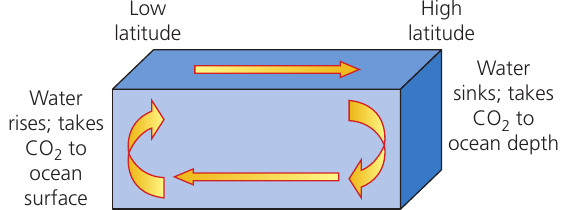
As the water cools in high-latitude regions, it becomes denser and sinks below the surface layer. The cold water can hold more dissolved CO₂, so it carries carbon dioxide down with it to the ocean depths.
Meanwhile, cold water from the depths returns to the surface in low-latitude regions through upwelling. As this cold water warms up, it loses its capacity to hold as much dissolved carbon dioxide, so CO₂ is released back into the atmosphere.
This vertical circulation continuously exchanges carbon dioxide between the ocean and the atmosphere. The circulation also acts as an enormous carbon pump, storing much more carbon in the ocean than would be possible if surface water was not being constantly replenished with cold, carbon-rich water from the depths.
The biological carbon pump
Living organisms in the ocean create another vital mechanism for moving carbon from the atmosphere into the deep ocean and eventually into rocks.
Important
Biological carbon pump
The biological carbon pump describes how marine organisms move carbon from the atmosphere into surface waters, then down into the deeper ocean, and eventually into geological storage.
The process works like this:
- Living organisms in the ocean incorporate carbon from seawater into their bodies, either as organic matter or as structural calcium carbonate (for shells and skeletons)
- When these organisms die, their cells, shells and other remains sink into deep water
- Decay of this organic material releases carbon dioxide into the deep water
- Some material sinks all the way to the bottom, where it forms layers of carbon-rich sediments
- Over millions of years, chemical and physical processes may transform these sediments into rocks, effectively locking up the carbon for geological timescales
Note
This biological pump removes carbon from the surface ocean (which exchanges with the atmosphere) and transfers it to the deep ocean and ocean floor. It represents a crucial long-term carbon storage mechanism.
Combustion
Combustion is the process that occurs when organic material burns in the presence of oxygen, releasing carbon dioxide, water and energy.
Important
Combustion
Combustion involves the rapid reaction of organic material with oxygen to produce carbon dioxide, water and energy. The organic material can be vegetation, fossil fuels, or any carbon-containing compound.
All organic materials contain at least carbon and hydrogen atoms, and may also contain oxygen. When other elements like sulphur or nitrogen are present, combustion produces a variety of pollutant molecules including sulphur oxides and nitrogen oxides.
Biomass combustion
Biomass combustion refers to the burning of living and dead vegetation. This occurs both naturally and through human activities.
Natural and human-induced fires occur globally. Major fire regions include:
- Boreal (northern) forests in Alaska, Canada, Russia, China and Scandinavia
- Savanna grasslands and forests in Africa, Brazil and northern Australia
- Tropical forests in Brazil, Indonesia, Colombia, Ivory Coast, Thailand, Laos, Nigeria, Philippines, Myanmar and Peru
- Temperate forests in the US, western Europe and southern Australia
- Agricultural waste burning after harvests in the US and western Europe
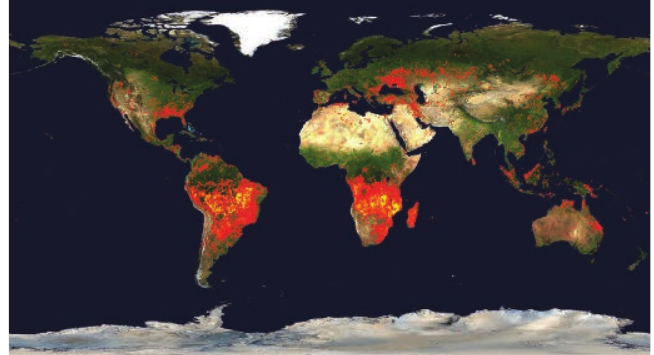
The relationship between forests and carbon dioxide emissions is complex and depends on the forest life cycle. When a forest experiences fire, trees die and decomposition begins. If a forest fully regenerates itself after fire, there will be no net change in carbon over the complete life cycle.
Note
However, fires do have immediate effects:
- They consume approximately 10-20% of the carbon stored in vegetation
- They immediately emit this carbon into the atmosphere
- They kill trees but don't consume them, so dead trees continue to decompose and release carbon
- New trees grow and begin storing carbon again
- The organic layer of soil accumulates carbon from decomposition
This balance between carbon production (through new growth) and decomposition determines whether the forest acts as a net carbon sink or source.
Every year, fires burn 3-4 million km² of the Earth's land surface. These fires release more than a billion tonnes of carbon into the atmosphere as carbon dioxide. Interestingly, old-growth northern latitude forests are sometimes considered carbon 'sinks' even though fires kill trees, because mature forests contain decades or centuries of accumulated carbon. Their dense canopy blocks sunlight from reaching the forest floor, which slows decomposition of dead material.
Volcanic activity
Volcanic eruptions release carbon dioxide that has been stored in the Earth's interior. However, recent research suggests volcanic activity is not a major contributor to current global warming.
According to the United States Geological Survey (USGS), "the carbon dioxide released in recent volcanic eruptions has never caused detectable global warming of the atmosphere."
This is probably because:
- The warming effect of emitted CO₂ is counterbalanced by a large amount of sulphur dioxide released simultaneously. This sulphur dioxide converts to sulphuric acid, which forms fine droplets that increase the reflection of solar radiation back into space, actually cooling the lower atmosphere.
- The amounts of carbon dioxide released by present-day volcanic activity are very small compared to human emissions. All research to date indicates that current sub-aerial and submarine volcanoes release less than 1% of the CO₂ currently emitted by human activities.
Note
Whilst volcanic activity is not driving current warming, some scientists have proposed that intense volcanic releases of carbon dioxide in the deep geological past may have caused large increases in atmospheric CO₂, leading to rises in atmospheric temperatures and possibly contributing to mass extinctions. This remains a topic of active scientific debate.
Hydrocarbon extraction and burning – cement manufacture
Fossil fuel formation and combustion
Dead plants and animals gradually transform into fossil fuels following burial. The pressure from multiple layers of sediment creates an anoxic (oxygen-free) environment. In these conditions, decomposition occurs without oxygen.
When heat from the Earth is added, the carbon in organic molecules is rearranged to form different compounds. The type of material that is buried determines the final product:
- Animal remains tend to form petroleum (crude oil)
- Plant remains are more likely to form coal and natural gas
When these fossil fuels are extracted from underground and then burnt, carbon dioxide and water are released back into the atmosphere. This represents a major transfer of carbon from long-term geological storage into the active atmosphere.
Cement production
The cement industry is a significant contributor to atmospheric CO₂. Cement manufacture contributes CO₂ through two pathways:
- Chemical process emissions - When calcium carbonate is heated to produce cement, it releases lime and carbon dioxide. This chemical process itself accounts for approximately 50% of cement industry emissions.
- Fuel combustion emissions - The fossil fuels burnt to provide heat for the cement manufacturing process contribute approximately 40% of the industry's emissions.
The remaining 10% comes from other sources.
Note
It is estimated that the cement industry produces around 5% of global anthropogenic (human-caused) CO₂ emissions. For every 1,000 kg of cement produced, more than 900 kg of CO₂ is emitted.
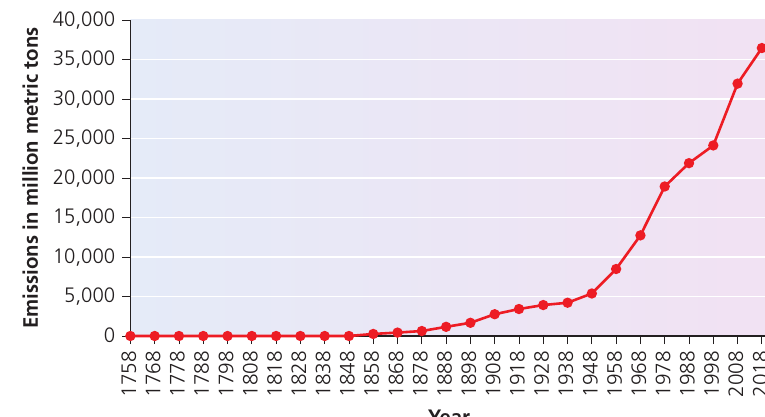
The graph above shows the dramatic acceleration in global emissions from fossil fuel combustion and industrial processes since 1750. Between 2017 and 2018, global energy-related CO₂ emissions rose by 1.7% to reach a historic high of 33.1 GtC (gigatonnes of carbon).
Emissions from fossil fuel burning have increased substantially, with electricity generation accounting for just over 60% of this growth. Coal burning, mainly in China, India and the US, accounted for 10 GtC of CO₂ emissions and 85% of the net increase in emissions. However, there was a decline in Germany, Japan, Mexico and France in the United Kingdom as these countries increased their use of renewable energy.
Farming practices
Agricultural activities significantly impact the carbon cycle through several mechanisms.
When soil is ploughed, the soil layers become inverted and mixed with air. This dramatically increases soil microbial activity. The result is that soil organic matter breaks down much more rapidly, releasing carbon from the soil into the atmosphere.
In addition to the direct effect on soil, emissions from farm machinery (tractors, harvesters) increase carbon dioxide levels in the atmosphere during ploughing and harvesting operations.
Note
According to a 2019 report from the United Nations Food and Agriculture Organization (FAO):
- Agriculture and forestry together cause almost one-quarter of all human greenhouse gas emissions
- One-third of all soils are degraded, having released 78 GtC into the atmosphere
- The largest source of carbon emissions from agriculture is enteric fermentation, a digestive process in livestock that releases methane (CH₄)
- Livestock account for 14.5% of all anthropogenic emissions
- Greenhouse gases from rice paddies make up 10% of total agricultural emissions
- The burning of tropical grasslands accounts for 5%
The FAO also reported that 44% of agriculture-related greenhouse gas emissions occurred in Asia, followed by the Americas (25%), Africa (15%), Europe (12%) and Oceania (4%). This regional distribution has remained relatively constant over the past decade.
Land use change
Deforestation
CO₂ emissions resulting from land use change, mainly through deforestation, account for up to 30% of anthropogenic CO₂ emissions.
Most deforestation is driven by the need for additional agricultural land. Often, subsistence farmers in tropical regions clear a few hectares to feed their families through a process known as 'slash and burn' agriculture.
However, commercial logging operations also remove substantial forest areas. Loggers, some operating illegally, build roads to access increasingly remote forests. This road construction leads to further deforestation as it opens up previously inaccessible areas. Forests are also cleared to accommodate growing urban areas.
Note
Not all deforestation is deliberate. Some results from a combination of human and natural factors, such as wildfires and subsequent overgrazing, which may prevent the re-establishment of young trees.
According to Global Forest Watch, there was a total loss of 361 Mha (million hectares) of tree cover globally between 2001 and 2018 - roughly one and a half times the size of the United Kingdom. This loss released an estimated 98.7 GtC of CO₂ emissions.
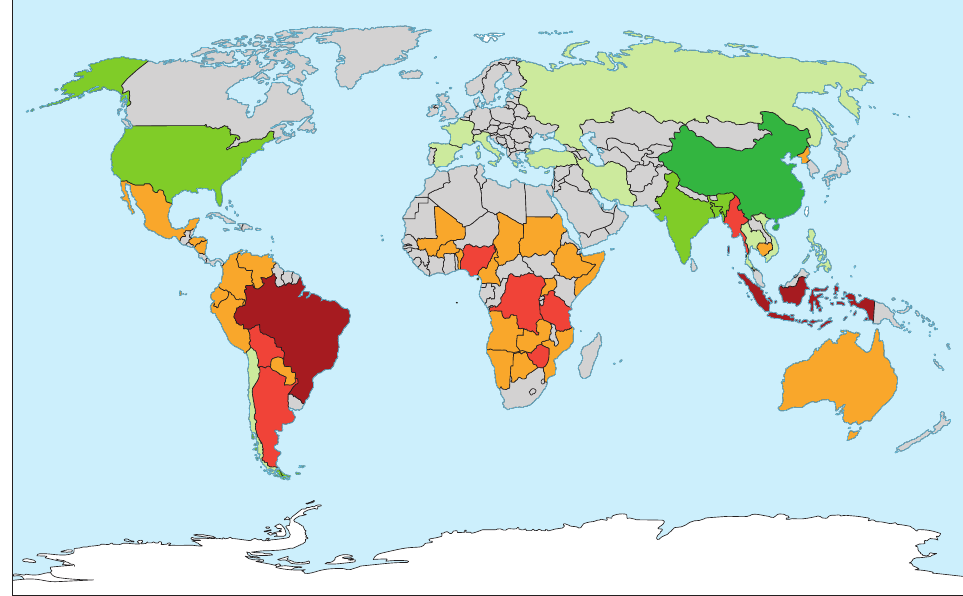
At the same time, tree planting initiatives have resulted in forests being established or extended in some regions. Research by NASA and the University of Maryland in 2018, using modern satellite imagery, demonstrates that global tree cover is actually increasing overall.
However, the loss caused by deforestation in the tropics is greater than the gains from reforestation in temperate areas, particularly in agricultural regions of Asia. The long-term outcome could be a complete loss of tropical rainforest but an increase in temperate forest on former natural grasslands.
Impact of deforestation on the carbon cycle
When forests are cleared for conversion to agriculture or pasture, a large proportion of the above-ground biomass may be burnt. This rapidly releases most of the stored carbon into the atmosphere. Some wood may be used for products and thus preserved for a longer period. Forest clearing also accelerates the decay of dead wood, leaf litter and below-ground organic carbon in the soil.
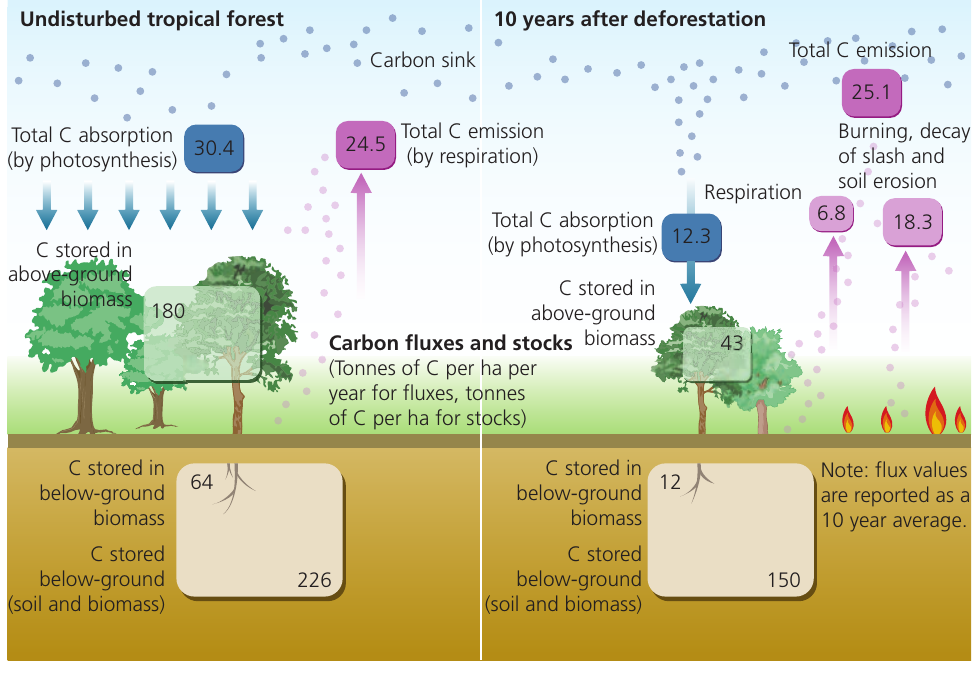
The diagram above illustrates how deforestation dramatically changes carbon storage and fluxes. An undisturbed tropical forest stores 180 tonnes of carbon per hectare in above-ground biomass and 226 tonnes below ground. Ten years after deforestation, above-ground biomass storage has dropped to just 43 tonnes, with below-ground storage reduced to 150 tonnes. Meanwhile, carbon emissions through burning, decay and soil erosion have released significant quantities of carbon to the atmosphere.
Urban growth
For the first time in human history, over half the world's population now lives in urban areas. As a proportion of global population, the urban population is expected to reach 60% by 2030, with urban areas growing at a rate of 1.1 million people every week.
As cities expand, land use changes from either natural vegetation or agriculture to built-up areas. The CO₂ emissions resulting from energy consumption for transport, industry, domestic use, plus the CO₂ emitted during cement manufacture for buildings and infrastructure, have all increased substantially.
Note
In 2019, according to the United Nations Community Programme, urban areas were estimated to be responsible for around 75% of global carbon emissions. If current trends continue, this proportion will rise as city populations grow.
The distribution of emissions is highly concentrated. The 20 highest-emitting cities contribute a large proportion of global energy-related carbon emissions.
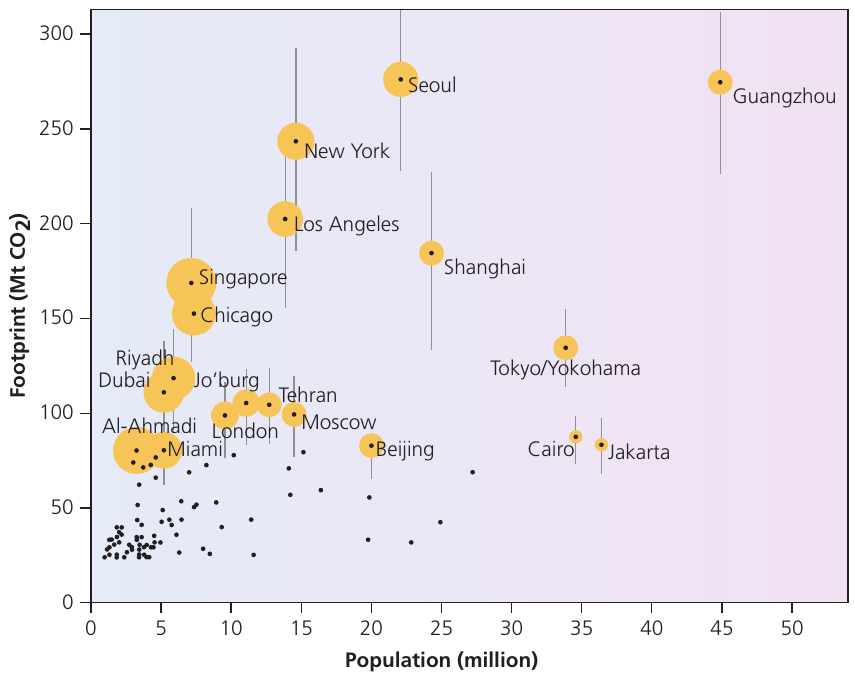
This scatter plot reveals the relationship between city population and carbon footprint. Interestingly, there is no simple linear relationship - population size alone doesn't determine emissions. Cities like Seoul and Guangzhou show the highest carbon footprints (around 270-280 Mt CO₂), whilst other large cities emit considerably less. This concentration of emissions in particular urban centres is likely to increase in the future.
Carbon sequestration
Important
Carbon sequestration
Carbon sequestration is the process of capturing CO₂ from the atmosphere and storing it for the long term. There are two primary approaches: geological sequestration and terrestrial (or biological) sequestration.
Geologic sequestration
Geologic sequestration involves capturing CO₂ at its source (such as power plants or industrial facilities) and then injecting it in liquid form into underground storage locations.
Potential storage sites include:
- Depleted oil and gas reservoirs
- Thin, uneconomic coal seams
- Deep salt formations
- The deep ocean
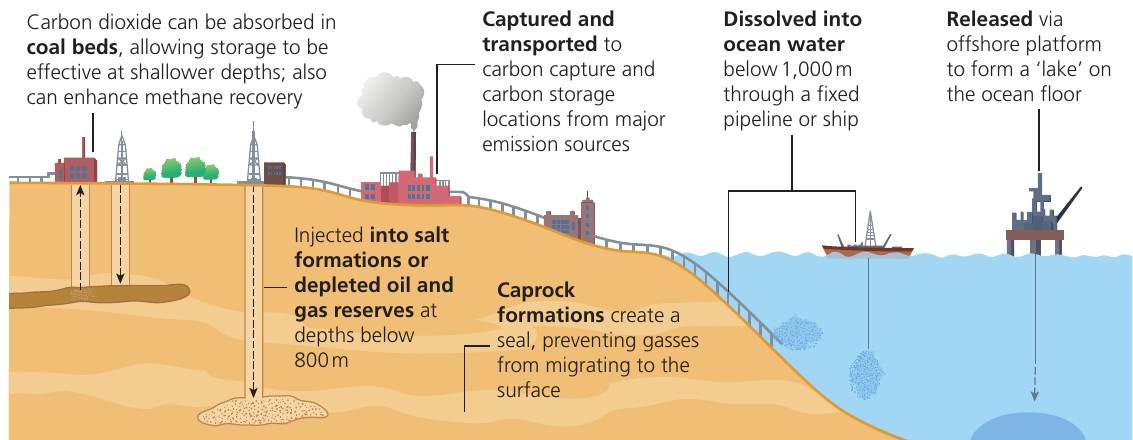
The diagram shows various geological sequestration methods. CO₂ can be captured from coal-burning power plants and industrial sources, then transported via pipeline and injected into salt formations or depleted oil and gas reserves at depths below 800 metres. Impermeable caprock formations create a seal that prevents the gas from migrating back to the surface.
Ocean-based storage involves dissolving CO₂ into ocean water below 1,000 metres depth, where it can form CO₂ 'lakes' on the ocean floor. However, this approach is still experimental.
Note
A major advantage of ocean sequestration is that the ocean can absorb much more additional carbon than terrestrial systems, simply because of its vast size. An additional advantage is that carbon sequestered in the deep ocean enters the Earth's circulation system, where it is commonly measured in thousands of years. By the time this carbon reaches the seabed, it has effectively entered the Earth's geological cycle.
However, a critical disadvantage is that the carbon within ocean systems is never permanently removed from the atmospheric system - it will eventually return, albeit over very long timescales.
Terrestrial sequestration
Terrestrial sequestration involves using plants to capture CO₂ from the atmosphere and then storing it as carbon in plant stems and roots as well as in the soil.
The aim is to develop land management practices that maximise the amount of carbon that remains stored in the soil and in plant material for extended periods. Most environmental authorities also believe that enriching plant ecosystems has positive environmental benefits beyond carbon storage, including enhancement of wildlife populations.
However, there are disadvantages to terrestrial sequestration:
- A forest planted specifically to capture carbon might lose that carbon back to the atmosphere in a catastrophic forest fire, or if the forest suffers disease or infestation
- Land-based sequestration plantations are slow-growing and require active monitoring and management throughout the lifetime of the plantation, typically many decades
- The carbon within terrestrial systems is never permanently removed from the atmospheric system
Summary
Key Points to Remember:
-
Carbon moves continuously between stores (atmosphere, oceans, biosphere, soil, rocks) through transfers called fluxes. Stores can act as carbon sinks or sources depending on whether they absorb or release more carbon.
-
The geological component operates over millions of years through weathering, burial of sediments, subduction and volcanic activity, creating a natural long-term regulator of atmospheric CO₂.
-
Photosynthesis and respiration are opposing processes that move carbon between the atmosphere and living organisms. Photosynthesis removes CO₂ and produces O₂; respiration does the reverse.
-
Ocean carbon pumps, particularly vertical deep mixing, transport enormous amounts of CO₂ from the surface to deep ocean waters. The biological pump moves carbon through marine organisms into long-term storage in ocean sediments and rocks.
-
Human activities significantly impact the carbon cycle through fossil fuel combustion, cement manufacture, deforestation, agriculture and urbanisation. These activities have dramatically increased atmospheric CO₂ levels, particularly since the Industrial Revolution.