Origins and Store of Carbon on Earth (AQA A-Level Geography): Revision Notes
📚Revision Notes
Origins and Store of Carbon on Earth
What is carbon?
Carbon is one of the most chemically versatile elements found in nature. Its name derives from the Latin word 'carbo', meaning coal. This versatility allows carbon to form more compounds than any other element, with scientists estimating over ten million different carbon compounds exist on Earth today.
Note
Carbon's exceptional versatility stems from its ability to form four strong covalent bonds with other atoms, allowing it to create long chains, rings, and complex three-dimensional structures. This property makes it the fundamental building block of all organic chemistry.
Carbon is essential to all life forms. It is found in living organisms, sedimentary rocks, diamonds, graphite, coal, and petroleum products such as oil and natural gas.
Understanding the carbon cycle
The carbon cycle describes the pathway carbon takes as it moves through different stores on Earth. This involves the transformation of carbon from its organic form (found in living organisms like plants and trees) to its inorganic form and back again.
Studying the carbon cycle helps us understand how chemical energy flows on Earth. Most of the energy needed for life is stored in organic compounds as bonds between carbon atoms and other atoms.
Important
Important key terms:
Anthropogenic – Carbon dioxide generated by human activity.
Carbon sequestration – The capture of carbon dioxide from the atmosphere or capturing anthropogenic from large-scale stationary sources like power plants before it is released to the atmosphere. Once captured, the gas (or the carbon portion of the ) is put into long-term storage.
Carbon sink – A store of carbon that absorbs more carbon than it releases.
Weathering – The breakdown of rocks in situ by a combination of weather, plants and animals.
Forms of carbon
Carbon exists in many different chemical forms as it moves through the carbon cycle. Important examples include:
- Carbon dioxide () – a gas found in the atmosphere, soils and oceans
- Methane () – a gas found in the atmosphere, soils, oceans and sedimentary rocks
- Calcium carbonate () – a solid compound found in calcareous rocks, oceans and in the skeletons and shells of ocean creatures
- Hydrocarbons – solids, liquids or gases usually found in sedimentary rocks
- Bio-molecules – complex carbon compounds produced in living things, including proteins, carbohydrates, fats, oils and DNA
Important
Carbon dioxide receives particular attention because of its significant effect on climate. It is challenging to separate the natural carbon cycle from one affected by human activity. Human emissions of carbon dioxide fundamentally alter the carbon cycle and consequently affect climate.
Origins of carbon on Earth
The original source of carbon on Earth came from the planet's interior. When Earth formed, carbon was stored in the mantle. This carbon escaped from the mantle through:
- Constructive and destructive plate boundaries
- Hot-spot volcanoes
Note
Much of the released at destructive plate margins derives from the metamorphism of carbonate rocks that are pushed down into the Earth's interior as oceanic crust subducts beneath continental crust.
Following its release from the Earth's interior, carbon takes different pathways:
- Some remains as in the atmosphere
- Some dissolves in the oceans
- Some is held as biomass in living or dead and decaying organisms
- Some becomes bound in carbonate rocks
Carbon is removed into long-term storage through the burial of sedimentary rock layers. Coal and black shales store organic carbon from undecayed biomass, whilst carbonate rocks like limestone store calcium carbonate.
The major stores of carbon
The Intergovernmental Panel on Climate Change (IPCC) uses gigatonne of carbon equivalent (GtC) and gigatonne of carbon equivalent per year () to measure the storage and transfer of global carbon. A gigatonne equals one billion tonnes.
The lithosphere
Note
Lithosphere – The crust and uppermost mantle, which constitutes the hard and rigid outer layer of the Earth.
Carbon is stored in the lithosphere in both inorganic and organic forms.
Inorganic carbon deposits include:
- Fossil fuels such as coal, oil and natural gas
- Oil shale (kerogens)
- Carbonate-based sedimentary deposits like limestone
Organic carbon deposits include:
- Litter and organic matter in soils
- Humic substances found in soils
Amounts of carbon stored in the lithosphere:
- Marine sediments and sedimentary rocks: up to 100 million GtC
- Soil organic matter: between 1,500 and 1,600 GtC
- Fossil fuel deposits: approximately 4,100 GtC
- Peat (dead but undecayed organic matter found in boggy areas): approximately 250 GtC
The hydrosphere
The ocean plays a crucial role in the carbon cycle. The Global Ocean Data Analysis project (GLODAP) has attempted to measure the amount of carbon in the oceans using data from research ships, commercial ships and buoys. These measurements come from both deep and shallow waters across all oceans.
The oceanic stores can be divided into three parts:
-
The surface layer (euphotic zone) – where sunlight penetrates so that photosynthesis can take place. This layer contains approximately 900 GtC.
-
The intermediate (twilight zone) and deep layer of water contain approximately 37,100 GtC.
-
Living organic matter (fish, plankton, bacteria, etc.) amounts to approximately 30 GtC, with dissolved organic matter totalling 700 GtC.
This gives a total for oceanic carbon of between 37,000 GtC to 40,000 GtC.
Note
Long-term carbon storage in oceans:
When organisms die, their dead cells, shells and other parts sink into deep water. Decay releases carbon dioxide into this deep water. Some material sinks to the bottom, forming layers of carbon-rich sediments. Over millions of years, chemical and physical processes may turn these sediments into rocks. This part of the carbon cycle can lock up carbon for millions of years. It is estimated that this sedimentary layer could store up to 100 million GtC.
The biosphere
The biosphere is defined as the total sum of all living matter. The terrestrial biosphere (land-based living matter) is considered separately from the oceanic biosphere for our purposes.
The total amount of carbon stored in the terrestrial biosphere has been estimated to be 3,170 GtC. The distribution of this carbon depends upon the ecosystem type.
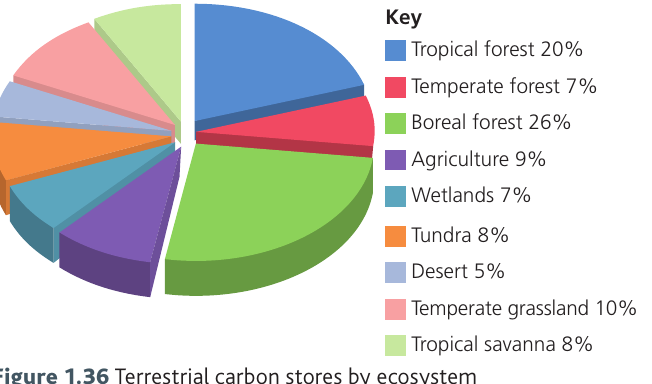
The main stores of carbon in the terrestrial biosphere are:
Living vegetation:
At the global level, 19 per cent of the carbon in the Earth's biosphere is stored in plants. Unlike the oceans, much of this carbon is stored directly in plant tissues. Although the exposed part of the plant is most visible, the below-ground biomass (the root system) must also be considered.
The amount of carbon in plant biomass varies between 35 and 65 per cent of the dry weight. The amount varies depending on location and vegetation type. It is estimated that half of the carbon in forests occurs in high-latitude forests, with a little more than one-third occurring in low-latitude forests.
Note
The two largest forest reservoirs of carbon are:
- The vast expanses of boreal forest in Russia, which hold roughly 25 per cent of the world's forest carbon
- The Amazon basin, which contains about 20 per cent
Plant litter:
This is defined as fresh, undecomposed, and easily recognisable plant debris (by species and type). This can be anything from leaves, cones, needles, twigs, bark, seeds/nuts, etc. The type of litter is directly affected by the type of ecosystem.
Leaf tissues account for about 70 per cent of litter in forests, but woody litter tends to increase with forest age. In grasslands there is very little above ground perennial tissue, so the annual fall of litter is very low.
Soil humus:
This originates from litter decomposition. Humus is a thick brown or black substance that remains after most of the organic litter has decomposed. It gets dispersed throughout the soil by soil organisms such as earthworms.
Important
In all forests (tropical, temperate and boreal together), approximately 31 per cent of the carbon is stored in the biomass and 69 per cent in the soil. In tropical forests, approximately 50 per cent of the carbon is stored in the biomass and 50 per cent in the soil.
Altogether, the world's soils hold more carbon (2,500 GtC) than the vegetation. Soil carbon can be either organic (1,550 GtC) or inorganic carbon (950 GtC). The inorganic carbon component consists of carbon itself as well as carbonate materials such as calcite, dolomite and gypsum.
The amount of carbon found in living plants and animals is comparatively smaller than that found in soil (560 GtC). The soil carbon pool is approximately 3.1 times larger than the atmospheric pool of 800 GtC. Only the ocean has a larger carbon store.
Peat:
This is an accumulation of partially decayed vegetation or organic matter that is unique to natural areas called peatlands or mires. Peat forms in wetland conditions, where almost permanent water saturation obstructs flows of oxygen from the atmosphere into the ground. This creates low oxygen anaerobic conditions that slow down rates of plant litter decomposition.
Peatlands cover over four million km² or three per cent of the land and freshwater surface of the planet. They occur on all continents, from the tropical to boreal and Arctic zones and from sea level to high alpine conditions. It is estimated that peat stores more than 250 GtC worldwide.
Animals:
These play a small role in the storage of carbon. They are, however, very important in the generation of movement of carbon through the carbon cycle.
The atmosphere
Carbon has been present in the atmosphere from early in Earth's history. Atmospheric carbon dioxide levels have reached very high values in the deep past, possibly exceeding 7,000 ppm (parts per million) in the Cambrian period around 500 million years ago. Its lowest concentration has probably been over the last two million years during the Quaternary glaciation when it sank to about 180 ppm.
Today, carbon dioxide is a trace gas in the Earth's atmosphere. Estimates of the overall amount of carbon stored in the atmosphere vary from 720 GtC to 800 GtC. It makes up about 0.04 per cent (400 ppm) of the atmosphere. This low concentration belies its importance to the planet and all life on it.
Important
Due to human activities, the present concentration of in the Earth's atmosphere is higher than it has been for at least 800,000 years, and likely the highest in the past 20 million years. Despite its relatively small concentration, is a potent greenhouse gas and plays a vital role in regulating the Earth's surface temperature. The recent phenomenon of global warming has been attributed primarily to increasing industrial emissions into the atmosphere.
Measuring atmospheric carbon:
Atmospheric carbon has been measured at the Mauna Loa Observatory (MLO) on Hawaii since 1958. The undisturbed air, remote location and minimal influences of vegetation and human activity at MLO are ideal for monitoring atmospheric constituents. The observatory is part of the American National Oceanic and Atmospheric Administration (NOAA).
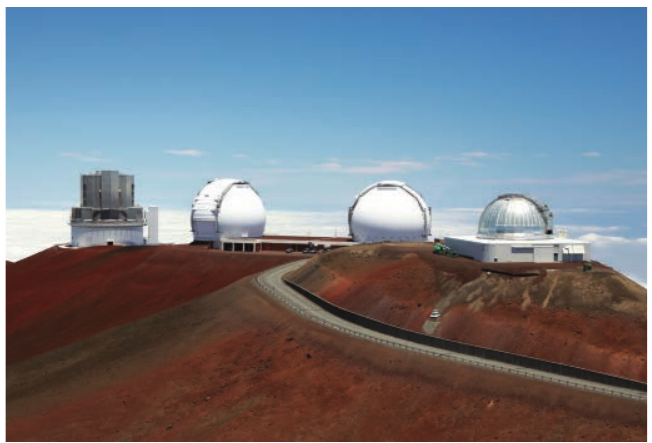
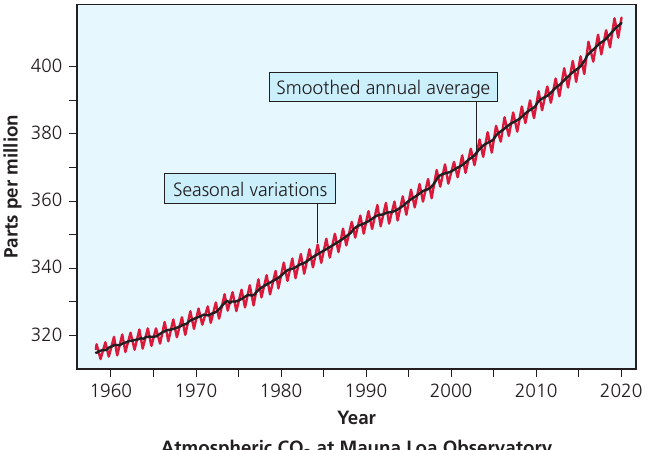
The measurements show that the total annual mean concentration of in the atmosphere has increased markedly since the Industrial Revolution, from 280 ppm to 317.7 ppm in March 1958 to 416.2 ppm as of May 2020. This increase is largely attributed to human derived (anthropogenic) sources, particularly the burning of fossil fuels and deforestation.
Note
A graph of this change has been named after the scientist who first started this research. It is called the Keeling Curve. Keeling was one of the first scientists to gather evidence that linked fossil fuel emissions to rising levels of carbon dioxide. Keeling's research has been backed up by other readings from around the world. For example, the trapped in ice cores from Antarctica and Greenland can be used to give a 'proxy' measure of the in the atmosphere at the time that snow was laid down.
The daily average at Mauna Loa first exceeded 400 ppm on 10 May 2013. It is currently rising at a rate of approximately 2 ppm per year and accelerating.
Movement of carbon
Carbon moves from one store to another in a continuous cycle.
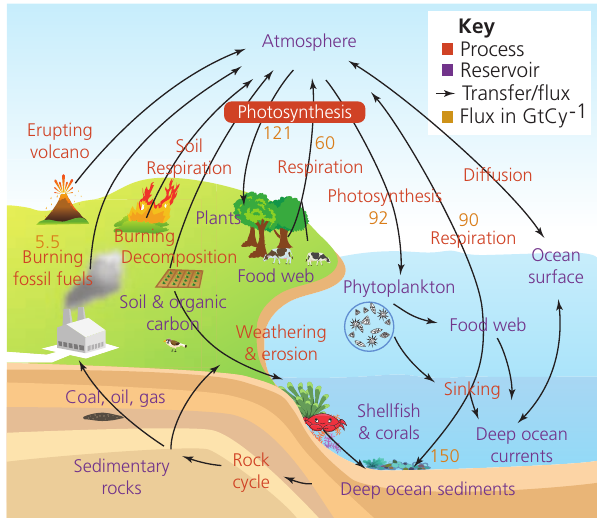
This cycle consists of several carbon stores as described above. The processes by which carbon moves between these stores are known as transfers or fluxes. If more carbon enters a store than leaves it, that store is considered to be a carbon sink. If more carbon leaves a store than enters it, that store is considered a net carbon source.
The geological component
The geological component of the carbon cycle is where it interacts with the rock cycle in the processes of weathering, burial, subduction and volcanic eruptions.
Weathering process:
In the atmosphere, carbon dioxide is removed from the atmosphere by dissolving in water and forming carbonic acid:
Example
Chemical Weathering Process:
As this weakly acidic water reaches the surface as rain, it reacts with minerals at the Earth's surface, slowly dissolving them into their component ions through the process of chemical weathering. These component ions are carried in surface waters like streams and rivers, eventually to the ocean, where they settle out as minerals like calcite, a form of calcium carbonate ().
Burial and limestone formation:
Calcium carbonate is also precipitated from calcium and bicarbonate ions in seawater by marine organisms like foraminifera, coccoliths or molluscs. When these creatures die, their skeletons sink to the bottom of the oceans where they collect as sediment. Burial by overlying layers of sediment can eventually turn these sediments into sedimentary limestone.
Note
Coral also extracts from seawater. These creatures live and eventually die in the same location. Dead coral is built upon by later generations of live coral and so it too becomes buried. The carbon is now stored below the sea floor in layers of limestone. Tectonic uplift can then expose this buried limestone. One example of this occurs in the Himalayas where some of the world's highest peaks are formed of material that was once at the bottom of the ocean.
Subduction and volcanic activity:
Tectonic forces cause plate movement to push the sea floor under continental margins in the process of subduction. The carbonaceous sea-floor deposits are pushed deep into the Earth where they heat up, eventually melt, and can rise back up to the surface through volcanic eruptions or in seeps, vents and -rich hot springs. In this way returns to the atmosphere.
Important
Weathering, burial, subduction and volcanism control atmospheric carbon dioxide concentrations over time periods of hundreds of millions of years.
Remember!
Summary
Key Points to Remember:
-
Carbon originates from the Earth's interior and was released through volcanic activity and tectonic processes at plate boundaries.
-
The major carbon stores are the lithosphere (marine sediments, fossil fuels, soil), hydrosphere (oceans: 37,000-40,000 GtC), biosphere (terrestrial living matter: 3,170 GtC), and atmosphere (720-800 GtC as trace gas).
-
The largest carbon store is the ocean, followed by soil, which holds approximately 3.1 times more carbon than the atmosphere.
-
Atmospheric concentrations have increased from 280 ppm before the Industrial Revolution to over 416 ppm today, primarily due to human activities like burning fossil fuels and deforestation.
-
The geological component of the carbon cycle involves weathering (forming carbonic acid), burial (creating limestone), subduction and volcanic eruptions, controlling atmospheric over millions of years.