The Major Stores of Water (AQA A-Level Geography): Revision Notes
📚Revision Notes
The Major Stores of Water
Introduction to the hydrosphere
Water on or close to the Earth's surface is known as the hydrosphere. Scientists have made various attempts to calculate the total volume of water within this system. Current estimates suggest the hydrosphere contains approximately km³ of water.
The water in the hydrosphere is distributed unevenly across different stores. Understanding this distribution is essential for comprehending the water cycle and how water moves through Earth's systems.
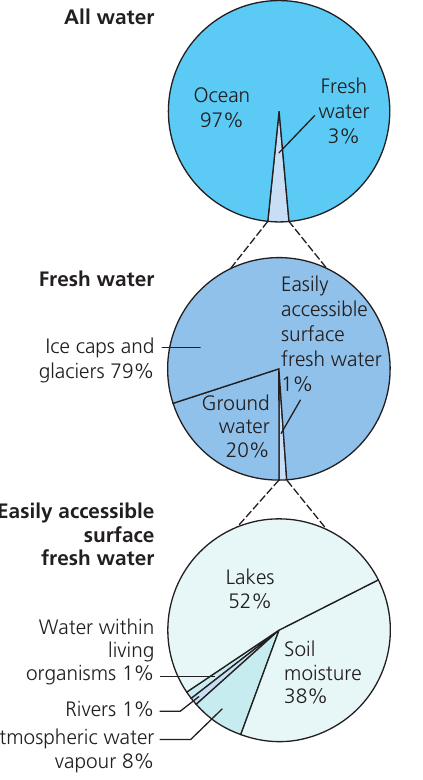
Distribution of global water
Water is stored in three main categories:
- Oceanic water (97% of all water) - contained in oceans and seas
- Fresh water (3% of all water) - locked up on land and in the atmosphere
- Atmospheric water (0.4% of all water) - exists as water vapour, clouds and precipitation
Note
Fresh water itself is subdivided into different stores:
- Ice caps and glaciers contain 79% of fresh water
- Groundwater holds 20% of fresh water
- Easily accessible surface fresh water represents just 1% of fresh water
This easily accessible surface water is further broken down into:
- Lakes (52%)
- Soil moisture (38%)
- Atmospheric water vapour (8%)
- Rivers (1%)
- Water within living organisms (1%)
Important
Hydrosphere is a discontinuous layer of water at or near the Earth's surface. It includes all liquid and frozen surface waters, groundwater held in soil and rock, and atmospheric water vapour.
Approximately 12,900 km³ of water vapour exists in the atmosphere at any time. This represents a global average of 26 kg/m² of water for each column of air on Earth's surface. Although atmospheric water comprises only 0.4% of all water, it plays a crucial role in weather, climate and the water cycle.
Oceanic water
Important
Oceanic water is the water contained in the Earth's oceans and seas, but does not include inland seas such as the Caspian Sea.
The oceans represent the dominant water store on Earth. Estimates of the exact volume vary, with figures ranging from 1,320,000,000 to 1,370,000,000 km³. The average depth of the oceans is approximately 3,682 m. This difference in volume is larger than all other water stores combined.
Note
Key characteristics of oceanic water:
- Contains approximately 97% of Earth's total water
- Covers roughly 72% of the planet's surface (3.6 × 10⁸ km²)
- Divided into several principal oceans and smaller seas
- Only about 5% has been explored by oceanographers
Oceanic water contains dissolved salts, which give it a salty taste and allow it to remain liquid at temperatures below 0°C. The salts are alkaline, with an average pH of approximately 8.14. This pH has been gradually declining over the past 250 years and appears likely to continue falling, linked to increasing atmospheric carbon dioxide levels.
The cryosphere
Important
Cryospheric water is water locked up on the Earth's surface as ice.
The cryosphere refers to those portions of Earth's surface where water exists in solid form. This represents a significant proportion of the planet's fresh water reserves.
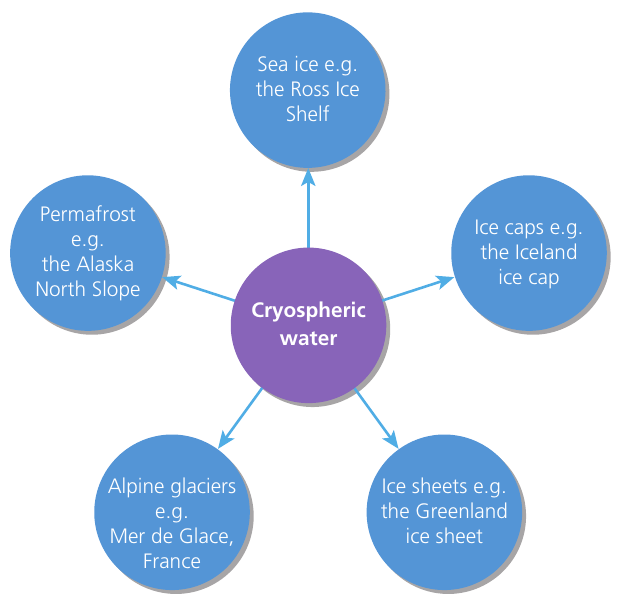
There are five main locations where cryospheric water is found:
- Sea ice
- Ice sheets
- Ice caps
- Alpine glaciers
- Permafrost
Sea ice
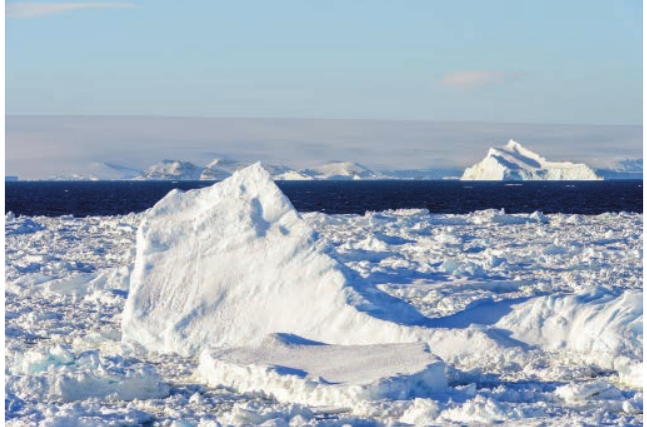
Sea ice forms when ocean water is cooled to temperatures below freezing point. Much of the Arctic Ocean remains frozen, with the extent growing during winter and shrinking in summer. The same pattern occurs in waters surrounding Antarctica.
Note
Important characteristics of sea ice:
- Forms from ocean water
- Does not raise sea level when it melts (because it already displaces water)
- Closely linked to planetary climate patterns
- Scientists are concerned about recent decline in extent
Ice shelves are platforms of ice that develop where ice sheets and glaciers extend out into the oceans. Examples include the Ross Ice Shelf in Antarctica and ice shelves in the Arctic near Canada and Alaska.
Icebergs are chunks of ice that break off from glaciers and ice shelves and drift in the oceans. They only raise sea level when they first leave the land and enter the water, not when they subsequently melt in the water.
Ice sheets
Important
An ice sheet is a mass of glacial land ice extending more than 50,000 km². The two major ice sheets on Earth today cover most of Greenland and Antarctica.
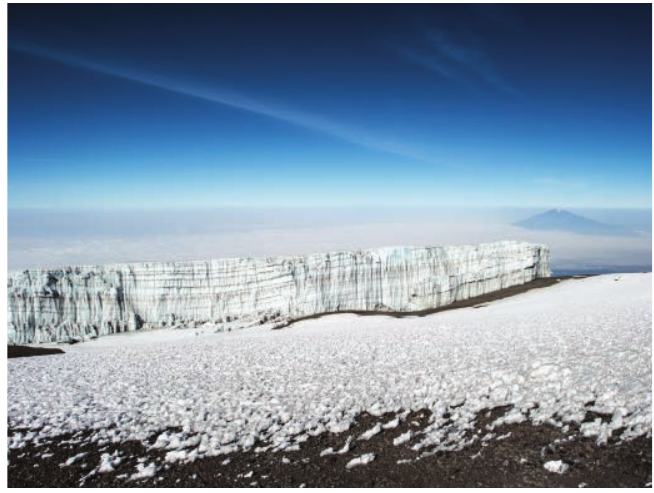
The Antarctic and Greenland ice sheets are Earth's largest frozen water stores:
Example
Worked Example: Comparing Earth's Major Ice Sheets
Antarctic Ice Sheet:
- Extends almost 14 million km² (roughly the area of the United States and Mexico combined)
- Contains approximately 30 million km³ of ice
- If melted, would raise global sea level by about 60 m
- Contains more than 99% of Earth's freshwater ice
Greenland Ice Sheet:
- Extends approximately 1.7 million km²
- Covers most of the island of Greenland
- If melted, would raise sea level by about six metres
- Contains substantial volumes of frozen fresh water
Formation and characteristics
Ice sheets develop in regions where snow falling in winter does not melt entirely during summer. Over thousands of years, layers of snow accumulate and compact into thick masses of ice, becoming progressively thicker and denser as new snow and ice layers compress the older layers beneath.
Ice sheets are constantly in motion, flowing slowly downhill under their own weight. Near coastal areas, the ice moves through relatively fast-moving outlets called ice streams. These ice streams can be up to 50 km wide, 2 km thick and hundreds of kilometres long. An ice sheet remains stable as long as it accumulates the same mass of snow as it loses to the sea.
Note
During the last ice advance, ice sheets also covered extensive areas of North America, northern Europe and Argentina.
Ice caps
Ice caps are thick layers of ice covering land areas smaller than 50,000 km². They typically form in mountainous regions and are usually dome-shaped, centred over the highest point of an upland area. Ice flows outwards from this central point, covering almost everything in its path and becoming the major source for many glaciers.
Distribution of ice caps:
- Polar regions (Arctic and Antarctic)
- Mountainous areas including the Himalayas, Rockies, Andes and Southern Alps of New Zealand
- Iceland has a significant ice cap
- The Furtwangler Glacier on Kilimanjaro (at 60,000 m²) is Africa's only remaining ice cap, but is melting rapidly and may soon disappear
Note
Ice caps tend to be dome-shaped and can flow in multiple directions, unlike valley glaciers which are confined to specific channels.
Alpine glaciers
Alpine glaciers are thick masses of ice found in deep valleys or upland hollows. Most valley glaciers originate from ice caps or smaller corrie glaciers located at higher elevations.
Note
Alpine glaciers are particularly significant in the Himalayas, where approximately 15,000 Himalayan glaciers create a unique reservoir supporting perennial rivers. Major river systems such as the Indus, Ganges and Brahmaputra depend upon meltwater from these glaciers. These rivers, in turn, provide the lifeline for millions of people across South Asian countries including Pakistan, Nepal, Bhutan, India and Bangladesh.
Permafrost
Important
Permafrost is defined as ground (soil or rock and included ice or organic material) that remains at or below 0°C for at least two consecutive years.
Characteristics of permafrost:
- Thickness varies from less than one metre to more than 1,500 m
- Most existing permafrost formed during cold glacial periods
- Has persisted through warmer interglacial periods, including the Holocene (the last 10,000 years)
- Some relatively shallow permafrost (30 to 70 m) formed during the second part of the Holocene (the last 6,000 years)
- Additional permafrost formed during the Little Ice Age (400 to 150 years ago)
Subsea permafrost occurs at depths of 0°C over large areas of the Arctic continental shelf. This formed during the last glacial period when sea levels were lower, exposing shelf landscapes. Permafrost is also found beneath ice-free regions of Antarctica and in areas where the ice sheet is frozen to its bed.
Climate concerns
Important
Permafrost has begun to melt as climate warms. This melting process is releasing substantial amounts of carbon dioxide and methane into the atmosphere, potentially affecting global climate patterns. This represents a concerning feedback loop in the climate system.
Terrestrial water
Important
Terrestrial water consists of groundwater, soil moisture, lakes, wetlands and rivers.
Terrestrial water is divided into four broad categories:
- Surface water (rivers, lakes, wetlands)
- Groundwater
- Soil water
- Biological water
Surface water
Surface water is the free-flowing water of rivers as well as the water contained in ponds and lakes.
Rivers
Important
Discharge is the amount of water in a river flowing past a particular point, expressed as m³s⁻¹ (cubic metres per second, also called cumecs).
Rivers serve a dual function - they are both a store and a transfer of water. They are streams of water flowing within a defined channel, transferring water from the ground, from soils and from the atmosphere to a store such as wetlands, lakes or oceans.
Key facts about rivers:
- Cover just 1,000,000 km² of Earth's surface
- Contain a volume of approximately 2,120 km³
- Represent only a tiny percentage (0.0002%) of all water
Despite their small volume, rivers are extremely important in the water cycle.
Example
Worked Example: The Amazon River
The Amazon River in South America exemplifies the importance of rivers in the water cycle:
- Largest river in the world by discharge
- Averages approximately 209,000 m³/s discharge
- Greater discharge than the next seven largest independent rivers combined
- Drains an area of about 7,050,000 km²
- Accounts for approximately one-fifth of the world's total river flow
- The portion of the drainage basin in Brazil alone is larger than any other river's basin
Remarkably, the Amazon discharges into the Atlantic Ocean with enormous flow, yet it already has a greater discharge at one-fifth of the way along its course than it has at its final discharge point.
Lakes
Lakes are collections of fresh water found in hollows on the land surface. A water body is generally classified as a lake if it is greater than two hectares in area. Any standing body of water smaller than this is termed a pond.
Note
Distribution and characteristics:
- The majority of Earth's lakes contain fresh water
- Most are located in the Northern Hemisphere at higher latitudes
- Canada has an estimated 31,752 lakes larger than 3 km²
- Finland has 187,888 lakes of 500 m² or larger, of which 56,000 are large (10,000 m²)
The Caspian Sea is Earth's largest lake:
- Covers 78,200 km³
- A remnant of an ancient ocean
- Approximately 5.5 million years old
- Generally contains fresh water, though it becomes more saline in southern areas where fewer rivers flow into it
The deepest lake in the world is Lake Baikal in Siberia, with a mean depth of 749 m and a deepest point at 1,637 m.
Wetlands
The Ramsar Convention provides an internationally recognised definition of wetlands: "areas of marsh, fen, peatland or water, whether natural or artificial, permanent or temporary, with water that is static or flowing where there is a dominance by vegetation."
Characteristics of wetlands:
- Areas where water covers the soil or is present at or near the surface
- Water present all year or for varying periods during the year, including growing season
- Water saturation determines soil development and types of plant and animal communities
- Support both aquatic and terrestrial species
- Prolonged water presence creates conditions favouring growth of specially adapted plants
- This promotes development of characteristic wetland soils
Note
Wetlands vary widely due to regional and local differences in:
- Soils
- Topography
- Climate
- Hydrology
- Water chemistry
- Vegetation
- Human disturbance
They are found from polar regions to the tropics and on every continent except Antarctica.
Example
Case Study: The Pantanal Wetlands
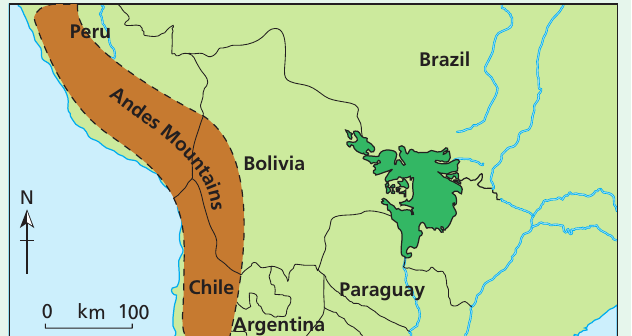
The Pantanal of South America is often considered the world's largest freshwater wetland system. It extends through millions of hectares across western Brazil, eastern Bolivia and eastern Paraguay. This complex system includes marshlands, flood plains, lagoons and interconnected drainage lines.
It provides substantial benefits including:
- Water purification
- Groundwater discharge and recharge
- Climate stabilisation
- Water supply
- Flood abatement
- An extensive transport system
Wetlands are the main ecosystem in the Arctic, where peatlands, rivers, lakes and shallow bays cover nearly 60% of the total surface area. Arctic wetlands store enormous amounts of greenhouse gases and are critical for global biodiversity.
Groundwater (lithosphere)
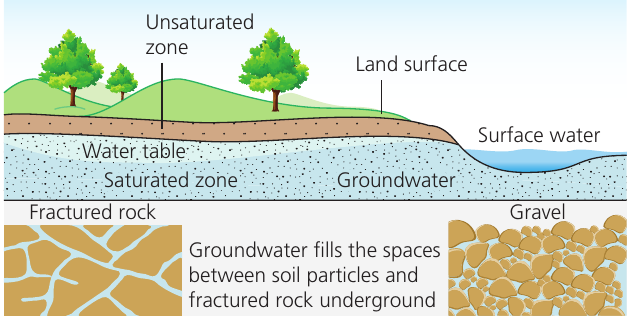
Groundwater is water that collects underground in the pore spaces of rock. Scientists estimate that a lower limit for groundwater exists at a depth of 4,000 m, though substantial quantities of water are known to exist below that depth. A very deep borehole in the Kola Peninsula in Northern Russia found huge quantities of hot mineralised water at a depth of 13 km.
Water table and zones
The depth at which soil pore spaces or fractures and voids in rock become completely saturated with water is called the water table. This creates two distinct zones:
Note
The two zones of groundwater:
- Unsaturated zone - above the water table, where pore spaces contain both air and water
- Saturated zone - below the water table, where all pore spaces are filled with water
Groundwater is recharged from precipitation and eventually flows to the surface. Natural discharge often occurs at springs and seeps, and can form oases in wetlands.
Threats to groundwater
Important
The amount of groundwater is reducing rapidly in many areas due to extensive extraction for irrigating agricultural land in dry regions. This unsustainable use threatens future water supplies.
Soil water
Soil water is that which is held, together with air, in unsaturated upper weathered layers of the Earth. This store is of fundamental importance to many processes:
- Hydrological processes
- Biological and biogeochemical processes
- Weather and climate patterns
- Run-off potential and flood control
- Soil erosion and slope failure
- Reservoir management
- Geotechnical engineering and water quality
Note
Soil moisture serves as a key variable controlling the exchange of water and heat energy between the land surface and the atmosphere through evaporation and plant transpiration. Consequently, soil moisture plays an important role in the development of weather patterns and the production of precipitation.
If vegetation is destroyed, this store is lost to the atmosphere and the climate can become more desert-like. Many plants are adapted to store water in large quantities. Cacti, for instance, are able to gather water via their extensive root systems and then use it very slowly until the next rainstorm. The baobab tree also stores water, though it is thought that this water strengthens the tree's structure rather than being used directly in growth.
Biological water
Biological water represents the water stored in all living biomass. The amount varies widely around the globe depending on vegetation cover and type. Areas of dense rainforest store substantially more water than deserts. The role of animals as a water store is minimal compared to plants.
Trees absorb water through their roots. This water is either transported and stored in the trunk and branches of the tree, or it is lost through the process of transpiration through stomata in the leaves. This storage provides a reservoir of water that helps maintain some climatic environments.
The atmosphere
Important
Atmospheric water is water found in the atmosphere, mainly as water vapour with some liquid water (cloud and rain droplets) and ice crystals.
Atmospheric water exists in three states, though the most common form is water vapour - a gas that is clear, colourless and odourless. Because we cannot see it, its presence is often taken for granted.
Properties of water vapour
Water vapour plays several crucial roles in the atmosphere:
- Absorbs, reflects and scatters incoming solar radiation, helping to keep the atmosphere at a temperature that can maintain life
- The amount of water vapour air can hold depends upon its temperature
- Cold air cannot hold as much water vapour as warm air
- This creates a pattern where air over the poles is quite dry, whereas air over the tropics is very humid
Water vapour and climate
Important
A small increase in water vapour levels will lead to an increase in atmospheric temperatures. This creates a positive feedback loop: a small increase in global temperature leads to a rise in global water vapour levels, which further enhances atmospheric warming.
Clouds and precipitation
Cloud is a visible mass of water droplets or ice crystals suspended in the atmosphere. Cloud formation results from air in the lower layers of Earth's atmosphere becoming saturated due to either or both of two processes:
- Cooling of the air
- An increase in water vapour content
When cloud droplets grow sufficiently large, they eventually fall as rain, returning water to Earth's surface and continuing the water cycle.
Remember!
Summary
Key Points to Remember:
-
The hydrosphere contains approximately km³ of water, with 97% stored in the oceans and only 3% as fresh water.
-
The cryosphere includes five main types of frozen water: sea ice, ice sheets, ice caps, alpine glaciers and permafrost. The Antarctic and Greenland ice sheets contain over 99% of Earth's freshwater ice.
-
Terrestrial water is divided into four categories: surface water (rivers, lakes, wetlands), groundwater, soil water and biological water. Although these stores represent small percentages of total water, they are crucial for supporting life and maintaining ecosystems.
-
Atmospheric water, though comprising only 0.4% of all water, plays a vital role in weather patterns, climate regulation and the water cycle through processes of evaporation, condensation and precipitation.
-
Water exists in dynamic equilibrium across these stores, with changes occurring at timescales from diurnal to geological, making the water cycle a complex and interconnected system essential for life on Earth.