Key Figures (AQA A-Level History): Revision Notes
📚Revision Notes
Key Figures
The period 1603-1629 was shaped by the actions, relationships, and conflicts between a distinct group of individuals who held power at court and in government. Understanding these figures—their roles, ambitions, and interconnections—is essential for analysing the growing tensions between monarchy and Parliament during the early Stuart era.
Note
Court politics during this period operated through complex networks of patronage, personal relationships, and competing factions. Access to the monarch often determined an individual's political influence more than their official position, making personal connections a crucial element of power.
Monarchs
James Stuart (James VI of Scotland/James I of England)
Reigned from 1603 to 1625, James inherited both the Scottish and English crowns, bringing the Stuart dynasty to England. His background as King of Scotland since infancy meant he arrived with established views on royal authority, particularly his belief in the Divine Right of Kings—the notion that monarchs derived their power to rule directly from God. This conviction shaped his approach to Parliament and governance throughout his reign. James's personality and style of rule contrasted sharply with the previous Tudor regime; he was intellectual, often preferring written debate to military action, yet struggled to manage the competing demands of court factions and parliamentary finance.
Charles Stuart (Charles I)
James's son ruled as Charles I from 1625 to 1649. Unlike his father, Charles was more reserved, deeply religious, and less willing to compromise with Parliament. His reign saw escalating conflict over issues of taxation, religion, and royal authority. Charles inherited many of his father's advisers initially but developed his own preferences, particularly his reliance on George Villiers, Duke of Buckingham, until the latter's assassination in 1628. Charles's commitment to what he perceived as proper ceremonial worship and his marriage to a Catholic princess would contribute to the religious anxieties that marked his early years as king.
Important
The transition from James I to Charles I marked a significant shift in monarchical style. While James was willing to engage in debate and compromise (even if reluctantly), Charles's more rigid approach and unwillingness to negotiate would prove fatally consequential for Crown-Parliament relations.
Royal favourites
The system of court favouritism was a defining feature of this period. A favourite was a courtier who enjoyed exceptional closeness to the monarch, often inspiring resentment among other nobles who felt excluded from royal access and patronage.
Esme Stuart
Served as James's favourite from 1579 to 1581, during James's youth in Scotland. Though his period of influence was brief and predated James's English reign, Esme Stuart established a pattern of favouritism that James would repeat throughout his life. His presence at the Scottish court demonstrated James's tendency to form intense personal attachments that blurred the lines between personal affection and political counsel.
Robert Carr
Rose to become James's favourite from 1607 to 1613, eventually gaining the title Earl of Somerset. Carr's ascent exemplified how physical proximity to the monarch (he served in the Bedchamber—the monarch's private apartments where select courtiers attended the king) could translate into political influence. His downfall came through the Overbury Scandal, when he became implicated in the poisoning of Sir Thomas Overbury. This scandal exposed the dangerous intersection of personal relationships, court intrigue, and criminal behaviour at the heart of royal government.
Example
The Overbury Scandal (1613)
The scandal that brought down Robert Carr demonstrates the volatile nature of court politics:
- Sir Thomas Overbury, Carr's close friend, opposed Carr's marriage to Frances Howard
- Howard and Carr arranged for Overbury to be imprisoned in the Tower of London
- While imprisoned, Overbury was slowly poisoned, dying in September 1613
- The murder was eventually uncovered in 1615, leading to trials and convictions
- Although Carr and Howard were found guilty, they were pardoned by James I
- The scandal destroyed Carr's position at court and paved the way for George Villiers's rise
This affair revealed how personal relationships at court could lead to criminal conspiracy and showed the limits of royal justice when favourites were involved.
George Villiers, Duke of Buckingham
Became James's favourite from 1615 to 1625 and uniquely maintained this position under Charles I from 1625 to 1628. Buckingham's influence exceeded that of earlier favourites; he accumulated offices, wealth, and power on an unprecedented scale. His control over patronage networks meant that those seeking advancement at court or in government needed his support. Buckingham's military expeditions, particularly the failed attack on Cádiz (1625) and the disastrous expedition to aid French Protestants at La Rochelle (1627), consumed vast sums of money and contributed to Parliament's growing frustration with Charles's government. His assassination in 1628 removed a figure who had become a lightning rod for criticism of royal policy.
Note
Buckingham's unprecedented power across two reigns made him uniquely influential but also uniquely vulnerable to criticism. His control of patronage meant that opposition to royal policy often focused on him personally, allowing critics to attack the king's policies while technically directing their criticism at his minister.
Government officials
Robert Cecil
Served as Treasurer from 1608 to 1612, having already established himself as a leading minister under Elizabeth I. Cecil's financial reforms attempted to address the Crown's chronic shortage of money through measures including the Great Contract (1610)—a proposed deal where James would surrender certain feudal revenues in exchange for a regular parliamentary grant. Cecil also oversaw the Book of Bounty and the Book of Rates, which aimed to reform royal finances and regulate customs duties. His death in 1612 left a gap in experienced financial management at a time when James's spending remained high.
Note
The Crown's Financial Crisis
The Stuart monarchy faced persistent financial difficulties due to:
- Inflation reducing the value of traditional Crown revenues
- The cost of maintaining an elaborate court
- James's generosity in rewarding favourites and courtiers
- Parliament's reluctance to grant adequate taxation without concessions
- The absence of a permanent system of taxation that could adapt to rising costs
These structural problems meant that even capable treasurers like Cecil and Cranfield struggled to balance the books.
Lionel Cranfield
Appointed Treasurer in 1621, Cranfield was a successful merchant who brought his business acumen to royal finance. He implemented cost-cutting measures and attempted to reduce the extravagance of the court. However, his reforms threatened established interests, and he faced opposition from those whose income depended on traditional forms of Crown expenditure. Cranfield's efforts demonstrated the practical difficulties of reforming royal finances without either substantially increasing revenue or fundamentally changing the expectations of how a court should operate.
Religious leaders
Religious authority was inseparable from political power during this period. The Church of England's leadership influenced not only spiritual matters but also parliamentary debates, court policy, and the broader question of what form English Protestantism should take.
Richard Bancroft
Served as Archbishop of Canterbury from 1604 to 1611. Bancroft played a central role in James's religious settlement, particularly at the Hampton Court Conference (1604) where the king met with Puritan ministers seeking further reformation of the Church. Bancroft supported Arminian positions and opposed further Protestant reform. His period in office saw the production of the King James Bible (completed 1611), but also the establishment of Bancroft's Canons (1604)—regulations that required conformity to Anglican practices and caused tension with those who wanted a simpler, more Protestant form of worship.
Important
Religious Tensions in the English Church
The English Protestant community was deeply divided over theology and ceremony:
- Calvinists believed in predestination and favoured simpler worship
- Arminians rejected predestination and supported ceremonial worship, emphasising ritual and church authority
- Puritans sought further reform to remove all "Catholic" elements from worship
These theological disputes were not merely academic—they shaped political alliances and influenced parliamentary opposition to the Crown. Many in Parliament associated Arminianism with Catholic practices and feared it represented a move away from the Protestant Reformation.
George Abbot
Succeeded Bancroft as Archbishop of Canterbury from 1611 to 1633. Unlike Bancroft, Abbot held more Calvinist theological views and was less sympathetic to ceremonial worship. However, his authority was compromised by a hunting accident in 1621 where he accidentally killed a gamekeeper, raising questions about whether someone who had caused death could perform spiritual duties. This incident, combined with Charles I's preference for more ceremonial worship, gradually marginalised Abbot during the 1620s. His extended tenure meant that for much of Charles's early reign, the most senior church position was held by someone increasingly out of step with royal religious policy.
William Laud
Began his rise to prominence as an Arminian cleric whom James allowed to participate actively in court debates, eventually becoming Archbishop of Canterbury in 1633 (after the period covered here, but his earlier influence was already apparent). Laud represented a theological and ceremonial approach to worship that emphasised ritual, the beauty of church buildings and services, and the authority of bishops. His views aligned with Charles's preferences but alarmed many English Protestants who associated elaborate ceremony with Catholic practices. By the 1620s, Laud's growing influence signalled the direction Charles would take in religious policy.
Royal family
Henrietta Maria
Charles I's Catholic wife, married in 1625. Her presence at court raised immediate concerns among English Protestants who feared Catholic influence on the king. The marriage treaty included provisions allowing Henrietta Maria to practise her Catholic faith openly and maintain Catholic priests in her household. This created a visible Catholic presence at the heart of the Protestant English court and contributed to wider anxieties about Charles's religious intentions. Henrietta Maria's position also connected Charles's court to Catholic European powers, particularly France, complicating England's diplomatic relationships during a period of religious conflict across Europe.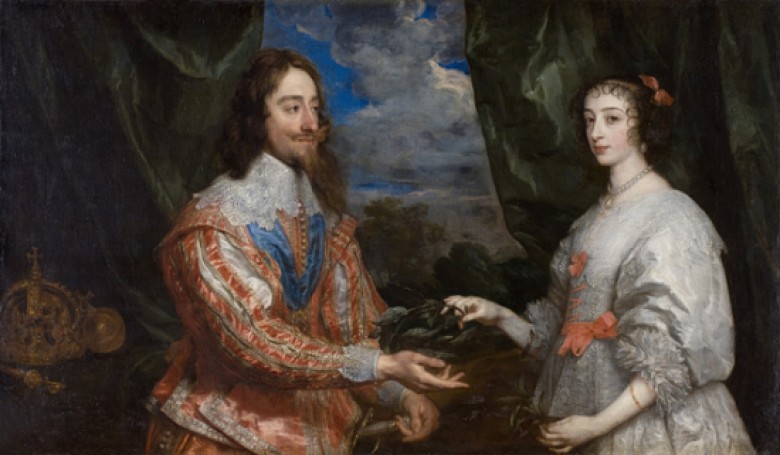
Note
Henrietta Maria's Catholic faith was not merely a private matter. In an age where religion and politics were inseparable, and where many English Protestants believed that Catholic powers sought to overthrow Protestant governments across Europe, a Catholic queen at the English court symbolised a potential threat to England's Protestant identity and independence.
Summary
Key Points to Remember:
-
James I and Charles I held contrasting personalities but shared a commitment to the concept of Divine Right, which shaped their approach to parliamentary relations and royal authority.
-
The system of court favourites (Esme Stuart, Robert Carr, and especially George Villiers) concentrated political power in the hands of individuals whose position depended on personal relationships rather than official roles, creating resentment among the wider nobility.
-
Financial officials like Robert Cecil and Lionel Cranfield attempted to address the Crown's money problems through reform, but structural issues and court expenditure limited their success.
-
Religious leadership under Bancroft, Abbot, and the rising Laud reflected competing visions of English Protestantism, with debates over ceremony, theology, and church authority intensifying during this period.
-
Henrietta Maria's position as a Catholic queen consort amplified Protestant fears about foreign and Catholic influence at court during the 1620s.