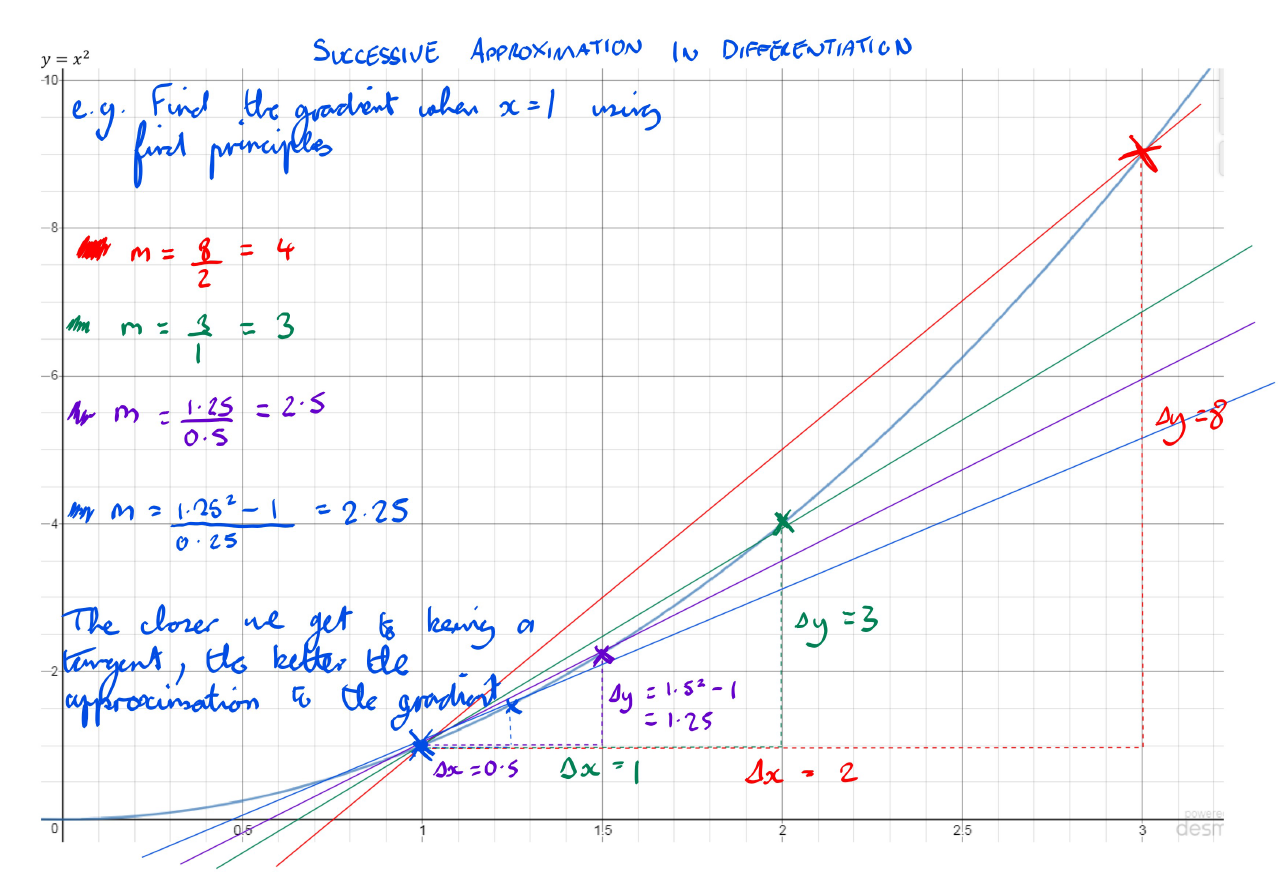
First Principles Differentiation (AQA A-Level Mathematics): Revision Notes
📚Revision Notes
7.1.2 First Principles Differentiation
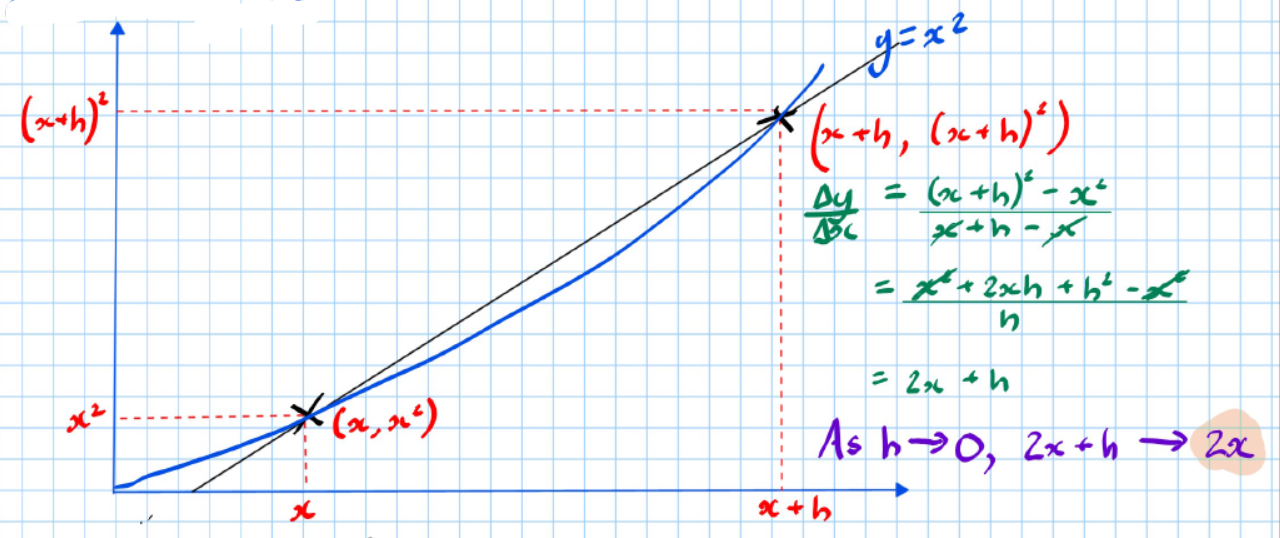
The following example shows how to find a formula for the gradient of .
Note
- Draw a chord (a rubbish tangent) between two points on the curve.
- Label the coordinates of the points at which the chord intersects the curve as and . Also, label the corresponding coordinates.
- Algebraically work out the gradient of the chord.
- The chord becomes a tangent as (" approaches 0" or " tends to 0").
Note
The gradient of is given by the formula , i.e., the gradient at any point is the -coordinate.
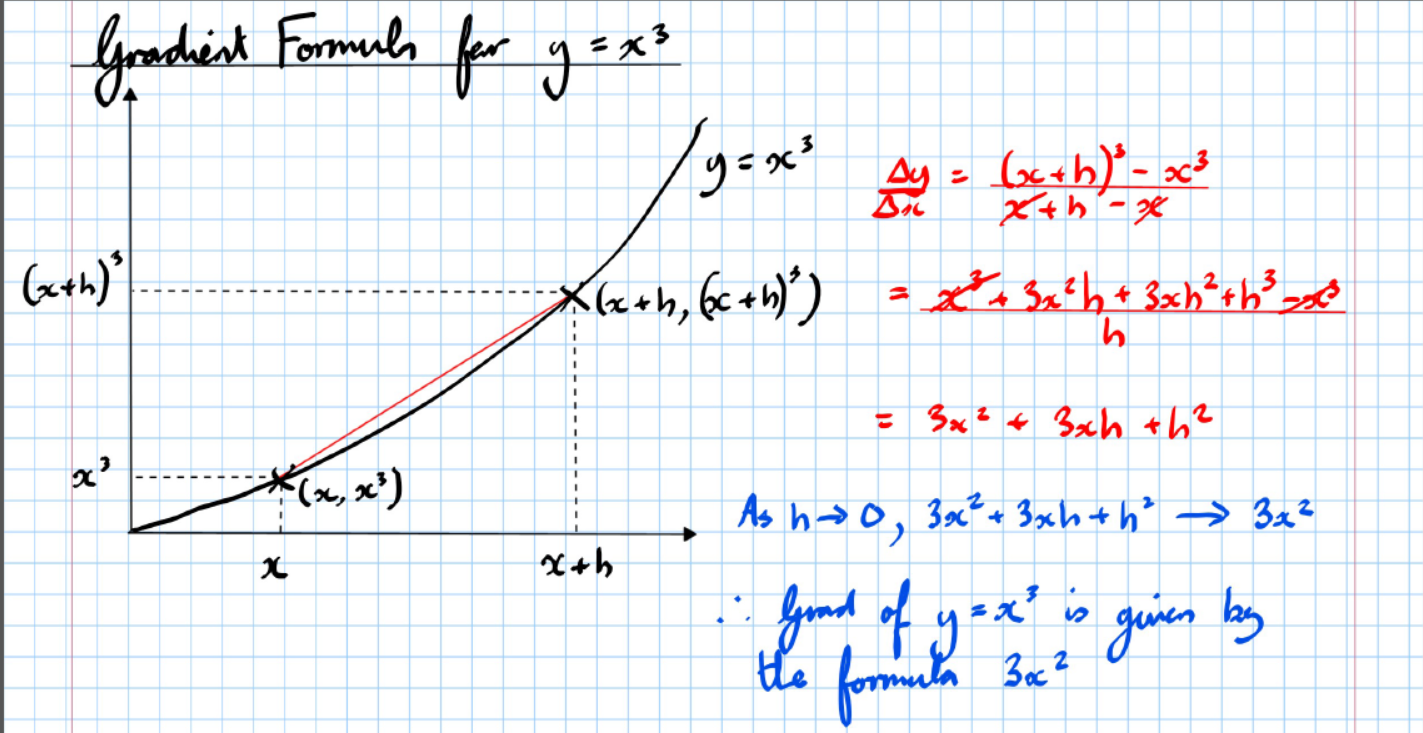
Summary: The gradient of is given by the formula
The limit as approaches 0.
Gradient of
(Table showing the relationship between and its gradient for different powers of )
- , Gradient =
- , Gradient =
- , Gradient =
- , Gradient =
The gradient function for , is given by .
Further Differentiation by First Principles
Note
Example: Differentiate by first principles. Find the gradient formula:
Notation/Terminology
The technical names for the gradient formula is:
- The differential
- The first differential
- The derivative
- The first derivative
- The gradient function
- The rate of change
Note
The differential can be denoted in two main ways:
- , which is pronounced " by ". This means the limit as of the gradient of the chord.
- , where the number of dashes indicates how many times the function has been differentiated.
Note
Example: If , use first principles to find .
- *Use to find the gradient of the curve when .