Second Order Derivatives (AQA A-Level Mathematics): Revision Notes
📚Revision Notes
7.2.3 Second Order Derivatives
Second order derivatives are the derivatives of the first derivative of a function. They provide insight into the curvature of the function and are crucial for understanding the concavity and inflexion points of the function, as well as for determining acceleration in physical contexts.
1. Definition of Second Order Derivative:
Note
If is a function, its first derivative represents the rate of change of with respect to The second derivative is the derivative of representing the rate of change of the first derivative.
- Mathematically: Here, denotes the second derivative of with respect to
2. Interpretation of the Second Derivative:
- Concavity: The second derivative tells us about the concavity of the graph of a function:
- Concave Up: If for all in an interval, the graph of is concave up (shaped like a ) on that interval.
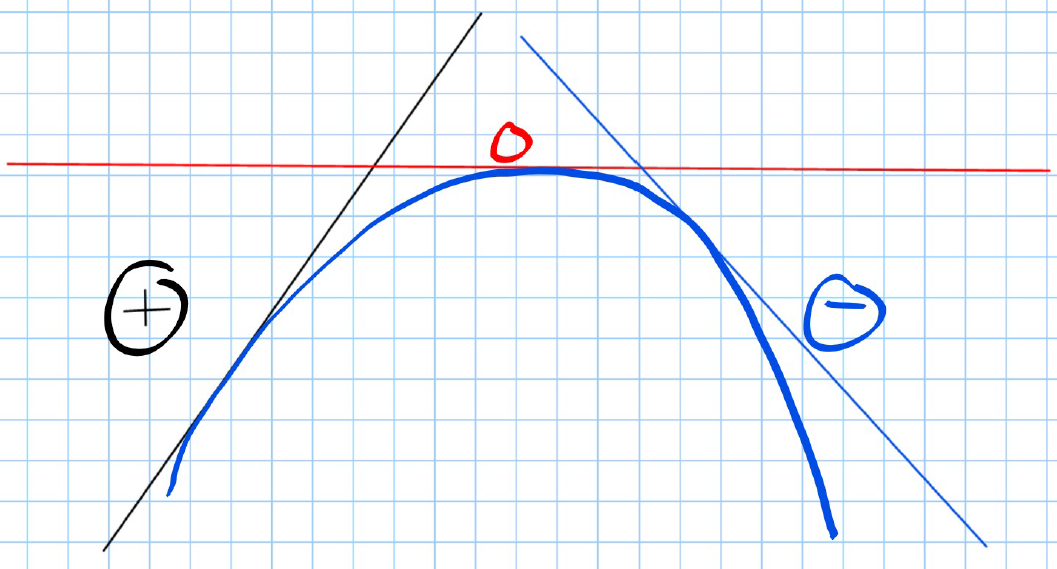
- Concave Down: If for all in an interval, the graph of is concave down (shaped like an inverted U) on that interval.
- Inflection Points: An inflection point is a point on the graph of where the concavity changes (i.e., the graph changes from concave up to concave down, or vice versa). These points occur where the second derivative changes sign (from positive to negative or from negative to positive).
3. Steps to Calculate the Second Derivative:
Note
- Find the First Derivative: Start by calculating the first derivative of the function
- Differentiate Again: Take the derivative of to obtain the second derivative .
4. Example Problems Involving Second Derivatives:
Note
Example 1: Find the second derivative of .
- Step 1: Find the first derivative:
- Step 2: Find the second derivative:
- Interpretation:
- The second derivative tells us about the concavity of the function . The sign of will determine where the function is concave up or concave down.
- when , indicating the function is concave up for
- when , indicating the function is concave down for .
- There is an inflexion point at , where the concavity changes.
Note
Example 2: Find the inflexion point(s) of
- Step 1: Find the first derivative:
- Step 2: Find the second derivative:
- Step 3: Set to find potential inflexion points:
- Step 4: Check the sign of :
- The second derivative is non-negative for all, meaning it is at and positive elsewhere. There is no change in concavity at is not an inflexion point.
- Conclusion:
- Since does not change sign at does not have an inflexion point.
5. Applications of Second Derivatives:
- Optimization: In optimisation problems, the second derivative test helps determine whether a critical point is a local maximum, local minimum, or saddle point.
- If at a critical point is a local minimum.
- If at a critical point is a local maximum.
- If at a critical point the test is inconclusive, and further analysis is needed.
- Physics: In kinematics, the second derivative of the position function with respect to time gives the acceleration of an object.
- Economics: The second derivative is used to analyse the curvature of cost functions, utility functions, and other economic models.
Summary:
Note
- Second order derivatives provide valuable information about the curvature of a function, indicating where the function is concave up or concave down.
- Inflection points occur where the second derivative changes sign, marking a change in the concavity of the function.
- The second derivative is widely used in optimisation, physics, and economics to analyse and predict the behaviour of functions and systems.
The Second Differential
The second differential/derivative tells us the rate of change of gradient and is denoted by:
or
If , this means the gradient is increasing.
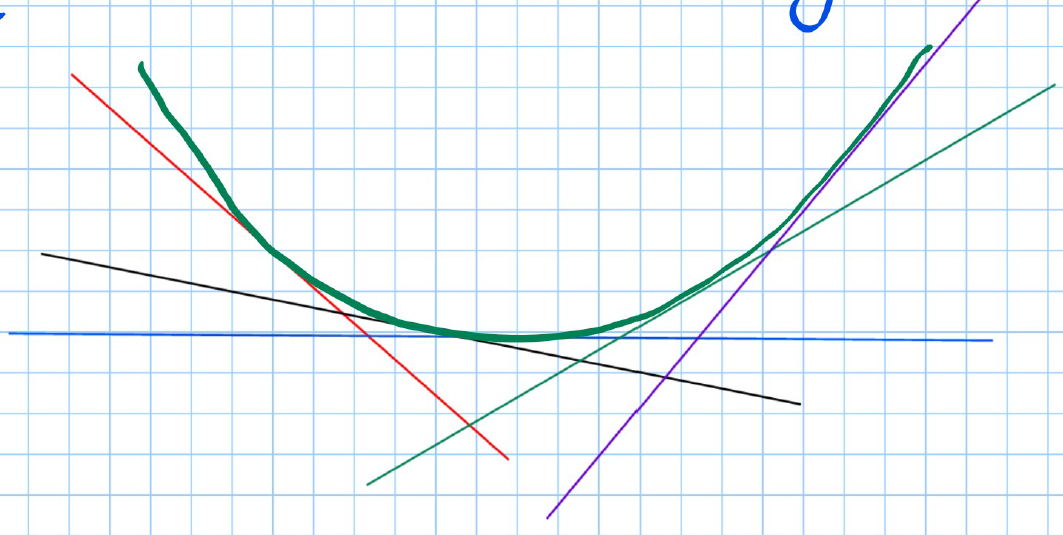
- Very negative less negative 0 a little positive more positive
Similarly, if , the gradient is decreasing.