Parametric Equations - Basics (AQA A-Level Mathematics): Revision Notes
📚Revision Notes
9.1.1 Parametric Equations - Basics
Parametric equations represent a curve by expressing the coordinates and as functions of a third variable, typically t (the parameter). Instead of a direct relationship between and , you have:
Note
Key Concepts:
- Parameter: t controls both x and y, defining the curve as t varies.
- Elimination of the parameter: You can sometimes eliminate t to find a direct y = h(x) relationship.
- Differentiation: To find the gradient, use the chain rule:
- Area under a curve can be found using Parametric equations are useful for modelling motion or curves that are difficult to describe with standard equations.
Parametric Equations
A parametric is a third, non-coordinate value that can be used to define coordinate variables in functions.
Note
Example: The following function is defined in terms of a third non-coordinate variable :
Where .
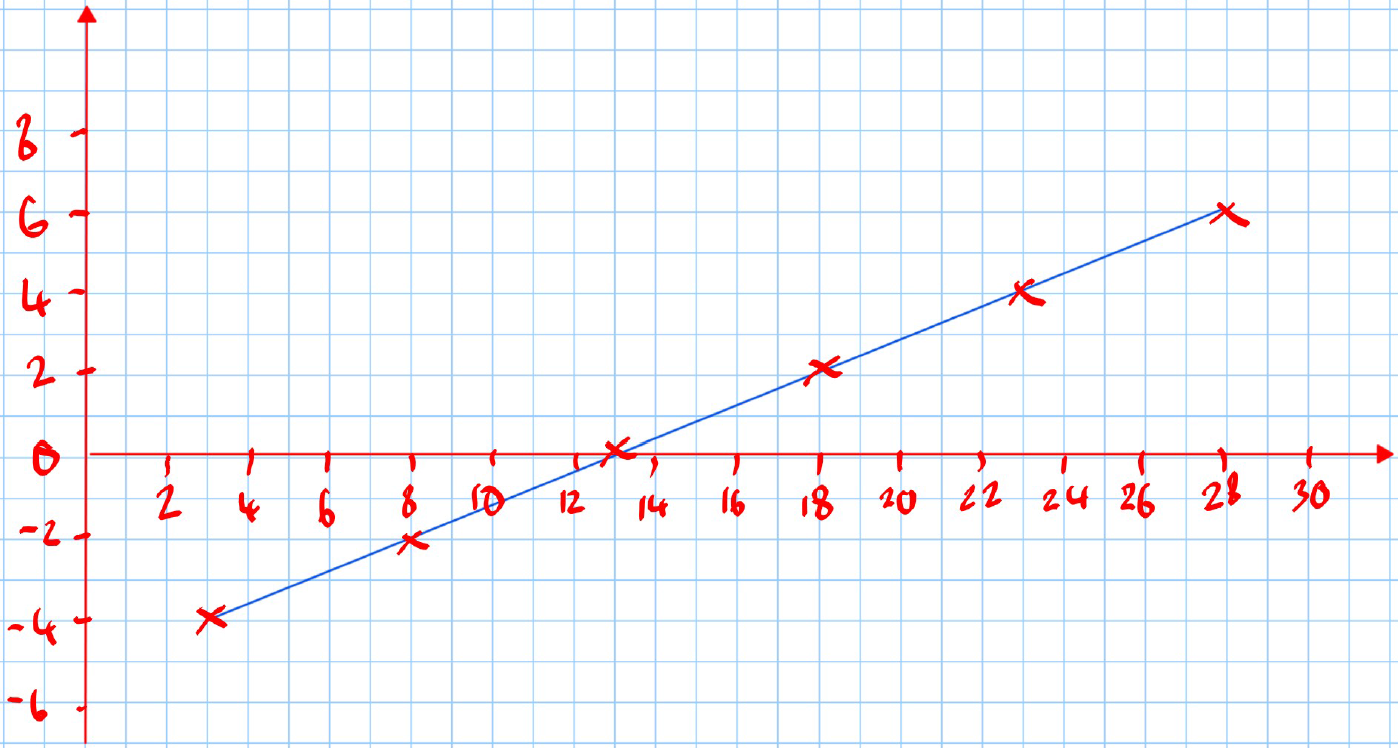
To sketch this, we can create a table of and values:
| t | 0 | 1 | 2 | 3 | 4 | 5 |
|---|---|---|---|---|---|---|
| x | 3 | 8 | 13 | 18 | 23 | 28 |
| y | -4 | -2 | 0 | 2 | 4 | 6 |
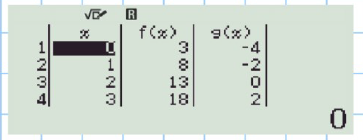
In table mode on the calculator:

Three calculator screens are shown:
- The equation for .
- The equation for .
- The table range settings with Start: , End: , Step: .
Parametric Equations to Cartesian Equations
When a curve is defined in such a way, the equations given are called parametric equations.
When written only in terms of the coordinate variables , this is called a Cartesian equation.
Note
Example: Write and where as a Cartesian equation.
- Rearrange any of the two equations to say From :
- Substitute into the other equation: Substitute into :