Trigonometry - Simple Identities (AQA A-Level Mathematics): Revision Notes
📚Revision Notes
5.3.1 Trigonometry - Simple Identities
Trigonometric identities are fundamental relationships between trigonometric functions that are true for all values of the variables involved. These identities simplify expressions and solve trigonometric equations. Below are some of the most important and commonly used trigonometric identities.
1. Pythagorean Identities:
These identities are derived from the Pythagorean theorem applied to the unit circle.
Note
- Basic Pythagorean Identity:
This identity states that the square of the sine of an angle plus the square of the cosine of the same angle is always equal to .
- Derived Pythagorean Identities:
This is obtained by dividing the basic Pythagorean identity by
This is obtained by dividing the basic Pythagorean identity by
2. Reciprocal Identities:
These identities express the basic trigonometric functions in terms of their reciprocals.
Note
- Sine and Cosecant:
- Cosine and Secant:
- Tangent and Cotangent:
3. Quotient Identities:
These identities express tangent and cotangent as the ratio of sine and cosine.
Note
- Tangent:
- Cotangent:
4. Co-Function Identities:
These identities show the relationship between trigonometric functions of complementary angles.
Note
- Sine and Cosine:
- Tangent and Cotangent:
- Secant and Cosecant:
5. Even-Odd Identities:
These identities show how trigonometric functions behave when their angle is negated.
Note
- Sine and Cosecant (Odd Functions):
- Cosine and Secant (Even Functions):
- Tangent and Cotangent (Odd Functions):
6. Sum and Difference Identities:
These identities are used to find the sine, cosine, or tangent of the sum or difference of two angles.
Note
- Sine of a Sum/Difference:
- Cosine of a Sum/Difference:
- Tangent of a Sum/Difference:
7. Double Angle Identities:
These identities are used to express trigonometric functions of double angles .
Note
- Sine:
- Cosine:
Which can also be written as:
- Tangent:
8. Half-Angle Identities:
These identities are derived from the double angle identities and are used to find the values of trigonometric functions at half an angle.
Note
- Sine:
- Cosine:
- Tangent:
Note
Example Problem Using Identities:
Problem: Prove that
Solution:
- Start with the identity
- Subtract from both sides:
Final Answer:
- The identity is proved:
| Category | Identity/Form |
|---|---|
| Pythagorean Identities | |
| Reciprocal Identities | |
| Quotient Identities | |
| Co-Function Identities | |
| Even-Odd Identities | |
| Sum and Difference Identities | |
| Double Angle Identities | |
| Half-Angle Identities | |
This table summarises the essential trigonometric identities, making it easier to quickly reference and apply them to various problems.
Summary:
Trigonometric identities simplify complex trigonometric expressions and solve equations. Mastery of these identities, such as Pythagorean, reciprocal, and sum/difference identities, is essential for success in trigonometry and related fields.
Trigonometric Identities
The Sign:
- means "identical to" and is a stronger statement than =.
Note
Examples: 3. : In this case, = is appropriate because there are a limited number of values that make the statement true. 4. : In this case, no matter which value we substitute for , the statement is true, i.e., is appropriate.
The key identities to learn are as follows:
-
1 Learn These
-
Common Misconception:
Proof of for Acute Angles
The identity is true for all values of , but this proof only concerns acute angles.
- Take a right-angled triangle with hypotenuse 1.
- Let be an angle in the triangle.
- Label the opposite side and adjacent side .
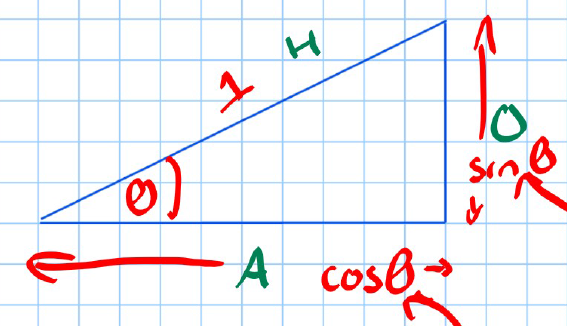
- Define Trigonometric Ratios:
-
-
From the triangle:
-
-
Thus, by the Pythagorean Theorem:
-
. Because the triangle is right-angled,
Proof of (for acute angles, although true for all angles):
- Consider a right triangle with hypotenuse , opposite side , and adjacent side .
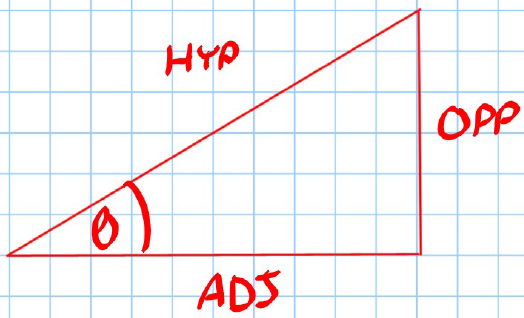
From the triangle:
- Thus:
These identities are useful in solving trigonometric equations.
Note
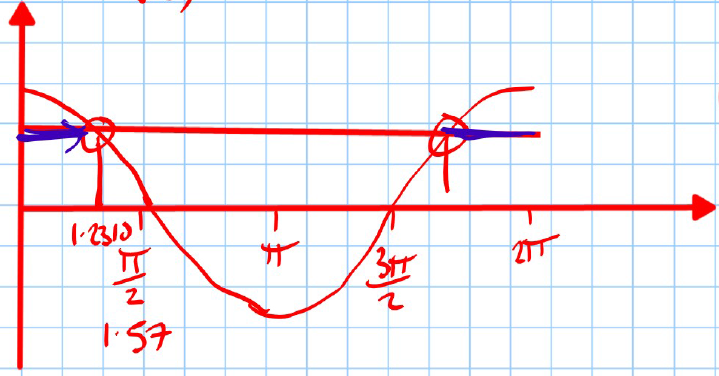
Example: Solve: .
Thought Process:
- Does the question have any square trig functions?
- If yes, use
- If no, choose one of:
Following the thought process to the right, it seems sensible to try to manufacture a .
Steps:
- Divide both sides by :
- Solve for :
- Use the arctan function:
- Adjust to the correct range :
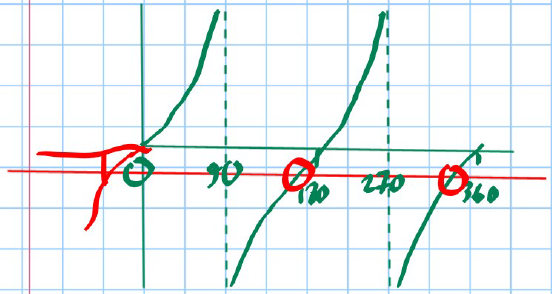
e.g.
For
Since it has & in it, it is recommendable to try to change this using
Incorrect Method:
Because is a solution, we have essentially divided by 0 and 'lost' the solution where .
Correct Method: Factorise
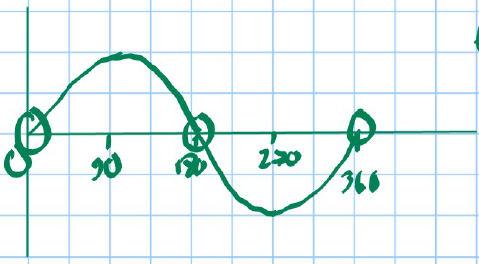
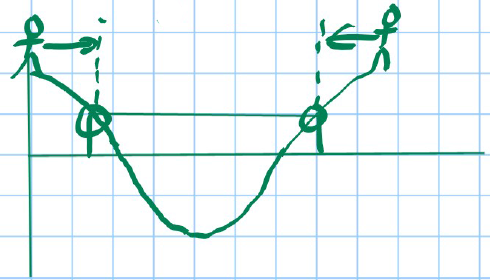
Beware: The limits at the beginning may be strict inequalities e.g. , invalidating some solutions.
Show that
How do we know what square trig functions to change?
We have a choice of using or
Cannot change this as it is not squared.
Finding One Trig Quantity Given Another
Recap of Identities:
Note
Example: Given that , find and . In this case, is acute.
Method 1**: Right-Angled Triangle**
Note: This method only works when is acute.
- Setup the triangle:
- Calculate adjacent:
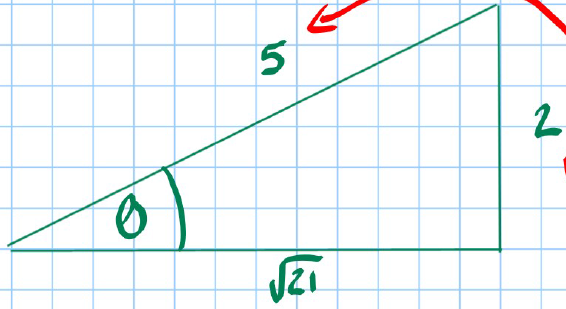
- Find :
- Find :
Method 2:
Note: Works with any angled angle.
Use the identity:
Note**:** is positive since is acute.
- Find :
Note
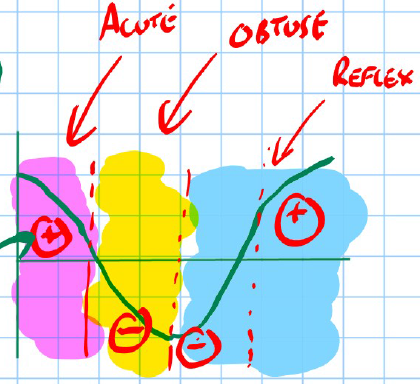
Example: Given that is obtuse, find when .
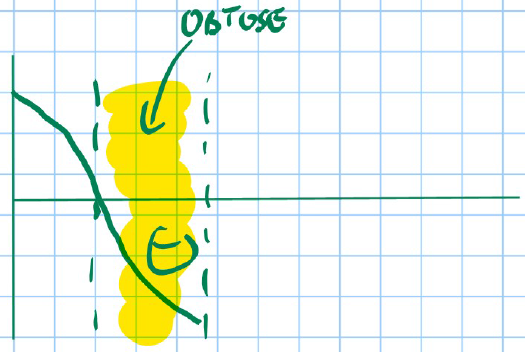
- Since is obtuse, .
Given that is reflex and , find .
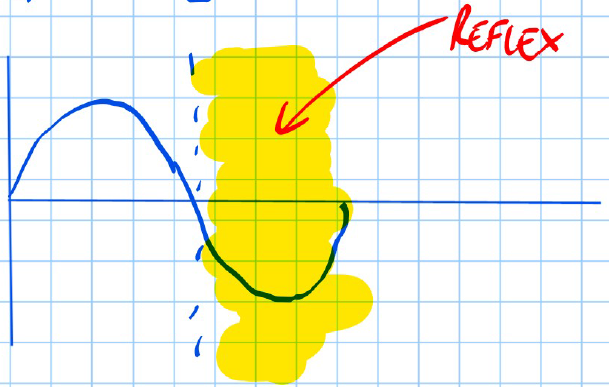
- Since is reflex, .
How to do a good proof
Note
Example: (OCR 4722, Q6, June 2010)
- Show that .
- Hence solve the equation .
- Tip: You should always start from the LHS, and your last line should be the RHS.
Part (i):
Note:
Part (ii):
Visual representation of solutions on a trigonometric graph.
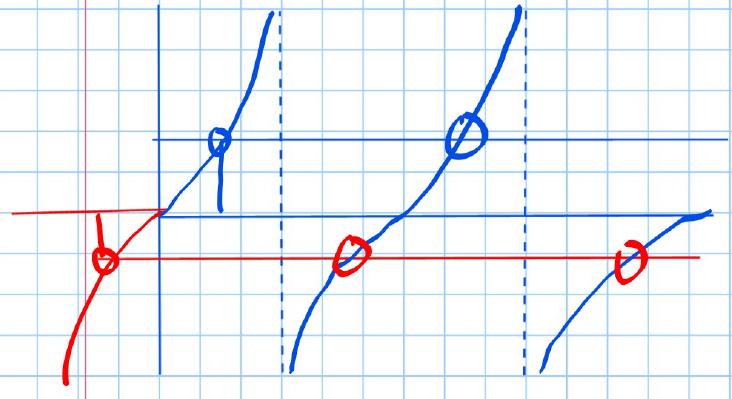
:::
Proofs Involving Trigonometric Functions
Key Points:
- Proofs usually go from left to right (i.e., the right-hand side should be the last thing you write).
- Trig proofs do not involve rearranging algebra. We simply use identities to re-present what is already true.
Prove each of the following identities:
a.
- Use Pythagorean identities to re-present the LHS as our target expression.
- Notice is not part of our target expression, so work at eliminating this from our given expression.
- LHS =
We need this in our answer. Therefore this term is to remain
e.
- LHS:
- Use identities:
- Rewrite LHS:
Note: Only when the Pythagorean formula gives a correct proof should you use .
h. Prove that
Supporting Identities Used
Reciprocal Pythagorean Identities
The first Pythagorean identity encountered was .
From this, two more identities can be derived:
- Dividing each side by :
- Dividing each side by :
Note
Example: Solve .
Reciprocal of both sides