Magnitude & Direction (AQA A-Level Mathematics): Revision Notes
📚Revision Notes
11.1.2 Magnitude & Direction
Magnitude and Direction of a Vector
Note
In vectors, magnitude and direction are key properties:
- Magnitude: The length or size of a vector, denoted . For a vector in 2D, the magnitude is:
In 3D, for :
- Direction: The angle the vector makes with a reference axis, often calculated using trigonometry. In 2D, if is the angle with the positive -axis:
Magnitude tells us how long the vector is, while direction indicates where it points. Together, they fully describe the vector's properties.
Note
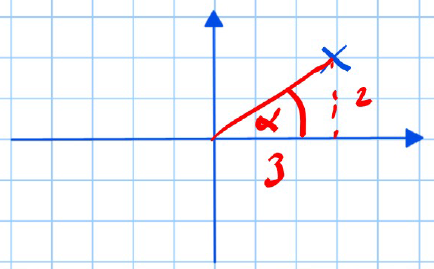
📑Example 1: Find the Direction of the Vector
-
Diagram Representation: The vector is represented as going from the origin to the point (3, 2).
-
Calculation:
Note
📑Example 2: Find the Direction of the Vector
-
Diagram Representation: The vector is represented as going from the origin to the point
-
Calculation:
Since the vector is in the second quadrant, we adjust the angle:
Magnitude of a Vector
Note
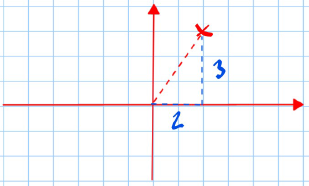
📑Example 1: Find the Magnitude of
-
Diagram Representation: The vector is represented as going from the origin to the point .
-
Calculation:
Note
📑Example 2: Find the Magnitude of when
- Note: This could be worded as "find ": The bars mean "magnitude".
- Calculation:
Note
📑Example: Write in the form the vector with direction 120° and magnitude .
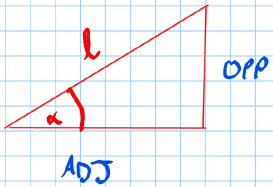
Diagram Representation:
- A right triangle is drawn with the angle and sides labelled as opposite (OPP), adjacent (ADJ), and hypotenuse (HYP). Notes:
- Trigonometric Relations:
- Therefore, which implies .
- Therefore, which implies .
- Horizontal and Vertical Components:
-
This approach extends to any horizontal and vertical components. Calculations:
-
For the -component:
- For the -component:
- Vector Representation: