Wave-particle duality (AQA A-Level Physics): Revision Notes
📚Revision Notes
12.2.5 Wave-Particle Duality
The de Broglie Hypothesis
The de Broglie hypothesis proposes that all particles exhibit both wave-like and particle-like properties. The wavelength of any particle can be calculated with the following equation:
where is Planck's constant and is the momentum of the particle. This relationship implies that the wavelength of a particle is inversely proportional to its momentum.
Since momentum is defined as mass times velocity, the equation can also be expressed as:
Evidence from Electron Diffraction
The phenomenon of electron diffraction provides experimental support for the de Broglie hypothesis. This experiment demonstrated that electrons, which are typically considered particles, can also exhibit wave-like behaviour, such as diffraction, which is a property usually associated with waves.
In this experiment:
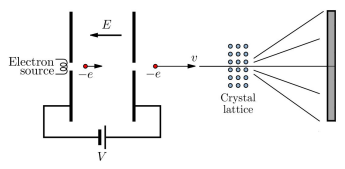
- Electrons are accelerated through a vacuum tube towards a crystal lattice.
- When electrons reach the crystal, they pass through the small gaps between atoms, creating a diffraction pattern on a fluorescent screen behind the crystal.
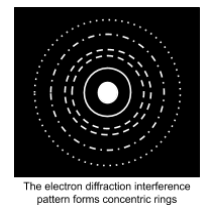
- This diffraction pattern forms concentric rings, similar to those formed by light waves in a diffraction experiment, confirming that electrons have wave-like properties.
Mathematical Derivation for the de Broglie Wavelength in Electron Diffraction
In the electron diffraction experiment, electrons are accelerated by a voltage . The kinetic energy gained by an electron, due to the accelerating voltage, is given by:
Where:
- is the charge of the electron,
- is the mass of the electron,
- is the velocity of the electron. Rearranging this equation to express in terms of :
Substituting this expression into the de Broglie wavelength formula:
Relationship between Wavelength and Voltage in Electron Diffraction
From the derived equation , it can be observed that:
-
As the accelerating voltage increases, the wavelength of the electrons decreases.
-
A decrease in wavelength means the electrons have higher momentum and energy, leading to greater diffraction as the spacing between the rings in the diffraction pattern decreases. Conversely:
-
If the accelerating voltage is decreased, the wavelength of the electrons increases, resulting in less diffraction and increased spacing between the rings. This behaviour aligns with wave theory, which states that fringe spacing in diffraction patterns is affected by the wavelength of the wave. Thus, this experimental evidence supports de Broglie's hypothesis, showing that particles like electrons can behave as waves under certain conditions.
Note
Key Points:
- de Broglie Hypothesis: Particles have an associated wavelength based on their momentum, represented by .
- Electron Diffraction: Experiment showing electrons can form diffraction patterns, providing evidence for their wave-like properties.
- Wave-Particle Duality: Particles such as electrons exhibit both wave-like and particle-like characteristics, challenging classical physics views.