Stable and unstable nuclei (AQA A-Level Physics): Revision Notes
📚Revision Notes
2.1.2 Stable and unstable nuclei
The Strong Nuclear Force (SNF)
The strong nuclear force (SNF) is responsible for holding the nucleus of an atom together. It does this by counteracting the electrostatic force of repulsion between protons, which are all positively charged and thus repel each other. Key characteristics of the SNF include:
- Short Range: The SNF acts only at very short distances within the nucleus, becoming attractive between nucleons (protons and neutrons) when they are approximately 0.5 to 3 femtometres (fm) apart. Beyond this range, the SNF rapidly loses strength and has no effect.
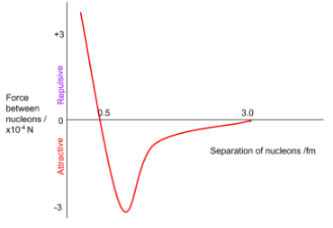
- Attractive and Repulsive Nature: The SNF is attractive between nucleons when they are close but becomes repulsive at extremely short distances (less than fm). This repulsion at very close ranges prevents the nucleus from collapsing in on itself. The following graph demonstrates this relationship between force and separation of nucleons:
- For separations below fm, the force is strongly repulsive.
- Between fm and fm, the force is attractive and maintains nuclear stability.
- Beyond fm, the SNF drops off, leaving electrostatic repulsion as the dominant force.
Unstable Nuclei and Radioactive Decay
Unstable nuclei have an imbalance in the number of protons and neutrons. This imbalance prevents the SNF from stabilising the nucleus, causing the nucleus to undergo radioactive decay to reach a more stable state. The type of decay depends on the specific imbalance within the nucleus:
- Alpha Decay: Occurs primarily in heavy nuclei with an excess of both protons and neutrons. In alpha decay:
- The nucleus emits an alpha particle (consisting of 2 protons and 2 neutrons).
- The proton number () decreases by .
- The nucleon number () decreases by . General Equation for Alpha Decay:
Here, the parent nucleus X transforms into a daughter nucleus after emitting an alpha particle.
- Beta-minus Decay: Occurs in neutron-rich nuclei, where there are too many neutrons. During beta-minus decay:
- A neutron is converted into a proton, emitting an electron (− particle) and an antineutrino .
- The proton number () increases by .
- The nucleon number () remains the same. General Equation for Beta-minus Decay:
The result is a daughter nucleus with one more proton but the same mass number as the original.
The Role of the Neutrino in Beta Decay
Initially, scientists observed that only an electron appeared to be emitted during beta-minus decay. However, energy and momentum seemed not to be conserved in this process, which contradicted fundamental physical laws. To resolve this discrepancy, physicists hypothesised the existence of an undetectable particle, which was later confirmed as the neutrino. The neutrino carries away the "missing" energy, ensuring conservation laws are satisfied.
Note
Key Concepts to Remember:
- Strong Nuclear Force (SNF): Short-range force that keeps the nucleus stable by balancing the repulsive force between protons.
- Alpha Decay: Reduces both the proton and nucleon numbers, commonly in heavy nuclei.
- Beta-minus Decay: Increases the proton number without changing the nucleon number, occurring in neutron-rich nuclei.
- Neutrino: Hypothetical particle introduced to ensure conservation of energy and momentum in beta decay, later confirmed experimentally.