Particles, antiparticles and photons (AQA A-Level Physics): Revision Notes
📚Revision Notes
2.1.3 Particles, antiparticles and photons
Particles and Their Antiparticles
Every fundamental particle has a corresponding antiparticle. An antiparticle has the same mass and rest energy as its particle counterpart but differs in certain other properties, such as charge. For instance:
- The positron is the antiparticle of the electron.
- The electron antineutrino is the antiparticle of the electron neutrino.
Here is a summary of some particles and their properties:
| Particle | Mass (kg) | Rest energy (MeV) | Charge (C) |
|---|---|---|---|
| Electron | 0.511 | ||
| Positron | 0.511 | ||
| Electron neutrino | 0 | 0 | 0 |
| Electron antineutrino | 0 | 0 | 0 |
Photons and Electromagnetic Radiation
Photons are particles of electromagnetic radiation that carry energy but have no mass. The energy of a photon is directly related to the frequency of the radiation it represents. The relationship is given by the equation:
Where:
- is the photon energy,
- is Planck's constant, approximately 6.63 × 10^-34 J s,
- is the frequency of the electromagnetic wave,
- is the wavelength of the radiation,
- is the speed of light in a vacuum, approximately 3.00 × 10^8 m/s.
Annihilation
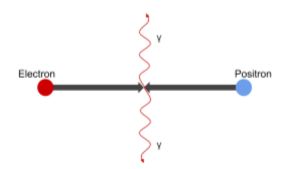
Annihilation occurs when a particle collides with its corresponding antiparticle. In this interaction:
-
Both the particle and the antiparticle are converted into energy.
-
The energy is released in the form of two gamma photons moving in opposite directions, which conserves momentum. A practical application of annihilation is in Positron Emission Tomography (PET) scanning:
-
A positron-emitting radioisotope is introduced into the body.
-
The emitted positrons encounter electrons in the body and annihilate.
-
This process releases gamma photons, which are detected to create a 3D image of the internal body structure, assisting in medical diagnosis.
Pair Production
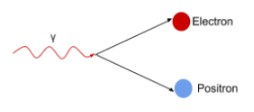
Pair production is the process by which a high-energy photon is converted into a particle-antiparticle pair. For pair production to occur:
- The photon must have energy greater than the combined rest energy of the particle and antiparticle it produces.
- Excess energy (beyond the rest energy of the particles) is converted into kinetic energy of the created particles. An example of pair production is when a gamma photon near a nucleus transforms into an electron and a positron. This phenomenon demonstrates the principle of energy-mass equivalence, where energy can transform into mass and vice versa.
Note
Key Concepts Summary
- Antiparticles: Same mass and rest energy as particles, but opposite charge.
- Photon Energy: Determined by frequency, given by .
- Annihilation: Particle and antiparticle collide, releasing energy as gamma photons.
- Pair Production: High-energy photon creates a particle-antiparticle pair, converting energy into mass.