What is Newton's law of gravity? (AQA A-Level Physics): Revision Notes
📚Revision Notes
What is Newton's law of gravity?
Historical development
In 1684, three members of the Royal Society—Christopher Wren, Robert Hooke, and Edmond Halley—discussed whether a gravitational force that decreased with the square of distance could explain planetary orbits around the Sun and the Moon's orbit around Earth. Unable to develop mathematical proof themselves, Halley approached Isaac Newton for assistance.
Newton had studied Galileo's projectile motion experiments, which showed that objects follow parabolic paths. Newton developed a theoretical scenario to explain the Moon's motion by treating it as a projectile.
Note
Newton's Cannon Thought Experiment
Newton imagined a cannon positioned on top of an extremely high mountain, firing cannon balls horizontally with progressively greater amounts of gunpowder. As the cannon balls travelled faster, they would travel further before hitting the ground. At a sufficiently high speed, the curvature of Earth would need to be considered. Eventually, at high enough speed, the falling cannon ball would never reach the ground but would orbit Earth continuously.
The key insight: The Moon behaves similarly—constantly falling towards Earth but never reaching the surface due to Earth's curvature. Newton's drawing of his cannon ball thought experiment
Through comparing the motion of a falling object at Earth's surface with the Moon's orbital motion, Newton demonstrated mathematically that gravitational force varies inversely with the square of distance from Earth's centre:
This fundamental relationship became known as the inverse square law.
Newton's law of universal gravitation
Newton concluded that gravity acts as an attractive force between all masses. This universal force not only pulls objects towards Earth's surface but also maintains the Moon in orbit around Earth and planets in orbit around the Sun. The force depends on both the distance between masses and the mass of each body.
Important
Newton's Law of Universal Gravitation
Any two point masses attract each other with a force that is directly proportional to the product of their masses and inversely proportional to the square of their separation.
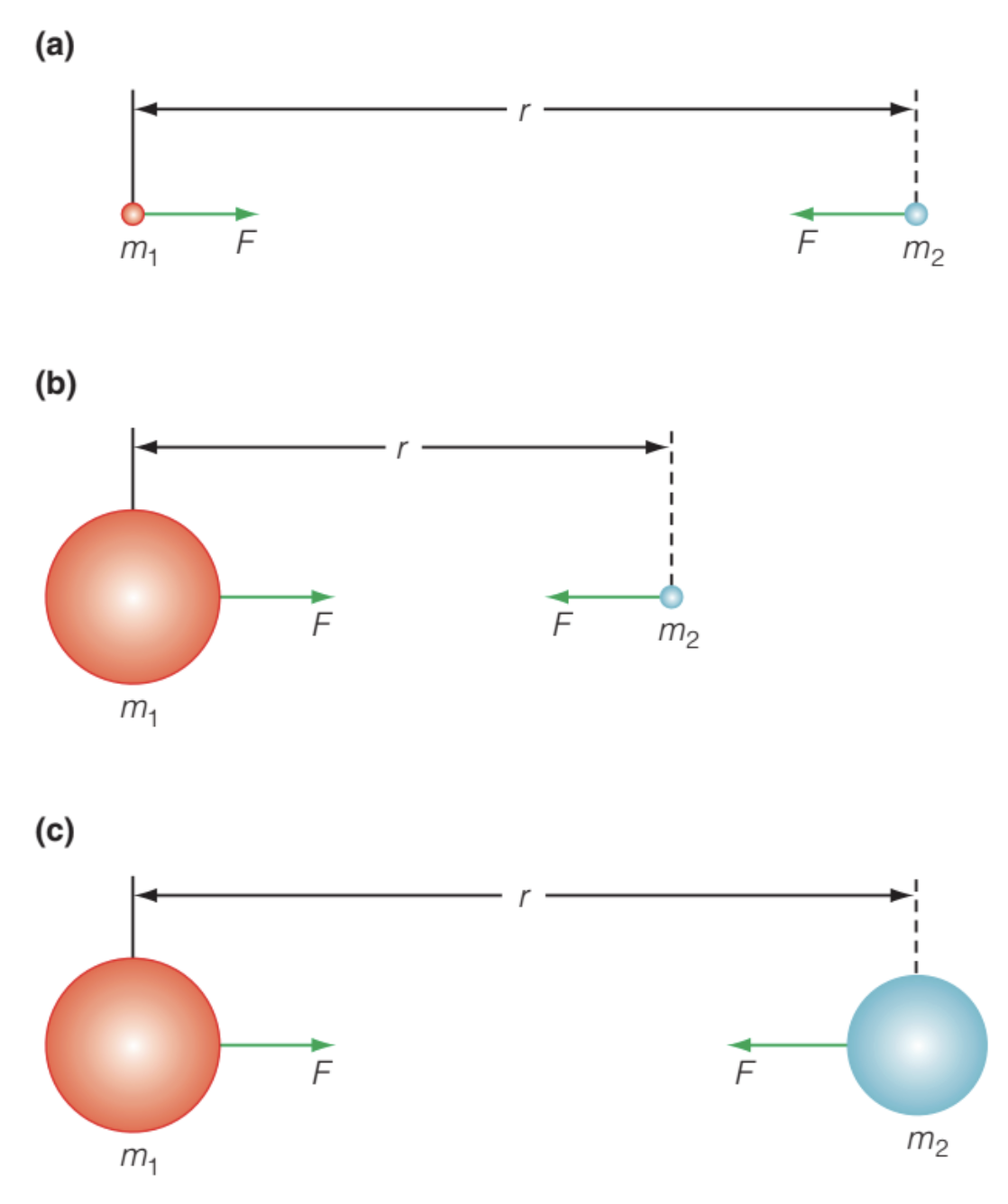
This relationship is expressed by the equation:

where:
- = gravitational force (N)
- and = masses of the two objects (kg)
- = distance between the centres of the two masses (m)
- = gravitational constant
The gravitational constant
The constant of proportionality is called the gravitational constant and has the value:
Newton presented his law of gravity alongside his laws of motion in Philosophiae Naturalis Principia Mathematica, first published in 1687.
Note
The Cavendish Experiment
The value of was determined experimentally by British scientist Henry Cavendish. He constructed an apparatus with two small lead spheres attached to the ends of a suspended rod, free to rotate. He positioned two larger lead spheres so that gravitational attraction between the large and small spheres caused the suspended rod to oscillate.
By measuring the oscillation, Cavendish determined the gravitational force between the spheres. Knowing this force and the masses involved, he calculated Earth's average density, obtaining a value within 1% of the currently accepted value. The gravitational constant was determined from Cavendish's experimental measurements.
Point masses
Important
Point Masses Concept
Newton's law refers to point masses—spherically symmetrical objects of uniform density whose gravitational effect acts as if all their mass is concentrated at their centre.
This approximation applies to planets, stars, and other spherical bodies when calculating gravitational forces between them.
Worked example: Earth-Moon system
The Earth-Moon system demonstrates the inverse square law in action.
Example
Worked Example: Verifying the Inverse Square Law with the Earth-Moon System
Given:
- Acceleration due to gravity at Earth's surface:
- Earth's radius:
- Mean Earth-Moon distance:
- Moon's orbital period:
Analysis:
The Moon is kept in orbit by gravitational force, which provides the centripetal acceleration. The gravitational acceleration experienced by the Moon can be compared with the surface value to verify the inverse square relationship.
Step 1: Calculate the ratio of distances
Step 2: Apply the inverse square law
According to the inverse square law, the gravitational acceleration at the Moon's orbital distance should be approximately times weaker than at Earth's surface.
Conclusion:
This prediction matches the observed centripetal acceleration of the Moon in its orbit, confirming that gravitational force decreases with the square of distance.
Remember!
Summary
Key Points to Remember:
-
Newton's law of universal gravitation: Any two point masses attract each other with a force proportional to the product of their masses and inversely proportional to the square of their separation:
-
Inverse square law: Gravitational force decreases with the square of distance—doubling the distance reduces the force to one quarter
-
Gravitational constant: is a universal constant determined experimentally by Cavendish
-
Point masses: Spherical objects can be treated as if all their mass is concentrated at their centre when calculating gravitational forces
-
Universal application: The same gravitational law governs falling objects on Earth, the Moon's orbit, and planetary motion around the Sun