Magnetic flux density (AQA A-Level Physics): Revision Notes
📚Revision Notes
7.5.1 Magnetic flux density
Concentric Circles
Note
When an electric current flows through a wire, it generates a magnetic field around the wire. For a long, straight current-carrying conductor, this magnetic field takes the form of concentric circles around the wire.
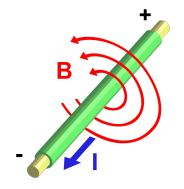
The strength of the magnetic field is represented by a quantity called magnetic flux density (). Magnetic flux density is a measure of the strength of a magnetic field and is measured in Teslas (). One Tesla is defined as the force of 1 Newton (N) acting on 1 metre of wire carrying a current of 1 Ampere (A) at right angles to the magnetic field.
When a current-carrying wire is placed within a magnetic field, it experiences a force. The force depends on the angle of the wire in relation to the magnetic field:
- If the current is parallel to the magnetic field, no force is exerted on the wire.
- If the current is perpendicular to the magnetic field, the maximum force is exerted. To calculate the force () on a current-carrying wire in a magnetic field, use the formula:
Where:
- B = magnetic flux density ()
- I = current ()
- l = length of the wire within the magnetic field ()
Fleming's Left-Hand Rule
To determine the direction of the force exerted on a wire within a magnetic field, use Fleming's Left-Hand Rule. Hold your left hand with the thumb, first finger, and second finger at right angles to each other:
- Thumb () – represents the direction of motion (force).
- First finger () – represents the direction of the magnetic field.
- Second finger () – represents the direction of the conventional current (opposite to the direction of electron flow). By aligning two of these directions (e.g., current and field), you can use the rule to determine the third direction (motion/force).

Direction of Magnetic Field in a Magnet
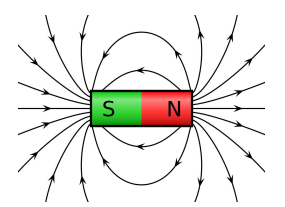
The magnetic field around a bar magnet flows from its North pole to its South pole. The field lines demonstrate the direction that a positive test charge would move within the field.