Moving charges in a magnetic field (AQA A-Level Physics): Revision Notes
📚Revision Notes
7.5.2 Moving charges in a magnetic field
Force on a Moving Charge in a Magnetic Field
A force acts on charged particles when they move through a magnetic field. This is the basis for why a force is exerted on a current-carrying wire, as current consists of moving charges, primarily electrons. Since these electrons are negatively charged particles, they are influenced by the magnetic field.
The magnitude of the force exerted on a charged particle with charge , moving at a velocity and perpendicular to a magnetic field of flux density , is given by the formula:
Determining the Direction of Force
The direction of the force experienced by a moving charge in a magnetic field can be determined using Fleming's Left-Hand Rule:
- Thumb represents the direction of Motion (or force).
- First finger represents the direction of the Field.
- Second finger represents the direction of Conventional Current (opposite to electron flow). Note: If the charge is negative, reverse the direction indicated by the second finger, as it represents conventional current (positive to negative).
Circular Motion of Charged Particles in a Magnetic Field
When a charged particle enters a magnetic field, the force exerted on it is always perpendicular to its motion. This causes the particle to move in a circular path, as the magnetic force acts as a centripetal force. For a charged particle in a magnetic field:
Since also provides the centripetal force , equating these gives:
Rearranging to solve for the radius of the circular path yields:
where:
- is the particle's mass,
- is its velocity,
- is its charge,
- is the magnetic flux density.
Note
Example Application: The Cyclotron
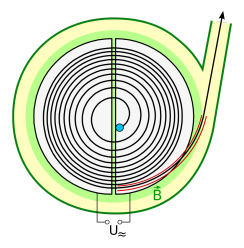
A cyclotron is a device used to accelerate charged particles by using a magnetic field. It consists of two semi-circular electrodes called "Dees" with a uniform magnetic field perpendicular to their plane and a high-frequency alternating voltage applied between them.
- Movement of Particles: Particles move from the centre towards the edge within one of the Dees, following a circular path due to the magnetic force acting perpendicular to their direction of travel. Note that the magnetic field does not increase the speed of the particles; it only changes their direction.
- Acceleration Across the Gap: When particles reach the edge of a Dee, they are accelerated across the gap by the electric field generated by the alternating voltage. This acceleration increases the radius of their circular path in the opposite Dee, where they travel at a higher speed.
- Increasing Speed in Each Cycle: Each time the particles cross the gap, the alternating electric field reverses, allowing the particles to accelerate again. This process continues until the particles reach the desired speed and exit the cyclotron.