Mass and energy (AQA A-Level Physics): Revision Notes
📚Revision Notes
8.1.6 Mass and energy
Mass and Energy Equation
In nuclear physics, mass and energy are interconvertible, and this principle is governed by Einstein's famous equation:
Where:
- is the energy,
- is the mass, and
- is the speed of light in a vacuum. This formula applies to all forms of energy transformations. Essentially, it tells us that a small amount of mass can be converted into a very large amount of energy because the speed of light squared is an incredibly large number.
Mass Defect and Binding Energy
When calculating the mass of a nucleus, you'll notice that it is always less than the combined mass of its protons and neutrons. This difference is known as the mass defect. This "missing" mass has been converted to energy, specifically binding energy, which holds the nucleus together.
-
Binding energy is the energy required to separate a nucleus into its individual protons and neutrons. Conversely, it is also the energy released when a nucleus is formed from separate nucleons. To measure this small mass difference, atomic mass units (u) are used:
-
is defined as the mass of a carbon- atom and is approximately . Since a change in u corresponds to a release of MeV of energy, u of mass defect releases MeV of binding energy.
Nuclear Fission and Fusion
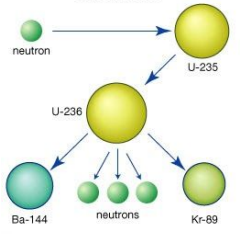
- Nuclear Fission: This is the splitting of a large nucleus into two daughter nuclei. It typically occurs in heavy, unstable nuclei (such as uranium). During fission:
- Energy is released because the daughter nuclei have a higher binding energy per nucleon than the original nucleus.
- Fission can be spontaneous or induced by bombarding the nucleus with a neutron.
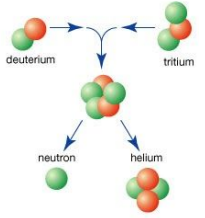
- Nuclear Fusion: Fusion is the joining of two smaller nuclei to form one larger nucleus. It requires extremely high temperatures and only occurs in smaller nuclei.
- Energy is released in fusion because the resulting nucleus has a higher binding energy per nucleon than the starting nuclei. Fusion releases more energy than fission, but it is difficult to achieve because of the strong electrostatic repulsion between the positively charged nuclei that must be overcome.
Binding Energy per Nucleon
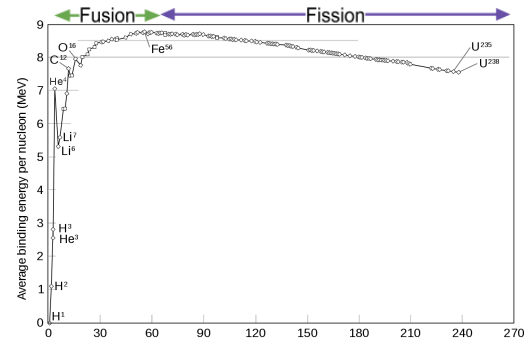
Binding energy per nucleon is calculated by dividing the binding energy of a nucleus by its total number of nucleons. By plotting binding energy per nucleon against nucleon number, we can determine:
- Which elements are more likely to undergo fusion (nuclei smaller than iron, which have a lower binding energy per nucleon).
- Which elements are more likely to undergo fission (nuclei larger than iron). The graph of binding energy per nucleon has a peak at iron (Fe), which has the highest binding energy per nucleon. Nuclei smaller than iron can undergo fusion, while nuclei larger than iron can undergo fission.
Practical Applications: Nuclear Fission in Power Generation
Nuclear fission is used in power plants to generate electricity, allowing energy production without greenhouse gas emissions. However, nuclear power has associated risks:
- Radioactive waste from fission products needs to be stored safely for thousands of years.
- Meltdowns at nuclear plants, though rare, can have catastrophic environmental impacts. Understanding the nuclear physics behind fission enables society to make informed choices regarding energy sources.
Note
Example Calculations
- Finding Binding Energy in MeV:
- If given a mass defect of :
- Convert this to kilogrammes and use to find binding energy in joules, then convert it to electron volts ().
- Alternatively, multiply by to directly find the energy in MeV.
- Example:
- Energy Released in Fission:
- If a uranium- nucleus splits into barium- and krypton-, with two neutrons released:
- Calculate the mass defect (mass before – mass after).
- Multiply the mass defect by to find the energy released in MeV.
- Example Calculation:
- Mass defect:
- Energy released: