Induced fission (AQA A-Level Physics): Revision Notes
📚Revision Notes
8.1.7 Induced fission
Note
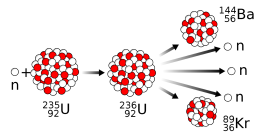
Induced fission occurs when certain large nuclei, such as uranium-235, absorb a neutron, causing them to become highly unstable. This instability leads the nucleus to split into two smaller daughter nuclei and release additional neutrons, along with a significant amount of energy. These additional neutrons can trigger further fission reactions, leading to a chain reaction.
Key Concepts in Induced Fission:
- Thermal Neutrons:
- Thermal neutrons have relatively low kinetic energy, making them more likely to be absorbed by uranium-235 nuclei. High-energy neutrons tend to bounce off rather than be absorbed, hence thermal neutrons are critical in maintaining the fission process.
- Once absorbed, the uranium-235 nucleus splits, producing daughter nuclei, free neutrons, and releasing energy.
- Chain Reaction:
- Each fission event releases neutrons, which can go on to induce further fissions in nearby uranium-235 nuclei. For the reaction to sustain itself, at least one of the neutrons released in each fission must cause another fission event.
- Critical Mass: This is the minimum amount of fissile material needed to maintain a self-sustaining chain reaction. If the mass of the uranium is below this threshold, neutrons escape without causing further fission, and the reaction eventually stops.
Nuclear Reactor Components:
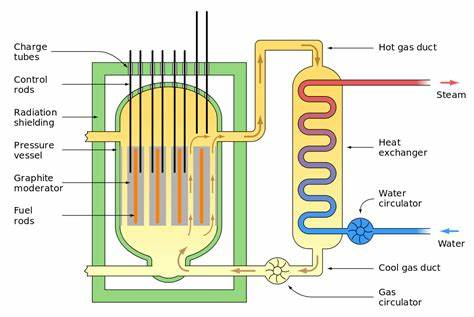
Nuclear reactors harness induced fission to generate electricity safely and efficiently. Several key components ensure the process remains controlled:
- Moderator:
- The moderator slows down the neutrons produced by fission to thermal speeds, making them more likely to be absorbed by uranium-235 nuclei.
- This is typically achieved through elastic collisions between neutrons and the nuclei of the moderator material.
- Water and graphite are commonly used as moderators because they effectively slow down neutrons, are inexpensive, and do not react chemically within the reactor.
- Control Rods:
- Control rods absorb excess neutrons, thereby controlling the rate of the chain reaction and ensuring it doesn't accelerate uncontrollably.
- The height of the control rods within the reactor core can be adjusted to control how many neutrons are absorbed and therefore, regulate the energy output.
- Materials like boron and cadmium are used in control rods due to their strong neutron-absorbing properties.
- Coolant:
- The coolant transfers the heat generated by fission to a secondary system where it is converted into steam to drive electricity-generating turbines.
- Common coolants include water (often serving a dual purpose as a moderator) and other substances like helium and molten salts.
- Coolants must have high specific heat capacity to absorb large amounts of thermal energy without quickly heating up themselves.
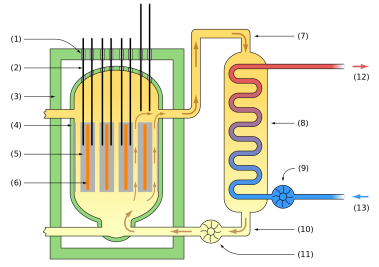
Diagram of a Nuclear Reactor
The typical layout of a nuclear reactor includes these components arranged within a containment structure, as shown in the diagram. The process involves control rods inserted into a reactor core containing uranium fuel rods. Heat generated by fission is transferred via the coolant to produce steam in an external loop, driving turbines to generate electricity.
Note
Example: Chain Reaction Calculation
In a chain reaction, a fission event in uranium-235 can release around 200 MeV of energy. Given the large scale of the chain reaction in reactors, this energy is harnessed to produce heat, which can then be converted into electricity.